PICO and SALVE: Understanding the subatomic world better
DFG-funded instrumentation enables world-class research in electron microscopy
Advertisement


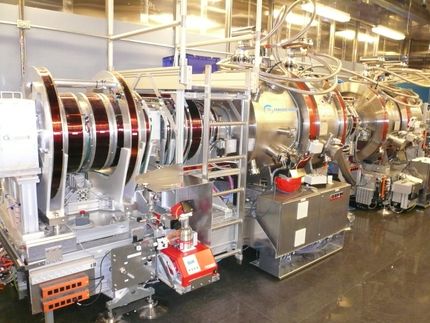
Two new high-resolution transmission electron microscopes, co-financed by the Deutsche Forschungsgemeinschaft (DFG, German Research Foundation), are set to open up new opportunities for research in physics and materials science. The new research microscopes at RWTH Aachen University and the University of Ulm will enable exceptional, state-of-the-art developments in the field of electron optics in Germany and be available to a broad group of users.
"With these new microscopes, Germany has the great opportunity to stay right at the cutting edge of electron microscopy," said Burkhard Jahnen, who is responsible for projects in materials science, engineering and electron microscopy at the DFG's Head Office. Thanks to these state-of-the-art microscopes it will not only be possible to study new materials at higher resolution in the future, for example for research in the fields of energy or information and communication technology, it will also open up an entirely new field of materials science that has been impossible to study to date with existing electron-optical techniques.
The "PICO" (Advanced Picometer Resolution Project) microscope, which has been approved for the RWTH Aachen, will extend the resolution that can be achieved by electron microscopes to a hitherto unimaginable scale. It will be the first microscope in the world to be capable of detecting the position of atoms to a resolution of 50 picometers – one picometer is one hundredth of the diameter of an atom – thus doubling the performance of the current generation of electron microscopes.
This will not only make it possible to see individual atoms, but also to measure the interatomic distance and atomic motion to an accuracy of approximately one picometer. At the same time, it will be possible to investigate the nature of the atoms by spectroscopic analysis and study their chemical bonds.
The DFG is providing 2.5 million euros in funding for the PICO project, which will cost approximately 15 million euros in total, which will be matched by the state of North Rhine-Westphalia. The Federal Ministry for Education and Research (BMBF) will provide funding for additional components for the microscope and finance some of the required building work. The new microscope will be located at the Ernst Ruska Centre (ER-C) for Microscopy and Spectroscopy with Electrons, which is operated by the RWTH Aachen and the Jülich Research Centre. The ER-C is one of the leading international research centres in the field of ultra-high resolution electron microscopy.
The resolution of the SALVE (Sub-Ångstrøm Low Voltage Transmission Electron Microscopy) project's low-voltage transmission electron microscope at the University of Ulm poses a serious challenge to researchers. The main focus of this five-year project is on imaging individual atoms in materials for applications in nanotechnology that are sensitive to the energy of the electron beam that would quickly be destroyed in conventional electron microscopy. The project plans to use low acceleration voltages that have barely been used in practice in electron microscopes to date, while simultaneously applying state-of-the-art electron-optical methods.
This new microscope will make it possible to reveal molecular structures and follow molecular processes, allowing researchers to unlock the secrets of chemical reactions. The DFG is providing 4.2 million euros in funding for the project, which will cost approximately 11.5 million euros in total, while the state of Baden-Württemberg will provide 2.4 million euros and a further 3.7 million euros, including an endowed chair, will be funded by Carl Zeiss AG from Oberkochen.


Other news from the department science






Most read news






More news from our other portals























See the theme worlds for related content
Topic World Spectroscopy
Investigation with spectroscopy gives us unique insights into the composition and structure of materials. From UV-Vis spectroscopy to infrared and Raman spectroscopy to fluorescence and atomic absorption spectroscopy, spectroscopy offers us a wide range of analytical techniques to precisely characterize substances. Immerse yourself in the fascinating world of spectroscopy!

Topic World Spectroscopy
Investigation with spectroscopy gives us unique insights into the composition and structure of materials. From UV-Vis spectroscopy to infrared and Raman spectroscopy to fluorescence and atomic absorption spectroscopy, spectroscopy offers us a wide range of analytical techniques to precisely characterize substances. Immerse yourself in the fascinating world of spectroscopy!