To use all functions of this page, please activate cookies in your browser.
my.chemeurope.com
With an accout for my.chemeurope.com you can always see everything at a glance – and you can configure your own website and individual newsletter.
- My watch list
- My saved searches
- My saved topics
- My newsletter
30 Current news of MPI für Quantenoptik
rssAn international team of researchers succeeds in generating flashes of extreme ultraviolet radiation via the reflection from a mirror that moves close to the speed of light
26-04-2013
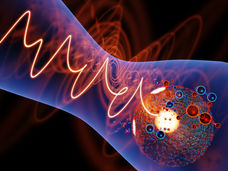
A dense sheet of electrons accelerated to close to the speed of light can act as a tuneable mirror that can generate bursts of laser-like radiation in the short wavelength range via reflection. A team of physicists from the Max-Planck-Institute of Quantum Optics (MPQ) in Garching, the ...
30-07-2012
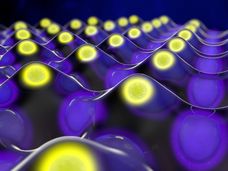
A collaboration of physicists from MPQ, LMU, Harvard and Caltech detect Higgs-type excitations in a low-dimensional system of ultracold atoms at the transition between different phases of matter. The sudden breaking of symmetry plays a fundamental role in physics, in particular for the ...
Gamma-rays for in-depth probes
16-05-2012
They can be bent after all: In defiance of a decades-old assumption, gamma-rays can be focused with lenses. The discovery opens up a range of potential applications – from monitoring of nuclear waste to new cancer therapies. Gamma-rays are extremely powerful electromagnetic waves that are far ...
Physicists from the Max Planck Institute of Quantum Optics trace the double ionization of argon atoms on attosecond time scales
11-05-2012
When an intense laser pulse interacts with an atom it generates agitation on the micro scale. A rather likely outcome of this interaction is single ionization, where one electron is ejected from the atom. From time to time, however, two electrons can be removed from the atom, resulting in the ...
Physicists at MPQ succeed in resolving the internal dynamics of individual molecules using UV femtosecond laser pulses
14-02-2012
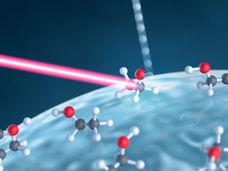
Nowadays, large laser systems provide ultra-short light pulses of very high intensity which – in principle – allow the imaging of matter and its dynamics on atomic scales, down to a single molecule or a virus. However, current methods fall short in efficiency to overlap a target molecule in a ...
White laser pulses with precisely tailored waveform enable the control of electrons in the microcosm
12-09-2011
An expedition through the fast-paced microscopic world of atoms reveals electrons that spin around at enormous speeds and have gigantic forces are acting on them. Monitoring the ultrafast motion of these electrons requires ultrashort flashes of light. However, in order to control them, the ...
For the first time scientists at MPQ achieve guiding of electrons by purely electric fields
12-05-2011
The investigation of the properties of electrons plays a key role for the understanding of the fundamental laws of nature. However, being extremely small and quick, electrons are difficult to control. Physicists around Dr. Peter Hommelhoff, head of the Max Planck Research Group “Ultrafast ...
28-04-2011
An international team of researchers succeeded at the Max Planck Institute of Quantum Optics to control and monitor strongly accelerated electrons from nano-spheres with extremely short and intense laser pulses. When intense laser light interacts with electrons in nanoparticles that consist ...
17-03-2011
Physicists of the Laboratory of Attosecond Physics at the Max Planck Institute of Quantum Optics succeeded in the first real-time observation of laser produced electron plasma waves and electron bunches accelerated by them. Flocking behavior does not only exist among birds, insects or ...
MPQ-scientists demonstrate the feasibility of optical trapping for ions, which may lead to a new kind of hybrid quantum systems.
27-10-2010
In the past decades setups for trapping single particles have played a key role in high precision quantum measurements because they allow for an ultimate control of all important experimental parameters. However, up to now scientists had to choose between two alternative strategies: either to ...