Large-scale and sustainable 3D printing with the most ubiquitous natural material
Advertisement


Cellulose is one of the most abundant and broadly distributed organic compound and industrial by-product on Earth. Yet, despite decades of extensive research, the bottom-up use of cellulose to fabricate 3D objects is still plagued with problems that restrict its practical applications: derivatives with vast polluting effects, used in combination with plastics, lack of scalability and high production cost.
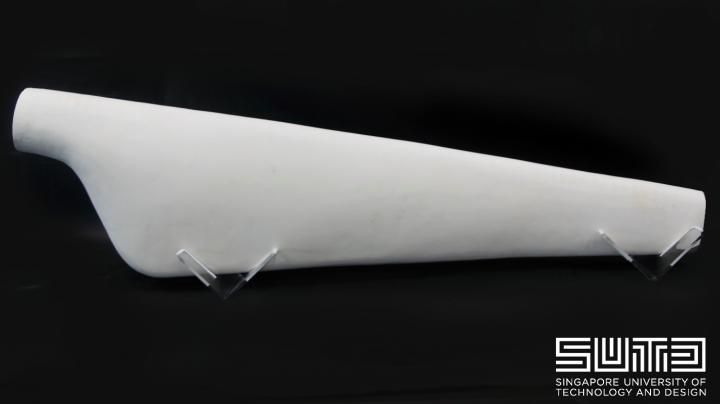
1.2m, 5.2kg turbine blade fabricated entirely with cellulose and chitosan, the most ubiquitous biopolymers on earth and produced in large amounts in almost every ecosystem. Both ingredients are obtained from by-products of the industry, resulting in production with negative ecological footprint.
SUTD
However, researchers from the Singapore University of Technology and Design (SUTD) have recently demonstrated the use of cellulose to sustainably manufacture/fabricate large 3D objects. Their approach diverges from the common association of cellulose with green plants and is inspired by the wall of the fungus-like oomycetes, which is reproduced introducing small amounts of chitin between cellulose fibers. The resulting fungal-like adhesive material(s) (FLAM) are strong, lightweight and inexpensive, and can be molded or processed using woodworking techniques.
This material is completely ecologically sustainable as no organic solvents or synthetic plastics were used to manufacture it. It is scalable and can be reproduced anywhere without specialised facilities. FLAM is also fully biodegradable in natural conditions and outside composting facilities. The cost of FLAM is in the range of commodity plastics and 10 times lower than the cost of common filaments for 3D printing, such as PLA (polylactic acid) and ABS (Acrylonitrile Butadiene Styrene), making it not only more sustainable but also a more cost-effective substitute. The researchers have furthermore developed an additive manufacturing technique specific for the material.
Co-lead of this research, SUTD Assistant Prof Javier Gomez Fernandez, also known for the development of Shrilk said: "We believe this first large-scale additive manufacturing process with the most ubiquitous biological polymers on earth will be the catalyst for the transition to environmentally benign and circular manufacturing models, where materials are produced, used, and degraded in closed regional systems. This reproduction and manufacturing with the material composition found in the oomycete wall, namely unmodified cellulose, small amounts of chitosan --the second most abundant organic molecule on earth -- and low concentrated acetic acid, is probably one of the most successful technological achievements in the field of bioinspired materials."
Co-lead SUTD Assistant Prof Stylianos Dritsas, added: "We believe the results reported here represent a turning point for global manufacturing with broader impact on multiple areas ranging from material science, environmental engineering, automation and the economy. So far we have been focusing on fundamental technology development, and little time has been invested in specific target applications. We are now at the stage of seeking industrial collaborators to bring this technology from the laboratory to the world."
With the increase in waste and pollution, the urgency for more sustainable manufacturing processes is growing. The establishment of a technology based on unmodified compostable polymers of great abundance that does not require cropland or forest resources, will foster the transition to environmentally benign manufacturing and a sustainable society.
Original publication
Naresh D. Sanandiya, Yadunund Vijay, Marina Dimopoulou, Stylianos Dritsas & Javier G. Fernandez; "Large-scale additive manufacturing with bioinspired cellulosic materials"; Scientific Reports; 2018


Other news from the department science



















Most read news











More news from our other portals

























Last viewed contents
Oil and gas production in the North Sea - Bilfinger extends service agreements with Statoil and Marathon Oil with a total volume of €130 million
Dr. Ingrid Sebald new member of the Executive Board at tesa - Dr. Ingrid Sebald fills the position of Technology on the tesa Executive Board
High-Tech Gründerfonds starts lining up investments for HTGF III fund - Seed-stage investor announces first investments from third fund
World Bank Raises 2017 Oil Price Forecast - OPEC agreement to limit production seen sending prices higher
Advance toward an 'electronic tongue' with a taste for sweets
Messer acquires a 30 per cent stake in four Lhyfe hydrogen sites - A ten-year supply contract with a minimum purchase volume secures recurring cash flows for Lhyfe
Old Mystery Solved: a "New Kind of Electrons" - Why do certain materials emit electrons with a very specific energy?
Merck and ESK Enter Cooperation Agreement for Functional Fillers
Global scouting for Innovative Startups and Researchers - GTEC supports Merck in their search for suitable startups