Base chemicals from end-of-life vehicles
Covestro and Fraunhofer UMSICHT advance the circular economy
Advertisement


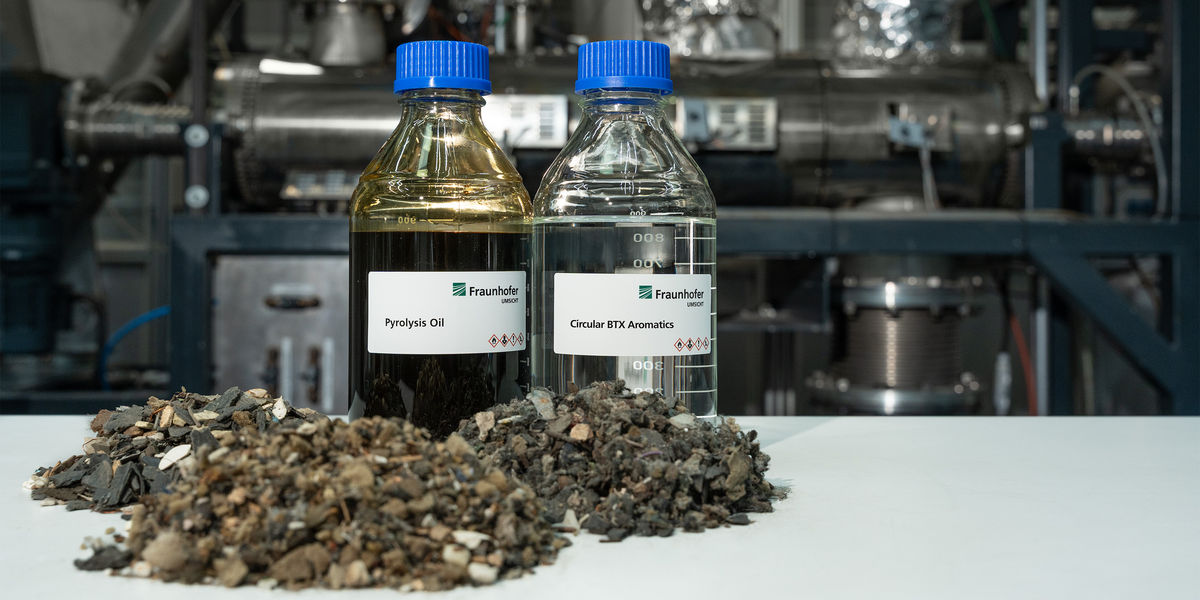
The plastics manufacturer Covestro and the Fraunhofer Institute for Environmental, Safety and Energy Technology UMSICHT have launched the research project CARBEX together with Carbon Minds GmbH. The aim of the joint project is to validate a recycling process that enables the recovery of the aromatics benzene, toluene, ethylbenzene and xylenes (BTEX) from shredder light fraction (SLF) – a residue from automotive recycling that has so far mainly been incinerated. Covestro is leading the project on the industrial side.
BTEX aromatics are essential feedstocks for the chemical industry: Covestro uses benzene as a precursor for producing MDI (methylene diphenyl diisocyanate) and toluene for producing TDI (toluene diisocyanate). MDI is used, for example, to make insulating foams for buildings and refrigeration appliances as well as structural and acoustic components in vehicle construction, while TDI is used to produce flexible foams for mattresses, upholstered furniture and car seats. It is precisely such components with a high polyurethane content that end up in the shredder light fraction at the end of a vehicle's life. CARBEX therefore opens up the prospect of a closed loop in automotive recycling.
Today, aromatics are produced predominantly by steam cracking of fossil naphtha – a process that in Germany alone causes process-related emissions of around 8 million tonnes of CO₂ equivalent per year, plus approximately 11 million tonnes from crude oil extraction and naphtha production. At the same time, more than 466,000 tonnes of shredder light fraction are generated in Germany each year. Of this, around 210,000 tonnes are recovered for energy or disposed of. The polyurethane content of this waste stream averages 20 percent by weight, but can vary considerably depending on its origin.

»With CARBEX, we are tapping into a carbon source that has so far mainly been incinerated,« says Dr. Stefanie Eiden, project manager at Covestro. »If we can recover benzene and toluene from shredder light fraction in the quality required for our MDI and TDI production processes, we close a loop while at the same time replacing an emission-intensive step in basic chemicals production.«
Pyrolysis coke becomes the catalyst
The technological basis of CARBEX is the Pyromat technology developed and patented by Fraunhofer UMSICHT. It combines pyrolysis with downstream autocatalytic reforming, in which the pyrolysis coke produced in the process itself is used as a catalyst and adsorbent. At around 500 °C, coke constituents such as calcium carbonate, titanium dioxide and copper promote the formation of aromatic compounds while simultaneously binding halogens such as chlorine and bromine, preventing them from entering the pyrolysis oil. An external, expensive catalyst – which would quickly be deactivated by impurities in real waste streams – is therefore not required.
In preliminary lab-scale trials with SLF, Fraunhofer UMSICHT achieved a BTEX content of 62 percent by weight in the pyrolysis oil – around 60 percent more than in conventional pyrolysis oils – and reduced the halogen content by up to 99 percent. According to the institute's calculations, the process-related emissions of the Pyromat route amount to around 1.1 tonnes of CO₂ equivalent per tonne of BTEX, almost 40 percent below the 1.6 to 1.8 tonnes of steam cracking.
»The Pyromat technology uses pyrolysis coke as both catalyst and adsorbent in one – this makes the process robust and cost-effective, especially for heavily contaminated waste streams,« explains Dr. Thomas Fehn, project manager at the Sulzbach-Rosenberg branch of Fraunhofer UMSICHT. »In the project, we are transferring this approach from the laboratory to continuous pilot-plant operation at 10 kilograms per hour.«
If the process were applied widely on an industrial scale, up to 640,000 tonnes of CO₂e could be saved in Germany each year. In addition, feedstock-related emissions would decrease, as fossil naphtha is substituted.
From residue to isocyanate
CARBEX covers the entire value chain of BTEX production and use: Fraunhofer UMSICHT is adapting one of its own pyrolysis plants, converting an existing fixed-bed reactor into a moving-bed reactor, and identifying stable process windows. In this way, at least 50 kilograms of BTEX-rich pyrolysis oil with halogen contents below 30 ppm are to be produced. This is the limit value for use in large-scale industrial plants for further processing. Covestro is developing a model-based separation concept for the distillative separation of the individual aromatics benzene and toluene from the pyrolysis oil, subsequently validating these in the MDI and TDI application pathways, and preparing a techno-economic analysis. As an independent partner, Carbon Minds GmbH is responsible for the ISO-compliant cradle-to-gate life cycle assessment of the new value chain.
After the end of the project, a demonstration plant (TRL 7) is to be planned on the basis of the results.
Closing loops, meeting quotas
The demand is substantial: in Germany, more than 2.6 million tonnes of aromatics with a market value of around 1.95 billion euros are produced each year. At the same time, regulatory requirements in recycling are increasing — the EU End-of-Life Vehicles Regulation (ELVR), for example, provides for mandatory recyclate content quotas for plastics in cars from 2032, with part of the recyclate having to originate from end-of-life vehicles. Polyurethane chemically recycled via the CARBEX route could meet these requirements.
The CARBEX project (duration: 09/2026–08/2029) is funded by the German Federal Ministry of Research, Technology and Space under the funding measure »Avoidance of climate-relevant process emissions in industry (KlimPro-Industrie II)«.


Other news from the department research and development




Most read news




More news from our other portals














Something is happening in the chemical industry ...
This is what true pioneering spirit looks like: Plenty of innovative start-ups are bringing fresh ideas, lifeblood and entrepreneurial spirit to change tomorrow's world for the better. Immerse yourself in the world of these young companies and take the opportunity to get in touch with the founders.