From the Cloud to the Lab: Currenta Tests Virtual Lab Automation
Simulate first, then automate

Advertisement


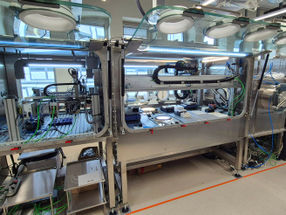
When thousands of samples need to be processed, every step counts. In the ELARA project, the chemical park operator Currenta is collaborating with the robotics company Wandelbots to investigate how the complex and highly varied processes of an environmental laboratory can be automated using digital twins and robotics. In the future, robots will take over routine tasks such as pipetting and sample handling, even when in direct contact with potentially hazardous substances. Occupational safety is therefore a clear focus of the project—the goal is to relieve skilled workers of the burden of directly handling these substances. The project also aims to achieve shorter processing times and higher availability.
Sensitive laboratory data remains protected throughout the process: With the Industrial AI Cloud, T-Systems provides a secure infrastructure in which the data is processed within the European legal framework.
Virtual Test Runs for Laboratory Use
The principle: simulate first, then automate. Before robots are deployed in the lab, they practice their movements in a digital twin. The simulation is designed to help identify potential errors early on. T-Systems provides the sovereign infrastructure for the NVIDIA Isaac Sim simulation environment and the NOVA components from Wandelbots used in the Industrial AI Cloud. This enables the partners to develop and validate robotic lab workflows on an infrastructure hosted in Germany and accelerated by NVIDIA GPUs.

ELARA combines Wandelbots’ NOVA with NVIDIA Isaac Sim—which is based on NVIDIA Omniverse—to model and validate robotic lab workflows in a physics-based digital twin. Using Wandelbots’ NOVA extension for Isaac Sim, robot movements can be simulated and tested before the workflows are transferred to physical robots. OpenUSD forms the basis for the 3D scene and the robot models, while NVIDIA PhysX enables the physics-based simulation. The partners have already replicated the lab workflows, calculated their economic viability, and defined the technical setup. Based on this, the partners are investigating the potential for future implementation with real robots.
Value Creation That Remains in Europe
“Europe’s and its industry’s greatest asset lies in data. ELARA demonstrates how this data can be used to virtually test complex laboratory workflows and prepare them for robotic deployment. The Industrial AI Cloud provides the powerful computing capacity needed for this—and lays the foundation for relieving skilled workers of routine tasks and potentially hazardous maneuvers in the future,” says Ferri Abolhassan, CEO of T-Systems
“For Currenta, as a chemical park operator, digitalization and automation are key areas of development. They enable greater workplace safety, improved availability, and ultimately significantly greater customer value. In the laboratory environment, the requirements are very specific—which is why we’re grateful to be developing the first prototype together with our partners Wandelbots and T-Systems,” says Hans Gennen, COO of Currenta.
How ELARA Works
ELARA stands for “Environmental Laboratory Automation and Robotics for Analytics.” The concept involves mapping various laboratory processes and robot types within a digital environment. The focus is, for example, on standardizable work steps in the processing of water and wastewater samples.
The particular challenge: Unlike in highly standardized laboratories, Currenta processes smaller quantities of different samples with varying work steps and requirements. Laboratory automation is intended to relieve employees of repetitive tasks and give them more time for technically demanding analysis and consultation. In the future, robotic systems could take over work steps in which employees regularly come into contact with potentially hazardous substances or contaminated wastewater samples.
“Fully automated analysis already exists, for example, for large quantities of similar samples in clinical analysis. Our laboratory work, on the other hand, is characterized by a wide variety of samples and varying process flows. Using a digital twin, we want to investigate how even such highly variable laboratory processes can be flexibly automated,” says Thomas Westfeld, project manager at Currenta.
The robotics software Wandelbots NOVA makes it possible to transfer simulated workflows to real robots at a later stage and to centrally control their operation. In the future, data from laboratory operations will flow back into the simulation, allowing for continuous improvement of the workflows. The Industrial AI Cloud provides the necessary computing power.
Wandelbots as an Anchor Customer of the Industrial AI Cloud
Since its launch in February 2026, Wandelbots has been part of the Industrial AI Cloud’s partner network. The company uses the AI computing power to connect digital twins of production facilities and manufacturing data with robotics and to develop AI applications for production.
Currenta Expands the Application Network
With Currenta, the Industrial AI Cloud is expanding its range of applications to include laboratory automation. The company operates CHEMPARK, with locations in Leverkusen, Dormagen, and Krefeld. In the ELARA project, Wandelbots contributes its NOVA software platform, while Currenta contributes its expertise in laboratory processes. T-Systems provides robust AI infrastructure and computing power from Munich and connects technology partners with users. Through ELARA, the project establishes the technical foundation for future robot-assisted laboratory processes.
Note: This article has been translated using a computer system without human intervention. LUMITOS offers these automatic translations to present a wider range of current news. Since this article has been translated with automatic translation, it is possible that it contains errors in vocabulary, syntax or grammar. The original article in German can be found here.


Other news from the department research and development


These products might interest you
Most read news


More news from our other portals



See the theme worlds for related content
Topic world Digitalization in the laboratory
The topic world Digitalization in the lab presents innovations and trends from digital data systems (ELN, LIMS) to laboratory robots and networked devices (IoT) to AI and machine learning.
Topic world Digitalization in the laboratory
The topic world Digitalization in the lab presents innovations and trends from digital data systems (ELN, LIMS) to laboratory robots and networked devices (IoT) to AI and machine learning.