Cleaner gas turbines using additive manufacturing
The new technology is suitable for many types of fuel and is intended to drive the energy transition forward
Advertisement


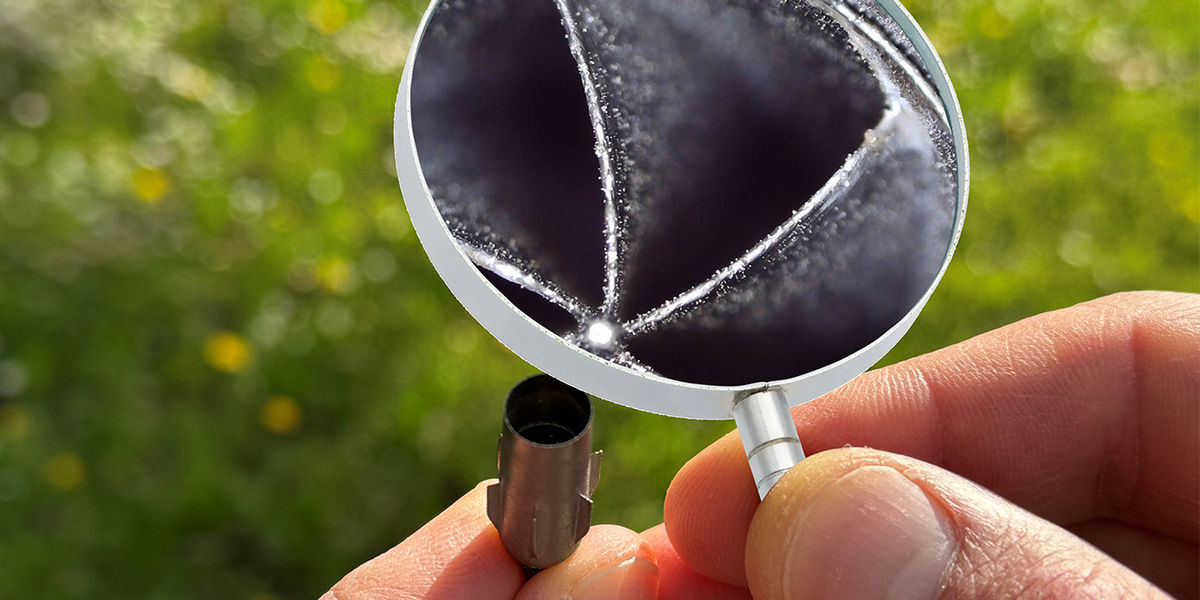
gas turbines can generate electricity from natural gas when solar and wind power are insufficient to meet energy demand. The goal is to operate them with the lowest possible carbon emissions using hydrogen, methanol, or other e-fuels. Researchers at the University of Stuttgart are developing injection systems for compact gas turbines that can burn a wide variety of fuels cleanly and be integrated directly into the burner using additive manufacturing.
“It is no longer unusual to use additive manufacturing to construct gas turbines. However, this has generally not been the case for one of the most important components—the injection systems that spray fuel into the combustion chamber,” says Dr. Fabian Hampp, Junior Research Group Leader at the Institute of Combustion Technology for Aerospace Engineering (IVLR) at the University of Stuttgart.
Together with Prof. Dr. Hans-Christian Möhring, director of the Institute for Machine Tools (IFW) of the University of Stuttgart, and Dr. Oliver Lammel, a senior researcher at the Institute of Combustion Technology of the German Aerospace Center (DLR), Hampp aims to close this research and development gap and produce an injector for compact gas turbines using additive manufacturing in order to cut costs and enable the low-emission combustion of a wide range of fuels, including hydrogen, e-fuels, and conventional fuels. As part of the Additively Manufactured Micro-Injection Concepts as Enablers for Fuel-Flexible and Low-Emission Combustion Systems (AMFlexInj) transfer project, the team aims to test the new process for widespread application.
Technology derived from aircraft turbines enables low-soot and low-nitrogen oxide combustion
Burning carbon-containing gases or liquids (e.g., gasoline, kerosene, natural gas, methanol, and other e-fuels) can release soot and nitrogen oxides, both of which should be minimized because they are harmful to the environment and human health. “Because soot and nitrogen oxides form mainly when the fuel and air aren’t mixed well enough, fuel injection systems are designed to produce the finest possible fuel mist and a homogeneous mixture,” says Hampp.
That is also why, at least for smaller turbines, the injectors have not yet been manufactured using 3D printing technology. In the conventional powder bed fusion of metals process, a thin layer of metal powder is spread over a build platform and then melted locally by a laser. After the material has solidified, the build platform is lowered, a new layer of powder is applied, and the process is repeated layer by layer until the component is fully built. Complex structures such as walls, cavities, and connecting passages take shape layer by layer. “The problem is that the surfaces of these printed structures are never completely smooth. This causes problems when a specific amount of fuel needs to be injected into a combustion chamber as a fine mist through very small openings,” says Möhring.
However, the research groups designed an injection system that works despite the roughness of the 3D-printed components. The additive manufacturing methods developed for this purpose enabled the researchers to miniaturize a principle used in aircraft turbines and incorporate it into a new injector design for the first time. “This allowed us to realise very clean combustion processes in the lab,” explains Möhring. This could substantially reduce gas turbine manufacturing costs because burners and combustion chambers are often already produced using additive manufacturing.
Injection nozzles work with fuels ranging from hydrogen to kerosene
Injection systems are typically designed for a specific type of fuel, but the new injectors work with a wide variety of fuels. Because hydrogen, natural gas, and relatively viscous kerosene have very different properties, optimal fuel-air mixing is generally possible only for a specific fuel. “However, the special design of our nozzles makes it possible to cleanly burn a wide range of fuels,” says Hampp. This flexibility is important because it is not yet clear which fuels will ultimately power gas turbines. The ability to retrofit older turbines with the new injection technology could also help reduce geopolitical dependence on certain energy sources.
So far, the injector has been tested only under laboratory conditions. The research teams now plan to optimize the additive manufacturing process and nozzle geometry before building a prototype and testing it with various fuels under real-world conditions in cooperation with DLR Stuttgart. The goal is to combine fuel flexibility with high power density, low emissions, and low costs.


Other news from the department science