Lighting the path to recycling carbon dioxide
Combining solar-harvesting materials with carbon-dioxide–consuming microbes could be an efficient way to generate clean fuels
Advertisement


Semiconductive photocatalysts that efficiently absorb solar energy could help reduce the energy required to drive a bioelectrochemical process that converts CO2 emissions into valuable chemicals, KAUST researchers have shown.
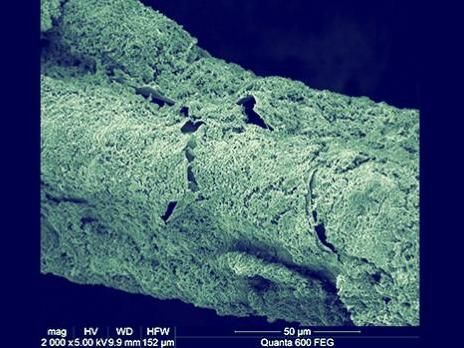
SEM image shows the dense and uniform cathodic biofilm, which mainly comprises chemolithoautotrophs, and could serve as biocatalysts for efficient carbon dioxide conversion to acetate.
© 2020 KAUST
Recycling CO2 could simultaneously reduce carbon emissions into the atmosphere while generating useful chemicals and fuels, explains Bin Bian, a Ph.D. student in Pascal Saikaly's lab, who led the research. "Microbial electrosynthesis (MES), coupled with a renewable energy supply, could be one such technology," Bian says.
MES exploits the capacity of some microbes to take up CO2 and convert it into chemicals, such as acetate. In nature, chemolithoautotroph microbes metabolize minerals as a source of energy in a process that involves the shuttling of electrons. This capability can be exploited to turn CO2 into value-added products if the microbes are supplied with a stream of electrons and protons from anodic water splitting in an electrochemical cell.
In their latest work, rather than focus on the CO2-to-acetate step, the team worked on reducing the energy input for molecular oxygen (O2) production at the anode, a reaction that keeps the overall cell in balance. "In MES systems, the process that consumes the most energy is believed to be the oxygen evolution reaction (OER)," Bian explains. Researchers have used light-capturing anode materials, such as titanium dioxide, that harness energy from sunlight to help drive the OER. In their current work, the team investigated a promising alternative for the photoanode, the light-harvesting material, bismuth vanadate.
Bismuth vanadate absorbed energy from a much broader range of the solar spectrum than titanium dioxide, making the whole MES cell more efficient, the team showed. "We obtained solar-to-acetate conversion efficiency of 1.65 percent, which is the highest reported so far," Saikaly says. "This efficiency is around eight times higher than the 0.2 percent efficiency of global natural photosynthesis, which is nature's solar-powered process for converting CO2 into energy-rich molecules," Bian notes.
So far the team has kept the microbe biocatalysts supplied with a steady stream of electrons and CO2 to sustain their growth. "The next step for us is to test our system under real sunlight and monitor the resilience of the biocatalysts under an intermittent renewable energy source," Saikaly says.
Original publication


Other news from the department science




















Most read news












More news from our other portals


























See the theme worlds for related content
Topic world Synthesis
Chemical synthesis is at the heart of modern chemistry and enables the targeted production of molecules with specific properties. By combining starting materials in defined reaction conditions, chemists can create a wide range of compounds, from simple molecules to complex active ingredients.
Topic world Synthesis
Chemical synthesis is at the heart of modern chemistry and enables the targeted production of molecules with specific properties. By combining starting materials in defined reaction conditions, chemists can create a wide range of compounds, from simple molecules to complex active ingredients.
Last viewed contents

Magnetic nanoparticles change their magnetic structure in a magnetic field - International research team studies the effects of magnetic fields on magnetic nanoparticles
Breakthrough in capturing 'hot' CO2 from industrial exhaust - A metal-organic framework is capable of capturing CO2 at extreme temperatures
Quantum Tricks to Unveil the Secrets of Topological Materials
The nano-lasagna: Novel 2D materials gain momentum - Research team develops environmentally friendly MXene synthesis without hazardous hydrofluoric acid for industrial scaling
Starch Instead of Plastic: Colombian Startup Reinventing Fruit Packaging - Natupla: From ISC3 start-up of the month to a pioneer in starch-based, biodegradable plastics
Researchers Test Novel Titanium-Air Battery - This is the first time that experimental results of such a battery have been published
Flow research on the outskirts of space - Experiments in weightlessness isolate classic diffusion phenomenon
Hydrogen chloride can now be stored, processed, and electrolyzed safely thanks to breakthrough - New method paves the way for safer, more sustainable hydrogen and base chemical production
Bayer wins BDI Environmental Prize - Complexing agent helps to reduce impact on inshore waters
Do We Need to Reassess Chemicals? - Chlorinated organic substances can be converted into dioxins in the atmosphere

ASCO SAS - Lucé, France