Researchers harvest abundant clean energy from thin air, 24/7
“The air contains an enormous amount of electricity”
Advertisement


A team of engineers at the University of Massachusetts Amherst has recently shown that nearly any material can be turned into a device that continuously harvests electricity from humidity in the air. The secret lies in being able to pepper the material with nanopores less than 100 nanometers in diameter.

Nanopores are the secret to making electricity from thin air.
Derek Lovley/Ella Maru Studio
“This is very exciting,” says Xiaomeng Liu, a graduate student in electrical and computer engineering in UMass Amherst’s College of Engineering and the paper’s lead author. “We are opening up a wide door for harvesting clean electricity from thin air.”
“The air contains an enormous amount of electricity,” says Jun Yao, assistant professor of electrical and computer engineering in the College of Engineering at UMass Amherst, and the paper’s senior author. “Think of a cloud, which is nothing more than a mass of water droplets. Each of those droplets contains a charge, and when conditions are right, the cloud can produce a lightning bolt—but we don’t know how to reliably capture electricity from lightning. What we’ve done is to create a human-built, small-scale cloud that produces electricity for us predictably and continuously so that we can harvest it.”
The heart of the man-made cloud depends on what Yao and his colleagues call the “generic Air-gen effect,” and it builds on work that Yao and co-author Derek Lovley, Distinguished Professor of Microbiology at UMass Amherst, had previously completed in 2020 showing that electricity could be continuously harvested from the air using a specialized material made of protein nanowires grown from the bacterium Geobacter sulfurreducens.
“What we realized after making the Geobacter discovery,” says Yao, “is that the ability to generate electricity from the air—what we then called the ‘Air-gen effect’—turns out to be generic: literally any kind of material can harvest electricity from air, as long as it has a certain property.”
That property? “It needs to have holes smaller than 100 nanometers (nm), or less than a thousandth of the width of a human hair.”
This is because of a parameter known as the “mean free path,” the distance a single molecule of a substance, in this case water in the air, travels before it bumps into another single molecule of the same substance. When water molecules are suspended in the air, their mean free path is about 100 nm.
Yao and his colleagues realized that they could design an electricity harvester based around this number. This harvester would be made from a thin layer of material filled with nanopores smaller than 100 nm that would let water molecules pass from the upper to the lower part of the material. But because each pore is so small, the water molecules would easily bump into the pore’s edge as they pass through the thin layer. This means that the upper part of the layer would be bombarded with many more charge-carrying water molecules than the lower part, creating a charge imbalance, like that in a cloud, as the upper part increased its charge relative to the lower part. This would effectually create a battery—one that runs as long as there is any humidity in the air.
“The idea is simple,” says Yao, “but it’s never been discovered before, and it opens all kinds of possibilities.” The harvester could be designed from literally all kinds of material, offering broad choices for cost-effective and environment-adaptable fabrications. “You could image harvesters made of one kind of material for rainforest environments, and another for more arid regions.”
And since humidity is ever-present, the harvester would run 24/7, rain or shine, at night and whether or not the wind blows, which solves one of the major problems of technologies like wind or solar, which only work under certain conditions.
Finally, because air humidity diffuses in three-dimensional space and the thickness of the Air-gen device is only a fraction of the width of a human hair, many thousands of them can be stacked on top of each other, efficiently scaling up the amount of energy without increasing the footprint of the device. Such an Air-gen device would be capable of delivering kilowatt-level power for general electrical utility usage.
“Imagine a future world in which clean electricity is available anywhere you go,” says Yao. “The generic Air-gen effect means that this future world can become a reality.”
Original publication


Other news from the department science




















Most read news












More news from our other portals


























Last viewed contents
Oxea lifts force majeure on Butyl Acetate in Europe

A recipe for zero-emissions fuel: Soda cans, seawater, and caffeine - MIT engineers have developed a fast and sustainable method for producing hydrogen fuel using aluminum, saltwater, and coffee grounds
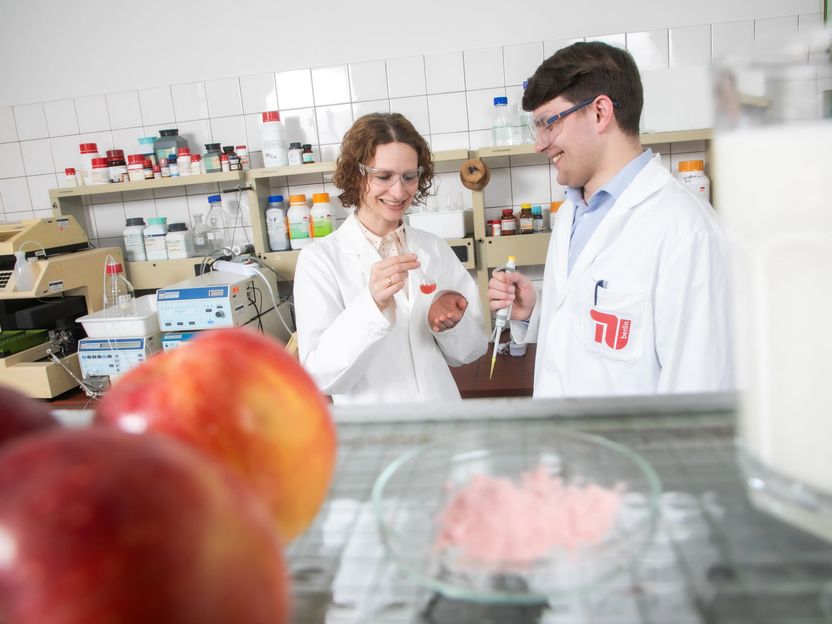
Masked ball in the realm of milk proteins - Food chemists are researching how to reduce the allergic reaction to milk protein by using phenolic compounds from apple pomace

New Executive Vice President Global Marketing & Sales at Oxea

Growth in visitor numbers, full halls, clear future topics: analytica 2026 sets standards - AI and automation as innovation drivers for the industry

A milestone on the pathway to Lab 4.0: A new standard for the smart lab - SPECTARIS presents the first industrial communication standard for laboratory and analytical devices
Schering sells Jenapharm's therapeutics business to Dermapharm AG

Hydrogen expert Prof. Wasserscheid receives the Archimedes Science Award - He has laid the essential foundations for the safe and cost-effective handling of hydrogen in the existing fuel infrastructure
Thousands of potentially harmful natural gas leaks found in Washington
PolyOne Suzhou Achieves ISO 13485 Certification for Healthcare Quality Management
3M to sell its temporary protective films business to Pregis LLC
