Advanced magnesium-based hydrogen storage materials and their applications
Advertisement


As an energy carrier, hydrogen holds the prominent advantages of high gravimetric energy density, high abundance, and zero emission, yet its effective storage and transportation remain a bottleneck problem for the widespread applications of hydrogen energy. To address such an issue, different types of hydrogen storage materials are developed and carefully investigated in the past decades. Among them, magnesium hydride (MgH2) has been considered as one of the most promising hydrogen storage materials because of its high capacity, excellent reversibility, sufficient magnesium reserves, and low cost. However, the poor thermodynamic and kinetic properties of MgH2 limit its practical applications (the enthalpy of the hydrogen desorption is 74.7 kJ mol-1 H2 and the desorption energy barrier is about 160 kJ mol-1 H2). Alloying, catalyzing, and nano-structuring have been proposed and applied to overcome the abovementioned drawbacks. Among these strategies, the introduction of the catalysts can change the local electronic configuration of Mg/MgH2 and reduce the energy barrier for H2 dissociation/recombination. The nanostructured Mg-based materials own the advantages of shortening the diffusion pathway and increasing surface reaction area, hence the hydrogen absorption and desorption rate can be significantly accelerated. The idea of designing core-shell nanostructured Mg-based hydrogen storage materials aims to synergize the strengths of the above two modification methods. Through such a strategy, advanced Mg-based materials with core-shell nanostructures can be constructed and optimized, which are promising for both mobile and stationary applications.

A vision of the future applications of core-shell nanostructured magnesium-based hydrogen storage materials
Jianxin Zou, Shanghai Jiao Tong University, Shanghai, PR China
A new review from the team of Professor Jianxin Zou at Shanghai Jiao Tong University summarizes research progress in the field of core-shell nanostructured magnesium-based hydrogen storage materials was published in Industrial Chemistry & Materials recently, which mainly focuses on the preparation methods, microstructures, properties, and related mechanisms. The goal is to point out the design principles and future research trends of Mg-based hydrogen storage materials for industrial applications.
Core-shell nanostructured Mg-based hydrogen storage materials show excellent hydrogen absorption and desorption kinetics and long-term cycling performances. Besides, such a unique structure renders the composites some unique properties, for example, anti-air oxidation ability, rapid hydrolysis rate, etc. In consideration of the above, Zou’s group suggests a bright vision for the use of core-shell nanostructured Mg-based hydrogen storage materials in the future. Environmental-friendly green hydrogen can be obtained by electrolysis of water using electricity generated from renewable sources, such as solar energy and wind energy, and the hydrogen is reserved in a solid Mg-based hydrogen storage tank. Core-shell nanostructured Mg-based materials can absorb and desorb hydrogen at a relatively low temperature, which significantly reduces energy consumption during hydrogen storage and release. The storage system, producing hydrogen by pyrolysis or hydrolysis, could supply hydrogen to fuel cells for electricity generation, small-scale portable backup power, industry usage, and so on. Recently, a tonnage Mg-based solid-state hydrogen storage and transpiration trailer (MH-100T) equipped with 12 solid-state hydrogen storage tanks and 14.4 tons of bulk porous Mg-Ni-based alloy pellets has been officially unveiled, which opens a new era for solid-state hydrogen storage, and transportation. In the future, core-shell nanostructured Mg-based materials having better hydrogen sorption properties, such as lowered hydrogen desorption temperature, faster sorption speed and higher storage capacity, can be applied to further improve the performances of Mg-based hydrogen storage systems and broaden their application fields in hydrogen industry.
Mg-based hydrogen storage systems have attracted much attention for possible applications as hydrogen carriers due to their high hydrogen storage densities, good cyclic performance, and high abundance of Mg on earth. The reduction of the hydrogen desorption temperature to the range compatible with the exhaust heat of a fuel cell stack (roughly 60-150 oC range) is probably the most important objective of the research on nanostructured hydrogen storage materials at present. However, the biggest challenge remains the current inability to simultaneously control kinetics, thermodynamics, and cyclic performances in a simple and efficient way. Many experimental and theoretical investigations have shown the relationships between core-shell structures and improved hydrogen sorption properties of Mg/MgH2. It is especially important to find the optimal processing parameters and technical routes to synthesize advanced core-shell nanostructured Mg/MgH2 nanoparticles with smaller sizes and better catalytic shells for improving their hydrogen storage properties and balancing the benefits and costs in order to meet the requirements for industrial applications. Moreover, new design principles for different specific nanostructured hydrogen storage materials are necessary to be developed in the future, for example, the precise control of catalytic effect in Mg/MgH2 lattice at the atomic level, composition, and structural optimization using material genome engineering methodology, etc.
"In this review, we would like to provide readers with the latest research and development of advanced Mg-based hydrogen storage materials and their future prospects in the field of hydrogen energy," Zou said.
Original publication


Other news from the department science




















Most read news












More news from our other portals


























Last viewed contents

How a persistent chemical enters our surface waters - Modeling the formation and distribution of trifluoroacetic acid (TFA) in the atmosphere

Simple process extracts valuable magnesium salt from seawater - This method plays a new trick with an old process

Team develops bioprocess for converting plant materials into valuable chemicals

Ytterbium thin-disk lasers pave the way for sensitive detection of atmospheric pollutants - The laser's capacity to generate high-power, stable pulses in the SWIR range is a game-changer for field-resolved spectroscopy and femtosecond fieldoscopy

Golden Ball Mills as Green Catalysts - A gold-coated grinding bowl proves to be a real marvel

Researchers discover new ultra strong material for microchip sensors - A material that doesn't just rival the strength of diamonds and graphene, but boasts a yield strength 10 times greater than Kevlar

Researchers are improving technology to generate high harmonics in nanostructured metasurfaces

“Dictionaries” make fluorescence-based data for integrative structure models and their dynamics accessible - 3D structures of biomolecules

How to control the movement of electrons in a molecule
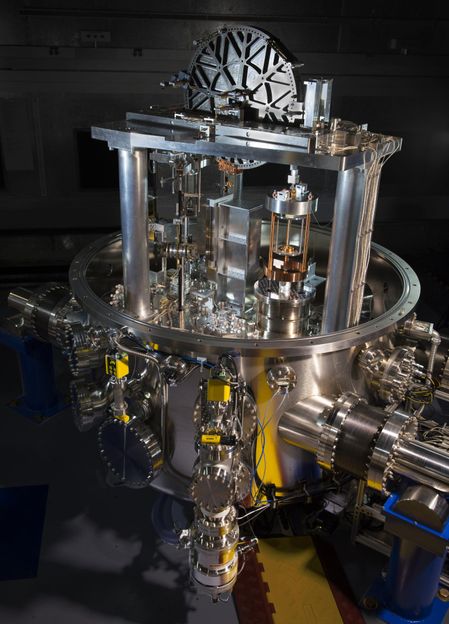
Measuring Planck's constant, watt balance brings world closer to new kilogram

From litter to power: Turning cigarette butts into high-performance supercapacitors - Conversion of cigarette butts into carbon electrodes with exceptional long-term stability
