Methane emissions from landfill could be turned into sustainable jet fuel in plasma chemistry leap
New research could help create a circular economy for waste-generated greenhouse gas emissions
Advertisement


In a world first, University of Sydney researchers have developed a chemical process using plasma that could create sustainable jet fuel from methane gas emitted from landfills, potentially creating a low-carbon aviation industry.
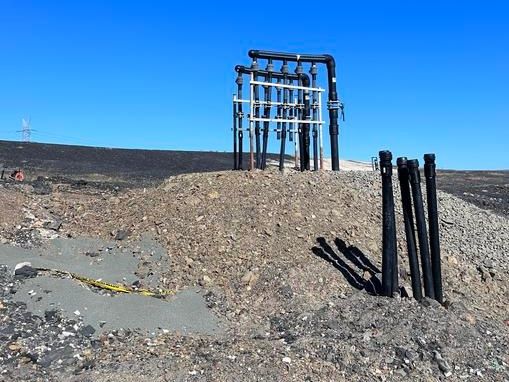
A methane well at a historical, enclosed landfill site.
Luisa Low, University of Sydney

How the plasma process could work on an industrial scale
Professor PJ Cullen, Dr Tianqi Zhang and Dr Emma Lovell

Methane is a far more potent greenhouse gas than carbon dioxide (CO2). According to the International Energy Agency, the concentration of methane in the atmosphere is currently around two-and-a-half times greater than pre-industrial levels and is increasing steadily, with waste emissions and the burning of fossil fuels accounting for a significant proportion.
The research was published in the Journal of the American Chemical Society.

Australia recently joined the international methane mitigation agreement with the United States, the European Union, Japan and the Republic of Korea.
Lead author, Professor PJ Cullen from the University of Sydney’s School of Chemical and Biomolecular Engineering and Net Zero Initiative said: “Globally, landfills are a major emitter of greenhouse gases, mainly a mixture of CO2 and methane. We have developed a process that would take these gases and convert them into fuels, targeting sectors that are difficult to electrify, like aviation.”
“Modern landfill facilities already capture, upgrade and combust their gas emissions for electricity generation, however, our process creates a much more environmentally impactful and commercially valuable product,” he said.
Global landfill emissions are estimated at 10–20 million tonnes of greenhouse gases per year, a value comparable to the emissions of the global energy sector.
Aviation currently accounts for approximately three percent of the world’s emissions. Creating a “closed loop” fuel based on existing emissions would eliminate the need for traditional and sustainable jet fuels, which add further emissions into the atmosphere.
How plasma makes the process work
The process would work by extracting methane from a landfill site, known as a methane well, which uses a shaft-like mechanism to extract gases.
“The beauty of this is that this simple process captures almost the exact composition that we need for our process,” said Professor Cullen.
“Non-thermal plasma is an electricity-driven technology which can excite gas at both a low temperature and atmospheric pressure. Essentially, what this means is this approach facilitates the conversion of the gas into value-added products by inducing plasma discharge within forming gas bubbles. The process doesn’t require heat or pressure, meaning it requires less energy, making it highly compatible with renewable energy power sources.”
Original publication
Josip Knezevic, Tianqi Zhang, Renwu Zhou, Jungmi Hong, Rusen Zhou, Christopher Barnett, Qiang Song, Yuting Gao, Wanping Xu, Dingxin Liu, Nicholas Proschogo, Biswaranjan Mohanty, Jyah Strachan, Behdad Soltani, Fengwang Li, Thomas Maschmeyer, Emma C. Lovell, Patrick J. Cullen; "Long-Chain Hydrocarbons from Nonthermal Plasma-Driven Biogas Upcycling"; Journal of the American Chemical Society, 2024-4-30


Other news from the department science




















Most read news












More news from our other portals


























Last viewed contents
AI instead of rare earths: Munich start-up searches for magnets made from abundant elements - Interview with the founder: alqem

‘Trustworthy AI’ focus for a new materials and chemicals project - Project to help drive adoption of machine learning wins funding from Innovate UK

Leipzig-based start-up converts CO₂ into green chemicals with patented plasma catalysis - CO₂ recycling as a useful complement to carbon capture and storage
Magnetic material could help monitor battery life - Researchers demonstrate the technique in a lithium-ion battery
On the trail of the missing hydrogen atoms - A new method could enable more accurate simulation of materials for various applications in the future

PlasCO₂ project: Greenhouse gas transformed into a raw material - Innovative process could significantly reduce energy requirements for the production important chemical products

Evonik aligns two business lines with new growth strategy - Businesses outside core areas are to be sold or discontinued

Milestone for laser technology: Huge research machine much smaller and cost-effective - Research team demonstrates free-electron laser driven by plasma accelerated electron beams and seeded by additional light pulses

Unprecedented insight into two-dimensional magnets using diamond quantum sensors

Plasma against toxic PFAS chemicals - “Ideally, the harmful PFAS substances are eliminated to the point that they can no longer be detected in mass spectrometric measurements”

Deeper insight thanks to neutrons from a laser source - The desire to make the hidden visible has always been a driving force of research