Magnetism without metal: a milestone for materials science
“This is fundamentally new”
Advertisement


Dr Hongde Yu and Prof Thomas Heine from TUD Dresden University of Technology have succeeded for the first time in predicting metal-free organic magnetic materials using precise computer simulations. These magnetic two-dimensional (2D) polymers could play an important role in data storage, medical technology or quantum computing in the future. Their discovery was recently published in the journal “Science Advances”.
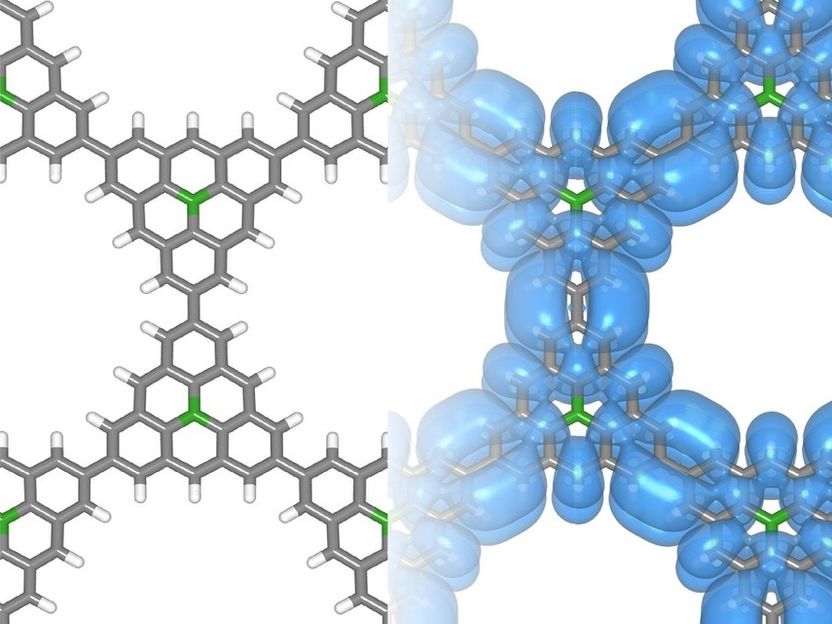
© Thomas Heine
Magnetism has fascinated people for centuries: whether children playing with magnets or scientists researching the fundamental forces behind the phenomenon. It is widely known that magnetism in nature is usually closely associated with metals - classic permanent magnets, for example, are based on iron or other metals.
Now Hongde Yu and Thomas Heine from the Chair of Theoretical Chemistry at Dresden University of Technology have shown for the first time through calculations that it is also possible to generate magnetism in purely organic materials. The scientists used so-called triangulenes, triangular molecules that have unpaired electrons and therefore a magnetic moment, as the basic building block. When these molecular building blocks are combined to form a 2D solid, these unpaired electron spins arrange themselves to create a ferromagnetic material.
“This is fundamentally new,” explains Hongde Yu. “Normally, the electron spins in organic materials have a random orientation and therefore cancel each other out in the solid. Through suitable chemical bonds, the spins arrange themselves in the 2D crystal, creating a ferromagnetic material.”
“Magnetism is based on the robust coupling of electron spins between neighboring molecular building blocks. In contrast to magnetism in metals, where the electron spins are localized at the metal atoms, we see a delocalized spin density that is distributed over the entire triangulene molecular compound. Depending on the composition of the molecule, so-called “Stoner ferromagnets”, where the spins of neighboring molecules are parallel, or antiferromagnetic Mott insulators, where the spins of neighboring molecules are opposite, can form,” explains Heine. The discovery that magnetic moments can be orderly coupled in metal-free materials opens the door for the development of magnetic materials where metals are undesirable, e.g. due to their weight or toxicity. Metal-free magnets could prove to be more robust and biocompatible, which would be particularly important in medical technology.
With this groundbreaking work, the research team has discovered a new class of magnetic materials that is not only theoretically fascinating, but also has the potential to significantly influence future technological developments.
Original publication


Other news from the department science




















Most read news












More news from our other portals


























Last viewed contents

Magnetic nanoparticles change their magnetic structure in a magnetic field - International research team studies the effects of magnetic fields on magnetic nanoparticles
Breakthrough in capturing 'hot' CO2 from industrial exhaust - A metal-organic framework is capable of capturing CO2 at extreme temperatures
Quantum Tricks to Unveil the Secrets of Topological Materials
The nano-lasagna: Novel 2D materials gain momentum - Research team develops environmentally friendly MXene synthesis without hazardous hydrofluoric acid for industrial scaling
Starch Instead of Plastic: Colombian Startup Reinventing Fruit Packaging - Natupla: From ISC3 start-up of the month to a pioneer in starch-based, biodegradable plastics
Researchers Test Novel Titanium-Air Battery - This is the first time that experimental results of such a battery have been published
Flow research on the outskirts of space - Experiments in weightlessness isolate classic diffusion phenomenon
Hydrogen chloride can now be stored, processed, and electrolyzed safely thanks to breakthrough - New method paves the way for safer, more sustainable hydrogen and base chemical production
Bayer wins BDI Environmental Prize - Complexing agent helps to reduce impact on inshore waters
Do We Need to Reassess Chemicals? - Chlorinated organic substances can be converted into dioxins in the atmosphere

ASCO SAS - Lucé, France