Sustainable chemistry with the help of Artificial Intelligence
The new process could make an important contribution to more environmentally friendly production
Advertisement


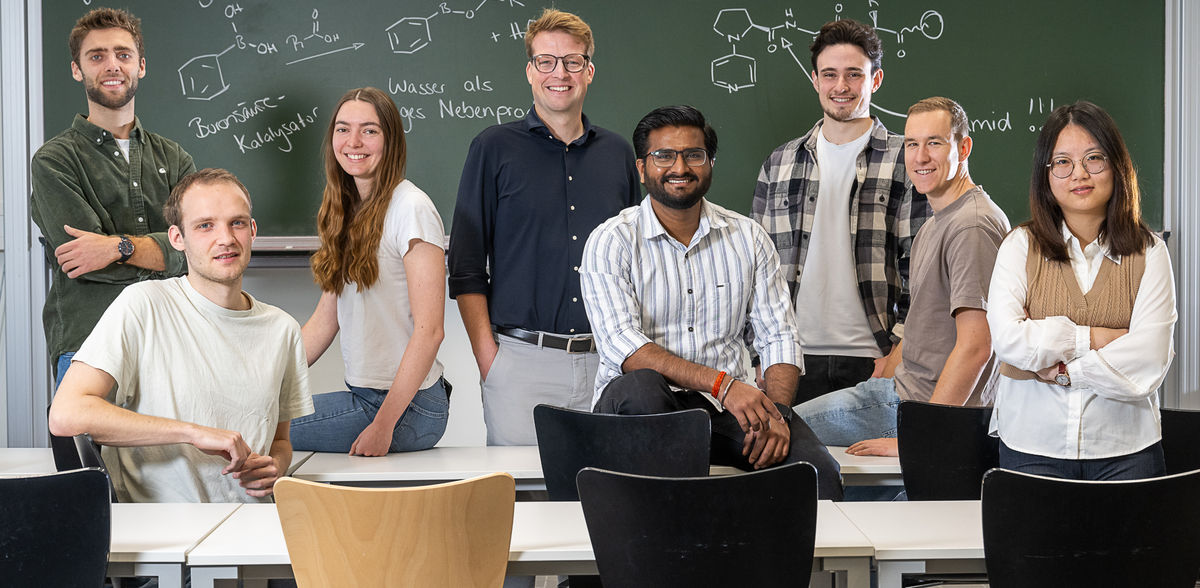
Amidation reactions are the most common reactions in the chemical industry. They are indispensable for a wide range of industrial production processes, but their ecological footprint is highly problematic. They generate large amounts of toxic waste and are energy-intensive. A team led by Dr Tobias Schnitzer, research group leader at the Institute of organic chemistry at the University of Freiburg, is using artificial intelligence (AI) to develop innovative, boronic acid-catalysed amidation reactions that do not require toxic reagents, use sustainable solvents and consume little energy. The research project is being funded by the Vector Foundation with £1.5 million over six years. “Our goal is the AI-driven development of an amidation process in which water is the only by-product, which is cost-effective and can significantly improve resource efficiency in the chemical industry,” says Schnitzer.
The development of catalysts for amidation
Around 16% of all reactions in the chemical industry are amidations. They are important for the production of pharmaceuticals, agrochemicals and polymers and play a central role in fine chemicals such as dyes, fragrances and additives. Classic amidation processes use chlorination and coupling reagents that are toxic, explosive or corrosive and produce large quantities of hazardous by-products. They also use toxic and poorly degradable solvents.
The Freiburg research project is developing novel boronic acid catalysts for efficient and sustainable amidations. The starting point is an extensive and structurally diverse catalyst library, which is being studied in high throughput with regard to its catalytic activity. The experimentally determined reactivity of each individual catalyst then serves as the data basis for the development of an AI-based prediction model. This model makes it possible to predict the properties and activities of hundreds of thousands of additional catalysts without their actual synthesis or experimental testing. This saves time, energy and chemical resources already in the development process.
Economical green chemistry
The aim of the research is to identify highly active catalysts that enable the amidation of any starting materials at room temperature in sustainable, bio-based solvents for the first time. The goal is to achieve an energy- and cost-efficient process with minimal waste for one of the most important chemical reactions.
The funded research work thus also makes a quantifiable contribution to achieving the United Nations' global sustainability goals, says Schnitzer: “Our project shows that green chemistry is feasible and economically relevant. I also hope that our work will help to change the image of chemistry – away from a ‘dirty and smelly’ science to a clean and sustainable discipline that delivers innovation and is part of the solution to global challenges.”
The Vector Foundation The Vector Foundation was established in 2011 as a corporate foundation. The Vector Foundation supports an average of 170 projects with approximately twelve million euros annually. Since 2011, it has allocated more than 100 million euros to its charitable work. The Vector Foundation is active in the fields of research, education and social engagement in Baden-Württemberg. Its funding focuses on scientific and technical research projects, STEM education (science, technology, engineering and mathematics) and combating homelessness and youth unemployment.


Other news from the department science





















Most read news











More news from our other portals



























Last viewed contents

Global underground CO₂ storage hits record 43.6 million tonnes - London Register expands reach
Research Breakthrough on the Path to a New Reserve Antibiotic - For the first time, chemists have succeeded in synthesizing the highly potent natural compound neosorangicin A

Endress+Hauser expands its presence in the U.S. - 44 million euros are being invested in the new facility in Greenwood, Indiana
Plastic bottles could find new life in batteries as graphite - Penn State researchers converting PET waste into synthetic graphite that outperforms natural graphite
Turning food waste into carbon captors - Expected to be cheaper than other capture methods

Study shows: Lithium and sodium-ion technologies are more closely linked than assumed - "Switching to a new battery technology does not automatically open the door to new market players"

ETH spin-offs sweep the board at Venture Awards
How to generate and steer electrons in liquid water - Surprising results reveal a new aspect of extremely strong electric fields in liquid water
Turning renewable energy into drop-in fuels - Synhelion advances scale-up with large-scale synthetic fuel project in Morocco
30 Million Euros for Catalyst Research Using AI-Controlled Laboratories - ASCEND is leveraging automated learning loops and 3D thin-film catalysts to develop industrially viable drop-in substitutes.
