New paths for quantum technologies: Optical control of nuclear spins in molecules
Molecular systems can be chemically tailored and could thus enable atomically precise qubits
Advertisement


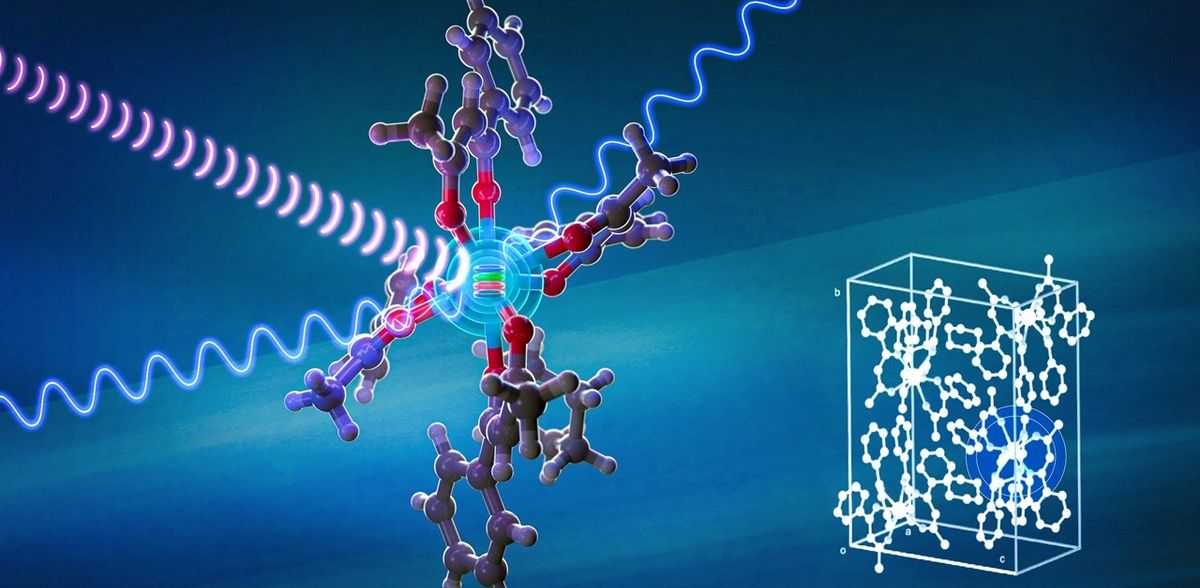
A research team at the Karlsruhe Institute of Technology (KIT) has made an important advance in quantum physics and materials research: For the first time, nuclear spins in a molecular material could be optically initialized, controlled and read out. Nuclear spins are considered to be particularly stable carriers of quantum information due to their low interaction with the environment. The results show that molecular nuclear spins could be a promising building block for future quantum technologies. Publication in Nature Materials.
Nuclear magnetic resonance (NMR) is an established analytical method for investigating materials and molecules. It ranges from chemical analysis to quantum information processing. In a recent study, KIT researchers investigated a molecular crystal containing europium ions. These ions have particularly narrow optical transitions that allow direct access to the nuclear spin states. With the help of laser light, they were first able to convert the nuclear spins into defined states and then read them out optically.
In addition to optical addressing, the researchers used high-frequency fields to control the spins and protect them from interfering influences from the environment. In doing so, they achieved nuclear spin quantum coherence with a lifetime of up to two milliseconds, a time interval in which a quantum system maintains a precisely defined quantum mechanical state.
Nuclear spins as stable carriers of quantum information
"The results show that molecular materials can be a promising platform for future quantum devices," says Professor David Hunger from the Institute of Physics at KIT. "It is particularly advantageous that we can address the nuclear spins here without interfering electron spins. This means that particularly stable and densely packed qubit registers can be realized in the future."
The molecular crystals studied were synthesized by researchers at the Institute of Quantum Materials and Technologies and the Institute of Nanotechnology at KIT in Professor Mario Ruben's research group and extensively characterized with regard to their suitability as a quantum platform.
Customized molecules for atomically precise qubits
In the long term, optically addressable nuclear spins in molecules open up new perspectives for the development of scalable quantum computers. Molecular systems can be chemically tailored and could thus enable atomically precise qubits. Optically detected nuclear magnetic resonance (ODNMR) also makes new high-resolution NMR methods feasible, which will enable the detailed investigation of complex materials in the future.
The research results thus underline the great potential of molecular systems for future quantum technologies and provide an important step towards optically networkable quantum processing systems.
Note: This article has been translated using a computer system without human intervention. LUMITOS offers these automatic translations to present a wider range of current news. Since this article has been translated with automatic translation, it is possible that it contains errors in vocabulary, syntax or grammar. The original article in German can be found here.
Original publication


Other news from the department science





















Most read news











More news from our other portals



























Last viewed contents

How Carbon Accounting Rules Shape Incentives for Hydrogen Production

How Chemicals End Up in the Mountains - Permanent chemicals harm insects—even in near-natural habitats
Quasiparticle solves mystery of vanishing conductivity - CAU team detects polarons in rare earth compound for the first time
Cryo-electron microscopy – Reaction cycle of an enzyme for CO2 fixation decoded - A promising enzyme candidate for biofuel production from carbon dioxide

Protein Content in Foods — New Conversion Factors Enable More Precise Assessment - Max Rubner Institute Releases New Database for Nitrogen-to-Protein Conversion

AI-driven microorganism mix has the potential for groundbreaking innovation - Federal Ministry for the Environment Launches First Joint SPRIND Challenge for a Biotech Breakthrough in the Circular Economy
Researchers develop cleaner, scalable process to recycle lithium-ion batteries - "We’ve shown that it’s possible to create high-performance batteries from recycled materials at scale"
30 Million Euros for Catalyst Research Using AI-Controlled Laboratories - ASCEND is leveraging automated learning loops and 3D thin-film catalysts to develop industrially viable drop-in substitutes.

Converting CO₂ Directly into Fuels and Chemicals - TU Berlin Launches Two Research Projects on Direct Electrochemical CO₂ Conversion—Without the Detour via Hydrogen
Malvern Instruments and PANalytical to merge