Common structural analysis of interfacial water is inadequate, according to a new study
Water molecules at the air-water interface characterised layer by layer for the first time
Advertisement


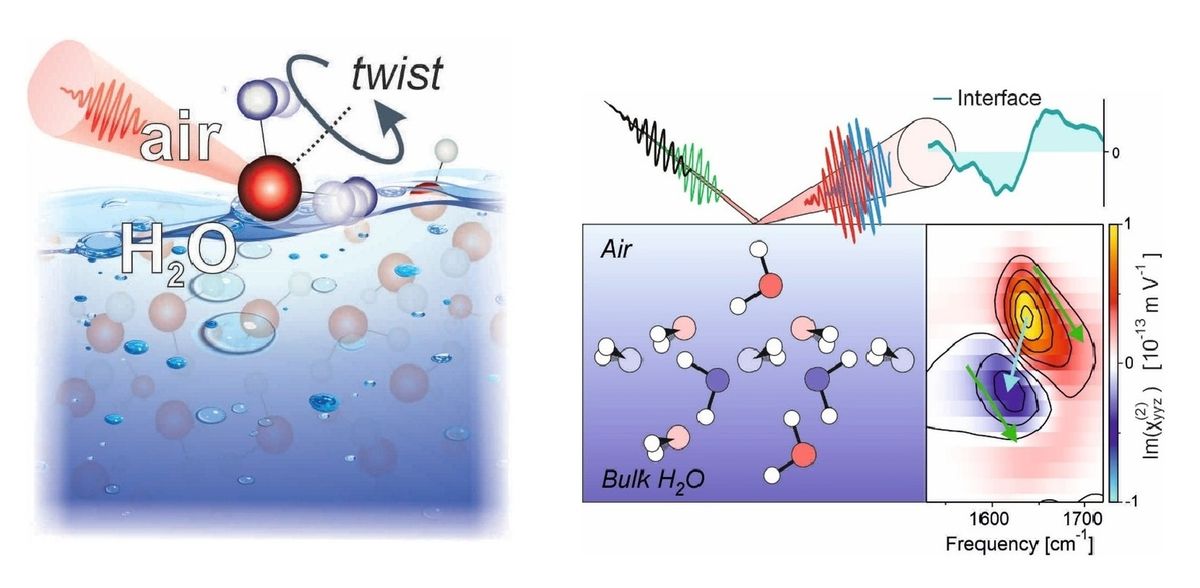
Researchers from the Department of Physical Chemistry at the Fritz Haber Institute and Freie Universität Berlin have revealed the arrangement of water molecules at the interface between liquid water and air. Their findings help to better understand interfacial chemistry, which is largely determined by the specific arrangement of the water molecules. The study shows that one parameter in particular - one that has been neglected until now - is of fundamental importance: the water twist.
Why study the air-water interface?
Water is arguably the most important molecule on Earth. Interfaces of water play a critical role in numerous processes within physiology, at the ocean surface, and in the atmosphere. In these processes, it is primarily the incredibly thin region of water directly at the boundary that governs their behavior. Crucially, the sheer presence of the interface perturbs the molecular structure of water, generating preferential orientations and an altered hydrogen-bond network, which give rise to profoundly different properties of water in that region. While these unique structures are at the heart of many interfacial phenomena, characterizing them is monumentally difficult.
The challenge: Obtaining structural details from the extremely thin interfacial water region
The interfacial water region is incredibly thin (~8 Angstroms), involving only about four layers of water molecules. Below this interfacial region water adopts its bulk properties. To elucidate details about the molecular water structure in the interfacial region researchers need to probe only these first four water layers and retrieve information on molecular orientations in each of them. However, performing such experiments has so far not been feasible, with the result that the exact molecular structure of interfacial water remained unknown despite decades of intensive research.
Depth-resolved vibrational spectroscopy in combination with simulations
The research team at the Fritz Haber Institute overcame this challenge through their recently developed depth-resolved vibrational spectroscopy that uses a combination of infrared and visible lasers to irradiate the water surface and excite nonlinear vibrations in the water molecules. This process generates two new laser beams at different visible frequencies, namely the sum- and difference frequency signals. Exploiting small differences in the phase and amplitude of these signals, the team managed to extract precise depth information and isolate the vibrational response from the interfacial water region. The resulting spectra were then combined with high level computer simulations performed by the team from the FU Berlin to obtain a clear picture of the orientations of water molecules within the interfacial region.
Thanks to this combined approach and their novel experimental technique, the researchers revealed that the water molecules in the first four layers possess a very well defined orientational structure with layer-to-layer alternating molecular tilt and twist angles. While the tilt angle is defined as the angle between the water dipole and the surface normal, the molecular twist angle describes a rotation about the dipole axis. Based on these findings the research team was able to show that the common structural analysis of interfacial water in terms of molecules pointing “up or down” is largely insufficient by underlining the importance of the previously ignored depth-dependent molecular twist distribution at the interface to air. This leads to a revised structural picture of interfacial water with important implications on our understanding of processes at aqueous interfaces.
Cooperation between the FHI and the FU Berlin
This study is a testament to a very fruitful collaboration between different science institutions in Berlin (FHI and FU Berlin), bringing together expertise in theory and experiment to tackle long-standing research questions. The authors anticipate to extend their studies to a wider range of aqueous interfaces including those in electrochemical devices such as batteries.
Original publication


Other news from the department science




















Most read news












More news from our other portals


























See the theme worlds for related content
Topic World Spectroscopy
Investigation with spectroscopy gives us unique insights into the composition and structure of materials. From UV-Vis spectroscopy to infrared and Raman spectroscopy to fluorescence and atomic absorption spectroscopy, spectroscopy offers us a wide range of analytical techniques to precisely characterize substances. Immerse yourself in the fascinating world of spectroscopy!

Topic World Spectroscopy
Investigation with spectroscopy gives us unique insights into the composition and structure of materials. From UV-Vis spectroscopy to infrared and Raman spectroscopy to fluorescence and atomic absorption spectroscopy, spectroscopy offers us a wide range of analytical techniques to precisely characterize substances. Immerse yourself in the fascinating world of spectroscopy!
Last viewed contents
WACKER Presents Innovation Award for Novel Manufacturing Process for Polymer Dispersions
Artificial rocks from macroplastics threaten ocean health - German-Indonesian research team identifies new rock-like compounds from plastic waste and coral rubble for the first time
RCT Reichelt Chemietechnik | Flow indicators | Reichelt Chemietechnik

World record for tandem perovskite-CIGS solar cell

New method for determining exchange energy in 2D materials - Detective work yielded a simple solution
Magnetism without metal: a milestone for materials science - “This is fundamentally new”

Magnetic nanoparticles change their magnetic structure in a magnetic field - International research team studies the effects of magnetic fields on magnetic nanoparticles
Breakthrough in capturing 'hot' CO2 from industrial exhaust - A metal-organic framework is capable of capturing CO2 at extreme temperatures
Quantum Tricks to Unveil the Secrets of Topological Materials
The nano-lasagna: Novel 2D materials gain momentum - Research team develops environmentally friendly MXene synthesis without hazardous hydrofluoric acid for industrial scaling
Starch Instead of Plastic: Colombian Startup Reinventing Fruit Packaging - Natupla: From ISC3 start-up of the month to a pioneer in starch-based, biodegradable plastics