Innovation paves way to make ‘clean’ chemicals, plastics and food using solar energy
Integrated solar reactor uses sunlight, water, CO2 and engineered bacteria to grow biomass in a single beaker
Advertisement


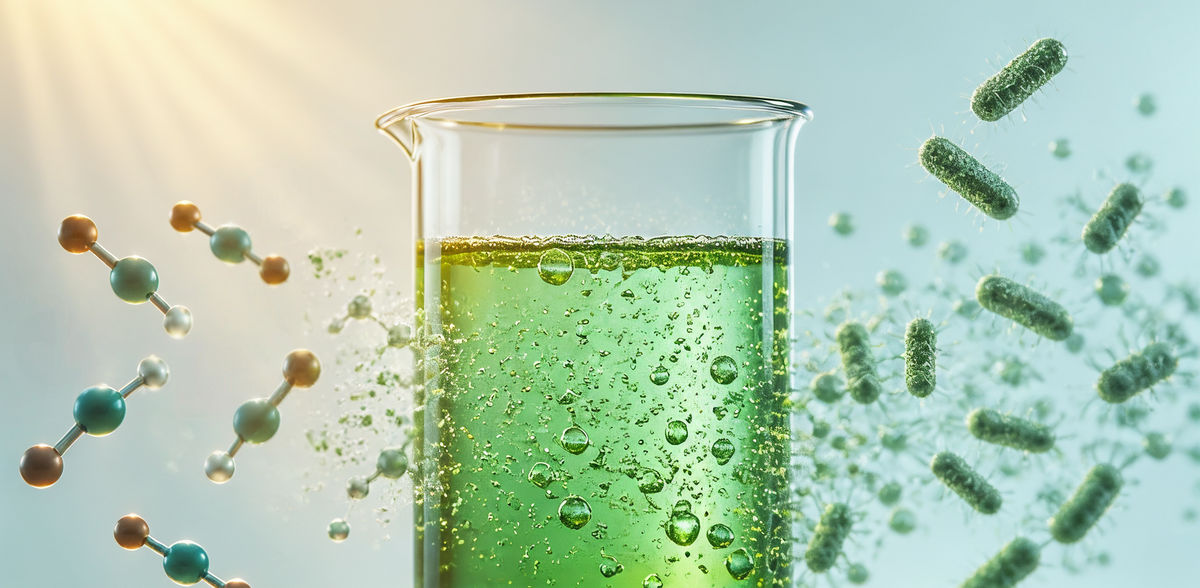
A new study led by Dr Lin Su of Queen Mary University of London, published in the Journal of the American Chemical Society, describes a new integrated solar reactor in which engineered Escherichia coli (E. coli) are grown directly inside the same liquid that converts CO₂ into a usable energy source using sunlight.
In future, this technology may be used to make environmentally clean chemicals, plastics or even microbial protein.
The device combines an organic solar cell, a semiconductor electrode, two enzymes, and an engineered bacterium, and converts CO₂ and water into living biomass, reproducing the stages of natural photosynthesis without any plant, alga or photosynthetic microbes.

Solar powered chemistry and engineered bacteria
Today's chemical industry runs on fossil fuels. Two clean alternatives are growing in parallel: solar-powered chemistry, where sunlight turns CO₂ into useful small molecules, and engineered bacteria, which can be programmed to make a wide range of chemicals. Several earlier biohybrid devices have already placed an abiotic light absorber and a microbe inside the same reactor, using different combinations of catalysts, intermediates and host organisms.
This paper asks: can the same one-pot integration be achieved using a set of components that are tractable to engineering on both sides, specifically an organic light absorber, a purified enzyme as the CO₂-reduction catalyst, the soluble single-carbon energy carrier formate, and an engineered E. coli chassis? This combination matters because each of these components can be independently tuned or swapped (the solar cell redesigned, the enzyme re-engineered, the strain rewired for a target product), giving a platform that is designed to be modified rather than fixed to one chemistry.
For a clean chemical industry to replace the fossil-fuel one, the chemistry that captures CO₂ and the biology that turns it into useful products will eventually need to share the same device. Two-step processes with manual transfer between reactors are too expensive and inefficient to scale. This work is an early demonstration that the chemistry and the biology can be made compatible inside one beaker, which is the foundation for any future integrated solar refinery for chemicals, materials, and microbial protein.
Inside the reactor, sunlight powers two reactions, and a third reaction follows in the same liquid. Sunlight splits water on one electrode, releasing oxygen for the bacteria to breathe. It powers an enzyme on a second electrode that captures CO₂ from the liquid and turns it into formate, a small molecule that carries the captured solar energy in a form the bacteria can use as fuel. The bacteria then take up the formate, burn it for energy using the oxygen the device just made, and use that energy to build themselves out of more CO₂ dissolved in the same liquid. Sunlight goes in. Living bacteria come out.
The value of the work is showing that the full chain, from photons to E. coli biomass in one liquid, is possible at all. This opens the way to swapping in engineered strains that produce target chemicals beyond biomass.
Dr Lin Su, a lecturer at Queen Mary University of London, said: "Previously the problem with trying to make living biomass like bacteria in a solar powered chemical reactor, is that the chemistry typically releases toxic metal ions that poison the bacteria. We have shown that a solar-powered chemical reactor and engineered bacteria can share a single beaker, using sunlight, water and CO₂ to grow living biomass safely.
“Once that integration works, a synthetic biologist can plug a different engineered E. coli strain into the same hardware to produce a different molecule.
“While it is at an early stage, with the yields still small and the reactor running for hours rather than weeks, it is very promising."
Dr Celine Wing See Yeung, from the University of Cambridge, said: “The project came together like a jigsaw puzzle shaped by years of research—from enabling organic photovoltaics to function at high temperatures to advancing enzyme purification and integrating it with synthetic biology. Together, we show how materials chemistry and synthetic biology can join forces to develop solar powered chemical refineries of the future.”
Professor Ron Milo, from the Weizmann Institute of Science, said: “The successful integration of these two systems is going to be key to sustainable production technologies. Advancements in growing bacteria using CO2 open the way for supplying our food in a way that uses much less land and water and can scale to meaningfully dampen the climate and ecological challenges humanity faces." Professor Erwin Reisner, from the University of Cambridge, said: “Our study demonstrates that synthetic light absorbers can be integrated with non-photosynthetic microbes to power the core reaction of natural photosynthesis. This achievement was made possible through a cross-disciplinary approach by careful selection and combination of semiconductors with isolated enzymes and engineered microbes in a solar-powered device. This approach opens up exciting new opportunities to produce high-value chemicals through semi-biological systems for sustainable manufacturing by taking advantage of the frontiers in synthetic biology.”
Original publication



Other news from the department science





















Most read news











More news from our other portals



























Last viewed contents
Chemicals and energy sectors move away from fossil raw materials - Fraunhofer and an Estonian deep-tech start-up are testing a modular biomass platform on an industrial scale
From Flue Gas to Raw Material: Extracting Carbon from CO₂ Produced by Waste Incineration - KIT and EEW Energy from Waste (EEW) plan to use CO₂ from flue gases in the NECOC process

KAIST identifies a route to faster-charging, longer-lasting EV batteries - Research team uses a 3D digital twin to reveal localized degradation mechanisms during fast charging

Matthews Engineering and start-up hs-tumbler partner on dry battery electrode manufacturing - Companies aim to enable dry electrode manufacturing through trajectory mixing

Winter-ready lithium batteries: scientists use "polarity-contras" electrolyte strategy to outsmart extreme cold - Lithium metal batteries retain 80% capacity after 150 cycles at -40 °C

The competitiveness of low-carbon fuels depends on location - New infrastructure could boost European production
Deep tech startup Reduciner introduces novel technology to turn captured carbon into sustainable fuels - Raising 3.6 million euros in its initial funding round, the Finnish startup plans to build its first industrial-scale pilot
Bruker announces strategic collaboration with Atinary Technologies to advance self-driving laboratories

FUST Lab Receives Investment from Asia2G Capital - The Korean deep-tech company plans to use the capital to expand into the U.S., European, and Japanese markets

ACHEMA Middle East: Debut in Saudi Arabia not until 2027 - Messe Frankfurt Saudi Arabia and DECHEMA are responding to regional uncertainties and are also changing the venue
New core-shell design for anodes significantly increases performance of sodium-ion batteries - Researchers coat porous carbon with a filter-like layer that allows sodium ions to pass through while keeping disruptive electrolyte molecules out
