Why fish don't freeze in the Arctic Ocean
Chemists unmask natural antifreeze
Advertisement


Together with cooperation partners from the U.S., the researchers surrounding Prof. Dr. Martina Havenith (physical chemistry II of the RUB) describe their discovery in a so-termed Rapid Communication in the Journal of the American Chemical Society (JACS). The journal's independent reviewers evaluated the work as one of the top 5% of all submissions.
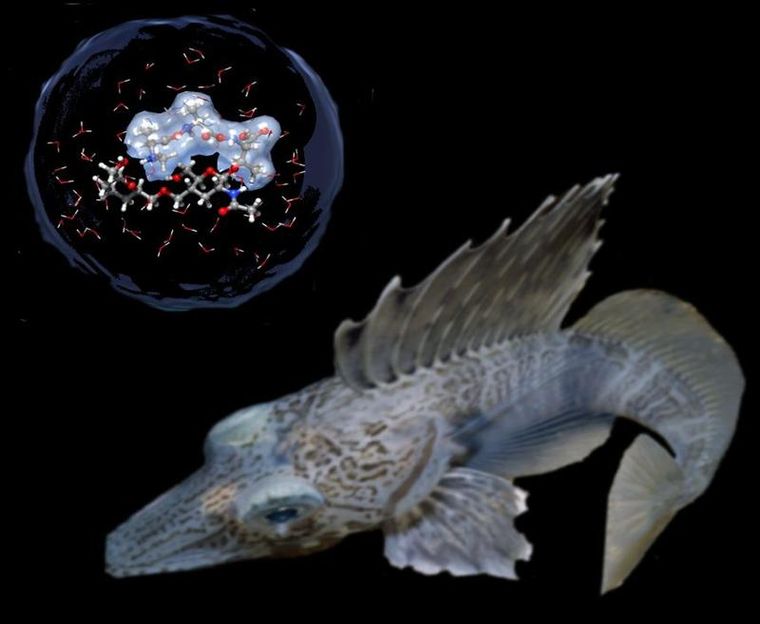
This is the fish, Macropteris maculatus, with antifreeze protein structure.
Konrad Meister
Better than household antifreeze
Temperatures of minus 1.8 ° C should really be enough to freeze any fish: the freezing point of fish blood is about minus 0.9 ° C. How Antarctic fish are able to keep moving at these temperatures has interested researchers for a long time. As long as 50 years ago, special frost protection proteins were found in the blood of these fish. These so-called anti-freeze proteins work better than any household antifreeze. How they work, however, was still unclear. The Bochum researchers used a special technique, terahertz spectroscopy, to unravel the underlying mechanism. With the aid of terahertz radiation, the collective motion of water molecules and proteins can be recorded. Thus, the working group has already been able to show that water molecules, which usually perform a permanent dance in liquid water, and constantly enter new bonds, dance a more ordered dance in the presence of proteins – "the disco dance becomes a minuet" says Prof. Havenith.
Souvenir from an Antarctic expedition
The subject of the current investigations was the anti-freeze glycoproteins of the Antarctic toothfish Dissostichus mawsoni, which one of the American partners, Arthur L. Devries, had fished himself on an Antarctic expedition. "We could see that the protein has an especially long-range effect on the water molecules around it. We speak of an extended dynamical hydration shell", says co-author Konrad Meister. "This effect, which prevents ice crystallization, is even more pronounced at low temperatures than at room temperature", adds Prof. Havenith. Nevertheless, to freeze the water, lower temperatures would be necessary. Complexation of the AFP by borate strongly reduces the antifreeze activity. In this case, the researchers also found no change in the terahertz dance. The researchers' results provide evidence for a new model of how AFGPs prevent water from freezing: Antifreeze activity is not achieved by a single molecular binding between the protein and the water, but instead AFP perturbs the aqueous solvent over long distances. The investigation demonstrated for the first time a direct link between the function of a protein and its signature in the terahertz range. The studies were funded by the Volkswagen Foundation.
Original publication: Simon Ebbinghaus et al.; "Antifreeze glycoprotein activity correlates with long-range protein-water dynamics"; Journal of the American Chemical Society. August 16, 2010


Other news from the department science




















Most read news












More news from our other portals


























See the theme worlds for related content
Topic World Spectroscopy
Investigation with spectroscopy gives us unique insights into the composition and structure of materials. From UV-Vis spectroscopy to infrared and Raman spectroscopy to fluorescence and atomic absorption spectroscopy, spectroscopy offers us a wide range of analytical techniques to precisely characterize substances. Immerse yourself in the fascinating world of spectroscopy!

Topic World Spectroscopy
Investigation with spectroscopy gives us unique insights into the composition and structure of materials. From UV-Vis spectroscopy to infrared and Raman spectroscopy to fluorescence and atomic absorption spectroscopy, spectroscopy offers us a wide range of analytical techniques to precisely characterize substances. Immerse yourself in the fascinating world of spectroscopy!
Last viewed contents

POWTECH 2023: Visitors from all around the world look forward to a wide-ranging programme
Artificial rocks from macroplastics threaten ocean health - German-Indonesian research team identifies new rock-like compounds from plastic waste and coral rubble for the first time
Pumping up the music of molecules - Significantly improving the "sense of smell" of molecular laser spectroscopy: Increases chances to reliably detect diseases

Wood pellets: Renewable, but not carbon neutral
Researchers discover an alternative to PEG - rPEG as a new type of Poly(ethylene glycol): random chains offer multiple advantages for medical application
Researchers Test Novel Titanium-Air Battery - This is the first time that experimental results of such a battery have been published

MXenes for energy storage: Chemical imaging more than just surface deep
Map of 224 European biorefineries published - BIC and nova-Institute showing european bio-production landscape
Breadcrumbs replace fossil hydrogen in chemical production - A one-pot microbial formula, which uses live microbes, eliminates the need for fossil fuels in hydrogenation

Nobel Prize in Physics for foundational discoveries and inventions in machine learning - John J. Hopfield and Geoffrey E. Hinton trained artificial neural networks using physics
New glass with supreme toughness