Solar smart window could offer privacy and light control on demand
Advertisement


Smart windows get darker to filter out the sun's rays on bright days, and turn clear on cloudy days to let more light in. This feature can help control indoor temperatures and offers some privacy without resorting to aids such as mini-blinds. Now scientists report a new development in this growing niche: solar smart windows that can turn opaque on demand and even power other devices.
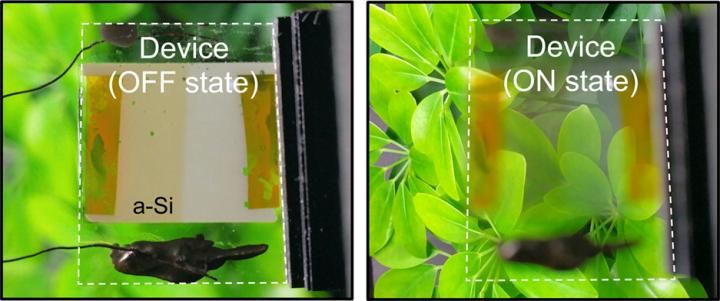
Scientists have developed a solar smart window that could power itself and other devices.
American Chemical Society
Most existing solar-powered smart windows are designed to respond automatically to changing conditions, such as light or heat. But this means that on cool or cloudy days, consumers can't flip a switch and tint the windows for privacy. Also, these devices often operate on a mere fraction of the light energy they are exposed to while the rest gets absorbed by the windows. This heats them up, which can add warmth to a room that the windows are supposed to help keep cool. Jeremy Munday and colleagues wanted to address these limitations.
The researchers created a new smart window by sandwiching a polymer matrix containing microdroplets of liquid crystal materials, and an amorphous silicon layer -- the type often used in solar cells -- between two glass panes. When the window is "off," the liquid crystals scatter light, making the glass opaque. The silicon layer absorbs the light and provides the low power needed to align the crystals so light can pass through and make the window transparent when the window is turned "on" by the user. The extra energy that doesn't go toward operating the window is harvested and could be redirected to power other devices, such as lights, TVs or smartphones, the researchers say.
Original publication


Other news from the department science




















Most read news












More news from our other portals


























Last viewed contents
Development of robot-based solutions for laboratory automation - University of Rostock and Yaskawa agree to continue their cooperation
Core technology springs from nanoscale rods

AI technique 'decodes' microscope images, overcoming fundamental limit - “We’ve given a proof-of-concept and shown how to use AI to significantly improve AFM images, but this work is only the beginning”

Sculpting with graphene foam
Moiré effect: How to twist material properties - 2D materials have triggered a boom in materials research. Now it turns out that exciting effects occur when two such layered materials are stacked and slightly twisted

When vibrations increase on cooling: Anti-freezing observed - Completely unusual and never observed like this before

DSM and LabTwin enter into cooperation - DSM chooses LabTwin to advance their digitalization strategy in Science & Innovation with the latest voice and AI solutions

Functional coatings from the plasma nozzle
Surface imaging technique illuminates potential improvements in plastics production - DESY's free-electron laser FLASH shows chemical changes in surfaces

enaDyne GmbH - Freiberg, Germany

Breakthrough in the simulation of complex quantum systems - A new method overcomes fundamental resolution limits and may provide insights into high-temperature superconductivity