Squeezing low-cost electricity from sustainable biomaterial
Advertisement


Mobile phone speakers and motion detectors in cars and video games may soon be powered by electricity generated from low cost and sustainable biomaterials, according to research carried out at University of Limerick (UL), Ireland.
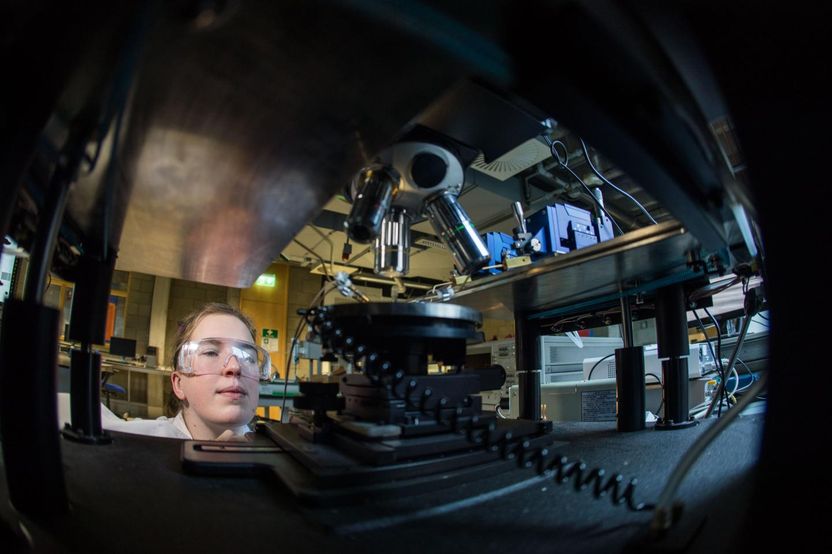
Mobile phone speakers and motion detectors in cars and video games may soon be powered by electricity generated from low cost and sustainable biomaterials, according to research carried out at University of Limerick (UL), Ireland. Scientists at UL's Bernal Institute have discovered that the biomolecule glycine, when tapped or squeezed, can generate enough electricity to power electrical devices in an economically viable and environmentally sustainable way. The research was published on Dec. 4, 2017 in leading international journal Nature Materials. Pictured is Sarah Guerin, Science Foundation Ireland funded post-graduate researcher at the Bernal Institute, UL.
Sean Curtin True Media
Scientists at UL's Bernal Institute have discovered that the biomolecule glycine, when tapped or squeezed, can generate enough electricity to power electrical devices in an economically viable and environmentally sustainable way.
Glycine is the simplest amino acid. It occurs in practically all agro and forestry residues. It can be produced at less than one per cent of the cost of currently used piezoelectric materials.

Piezoelectric materials generate electricity in response to pressure, and vice versa. They are widely used in cars, phones, and remote controls for games consoles. Unlike glycine, these materials are normally synthetic and often contain toxic elements such as lead or lithium.
"It is really exciting that such a tiny molecule can generate so much electricity," said lead author Sarah Guerin, a post-graduate student at the Department of Physics and the Bernal Institute, UL.
"We used computer models to predict the electrical response of a wide range of crystals and the glycine number was off the charts. We then grew long, narrow crystals of glycine in alcohol," she added, "and we produced electricity just by tapping them."
Sarah's PhD supervisor Dr Damien Thompson, adds, "The predictive models we are developing can save years of trial-and-error lab work. The modelling data tells us what kinds of crystals to grow and where best to cut and press those crystals to generate electricity."
Co-author and Science Foundation Ireland (SFI) Centre for Medical Devices (CURAM) investigator Professor Tofail Syed said: "We also have a pending patent that translates our findings to applications such as biodegradable power generation, devices detecting diseases inside of the body and physiologically controlled drug pumps".
Previously, Bernal scientists discovered piezoelectricity in the globular protein lysozyme, found in tears, egg-white and saliva, and hydroxyapatite, a component of bone.
"The current finding extends the technology towards pragmatic, low-cost, renewable sources for electricity generation," according to Professor Luuk van der Wielen, Director of the Bernal Institute and Bernal Professor of Biosystems Engineering and Design. "The finding translates the earlier Bernal scientists' world-leading contribution in bio-piezoelectricity towards a large-scale and affordable application potential."
Professor Edmond Magner, Dean of Science and Engineering at UL, said: "UL's Department of Physics and Bernal Institute researchers continue to pioneer the use of biological crystals for electrical applications. This work places them at the forefront in the development of bio-piezoelectric devices".
Original publication
Sarah Guerin, Aimee Stapleton, Drahomir Chovan, Rabah Mouras, Matthew Gleeson, Cian McKeown, Mohamed Radzi Noor, Christophe Silien, Fernando M. F. Rhen, Andrei L. Kholkin, Ning Liu, Tewfik Soulimane, Syed A. M. Tofail & Damien Thompson; "Control of piezoelectricity in amino acids by supramolecular packing"; Nature Materials; 2017


Other news from the department science




















Most read news












More news from our other portals


























Last viewed contents
Intense laser light modifies the pairing of electrons - Finding lights a way for bottom-up controlling chemical reactions with lasers in the future – based purely on electrons, the “glue” of chemistry
Microencapsulation produces uniform drug release vehicle

Scientists create rechargeable swimming microrobots using oil and water
Successful online marketing right from the start - As a Silver Sponsor of the Science4Life business plan competition, LUMITOS shares its expertise with entrepreneurs
Sensirion drives AI revolution in sensor technology - New partnership with Italian start-up Sintropy.ai and Repcom

Camels’ noses inspire a new humidity sensor - Device could reliably detect variations in humidity in settings that included industrial exhaust and the air surrounding human skin

New butterfly-inspired hydrogen sensor is powered by light - Light-activated sensor delivers precision results at room temperature: For medical applications and hydrogen economy
New technique paves way for imaging individual molecules - Pioneering experiment exploits quantum properties of X-ray light
Microswimmers move like moths to the light - Impressive behavior of synthetic microswimmers studied
Paper discs that can pick up hydrogen peroxide - “We are in touch with a start-up company in Chennai”

Thermal storage for the energy transition - The energy is not stored in the form of increased heat but in the form of a chemical state
