My watch list
my.chemeurope.com  
Login  

07-03-2013: A new way of preparing iron-nanoparticle catalysts, which could play an important role in converting greenhouse gases to useful organic compounds, has been developed by UK scientists.

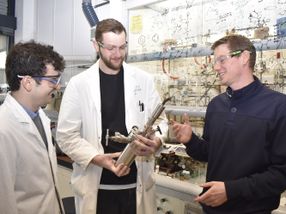
The catalyst comprises iron nanoparticles supported on carbon nanotubes. While such chemical architectures usually require multiple preparation steps, Dr Davide Mattia and co-workers have greatly simplified the procedure, using the same iron nanoparticle to both grow the nanotube and perform catalysis.

The catalyst facilitates the reaction of CO2 and CO – both gases contributing the greenhouse effect – with hydrogen, producing a mixture of useful organic starting materials. In a world where oil is an increasingly expensive resource, chemistry such as this could provide an economically viable route towards cleaner organic synthesis, as well as a use for sequestered CO2 from carbon capture and storage projects.
 

Original publication:
D Mattia, Catal. Sci. Technol., 2013

Contact / Request information

Request further information free of charge:

Watchlist

This is where you can add this news to your personal favourites

Additional Information

Facts, background information, dossiers
More about University of Bath
Contact
University of Bath


United Kingdom
  • News

    Thermally Stable Solar Cell Materials

    European researchers have developed a simple thermodynamic method to predict whether a substance can resist the high temperatures normally involved in the production of thin films for photovoltaic devices. The new approach could help scientists in their search for better energy materials. J ... more

    Cracking a controversial solid state mystery

    Scientists can easily explain the structural order that makes steel and aluminium out of molten metal. And they have discovered the molecular changes that take place as water turns to ice. But, despite the fact that glass blowers have been plying their trade since the first century BC, we h ... more

    Mechanical calculations for methyl transfer in solution

    Ian Williams and colleagues at the University of Bath, UK, have demonstrated that kinetic isotope effects (KIEs) for a prototypical S­N­2 methyl transfer in solution, and in an enzyme active site, show significant variations in magnitude owing to thermally-induced structural fluctuations. ... more

More about Royal Society of Chemistry
Contact
Royal Society of Chemistry (RSC)
Milton Road
CB4 0WF Cambridge
United Kingdom
Phone
++44 / 1223 / 432360
Fax
++44 / 1223 / 426017
  • News

    Bacterium breaks down grass into biofuel

    Research reports the discovery of the first microorganism that anaerobically degrades plant biomass, without the need for chemical pre-treatment, to produce raw materials that can be converted to biofuels. Scientists in the United States demonstrated that Caldicellulosiruptor bescii bacteri ... more

    Volcano pollution could lead to Parkinson’s misdiagnosis

    Research suggests that the effects of pollution from eruptions from Mount Etna could be leading to misdiagnosis of Parkinson’s disease in the surrounding area. Scientists in Italy used X-ray photoelectron spectroscopy (XPS) for the first time to investigate the chemical composition of the s ... more

    Nano-tattoos for bespoke surface design

    Research reports a new strategy for using atomic force microscopy (AFM) coupled with homogeneous catalysis to carry out chemical reactions that have been ‘tattooed’ onto a material surface. Researchers in France immobilised a homogeneous transition metal catalyst onto an AFM probe and used ... more

  • Companies

    Royal Society of Chemistry (RSC)

    The RSC is a leading international publisher of highly regarded journals and books in the chemical sciences. The RSC is also the professional body for chemists with a global membership of over 46,000. more

Your browser is not current. Microsoft Internet Explorer 6.0 does not support some functions on Chemie.DE