Engineers make first 'active matrix' display using nanowires
Advertisement


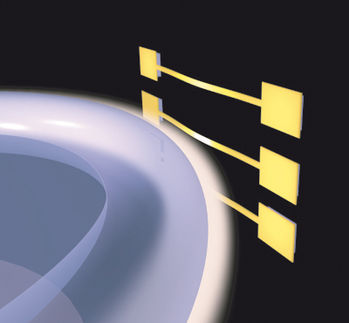
Engineers have created the first "active matrix" display using a new class of transparent transistors and circuits, a step toward realizing applications such as e-paper, flexible color monitors and "heads-up" displays in car windshields. The transistors are made of "nanowires," tiny cylindrical structures that are assembled on glass or thin films of flexible plastic. The researchers used nanowires as small as 20 nanometers to create a display containing organic light emitting diodes, or OLEDS. The OLEDS are devices that rival the brightness of conventional pixels in flat-panel television sets, computer monitors and displays in consumer electronics.
"This is a step toward demonstrating the practical potential of nanowire transistors in displays and for other applications," said David Janes, a researcher at Purdue University's Birck Nanotechnology Center and a professor in the School of Electrical and Computer Engineering.
The nanowires were used to create a proof-of-concept active-matrix display similar to those in television sets and computer monitors. An active-matrix display is able to precisely direct the flow of electricity to produce video because each picture element, or pixel, possesses its own control circuitry.
"We've shown how to fabricate nanowire electronics at room temperature in a simple process that might be practical for commercial manufacturing," said Tobin J. Marks, the Vladimir N. Ipatieff Research Professor in Chemistry in Northwestern's Weinberg College of Arts and Sciences and a professor of materials science and engineering.
Unlike conventional computer chips - called CMOS, for complementary metal oxide semiconductor chips - the nanowire thin-film transistors could be produced less expensively under low temperatures, making them ideal to incorporate into flexible plastics that would melt under high-temperature processing.
Conventional liquid crystal displays in flat-panel televisions and monitors are backlit by a white light, and each pixel acts as a filter that turns on and off to create images. OLEDS, however, emit light directly, eliminating the need to backlight the screen and making it possible to create more vivid displays that are thin and flexible.
The technology also could be used to create antennas that aim microwave and radio signals more precisely than current antennas. Such antennas might improve cell phone reception and make it more difficult to eavesdrop on military transmissions on the battlefield.
The nanowire transistors are made of a transparent semiconductor called indium oxide, a potential replacement for silicon in future transparent circuits. The OLEDS consist of the transistors, electrodes made of a material called indium tin oxide and plastic capacitors that store electricity. All of the materials are transparent until activated to emit light.
Originalk publication: Sanghyun Ju, Jianfeng Li, Jun Liu, Po-Chiang Chen, Young-geun Ha, Fumiaki Ishikawa, Hsiaokang Chang, Chongwu Zhou, Antonio Facchetti, David B. Janes, Tobin J. Marks; "Transparent Active Matrix Organic Light-Emitting Diode Displays Driven by Nanowire Transistor Circuitry"; Nano Letters 2008.


Other news from the department science













Most read news








More news from our other portals




























Last viewed contents

Are critical raw materials for EVs less critical than previously thought? - A 15-year analysis identifies four innovation leaps that repeatedly reshaped which raw materials the market relies on

New 'blue-green' solution for recycling world's batteries - Scientists show solvent leaches cobalt, lithium for reuse from spent batteries
