Photocatalyst system for plastics production
Properties of recyclable plastics can be defined by the wavelength
Advertisement


A research team from Berlin has developed a novel catalyst system, which enables the regulation of multiple polymerization processes to produce biodegradable plastics solely by illumination with light of different colors.
The properties of a polymeric material are highly dependent on factors, such as the connected monomer building blocks as well as the length and composition of the formed polymer chains. Typically, these factors are predetermined by the choice of the employed reaction conditions. In order to overcome this limitation and generate materials with new and unprecedented properties, regulation of polymerizations by means of external stimuli represents an attractive goal. Similarly to dental repair, light serves to precisely control the location and duration of the chemical reaction during polymer formation.
A new method for the light-regulated production of biodegradable polymers has now been developed by chemists of the Humboldt-Universität zu Berlin (HU), the Federal Institute for materials research and Testing Berlin, and the Heinrich-Heine-Universität Düsseldorf. Their work is based on the design of a unique catalyst, which is capable to change its activity reversibly by illumination with light of different wavelength. Using their catalyst, the scientists were able to turn the formation of polylactide on and off on demand, which allowed them to control the chain length of the produced polymer strands. Moreover and for the first time, they were able to regulate the incorporation of two different monomers into the same polymeric backbone with light.
Fabian Eisenreich and Michael Kathan from the department of chemistry at the HU and first authors of the study explain: “With our remote-controlled catalyst we are in principle able to program the formation of the desired polymer strand by employing a specific order and duration of light pulses.” Their promising development is an important step toward smart production processes of (biodegradable) polymers with the aim to meet the growing demands of future applications, including light-guided 3D printing.
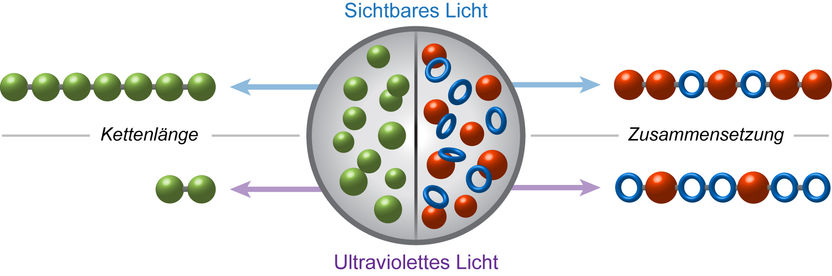
With the aid of a photoswitchable catalyst system, both the chain length (left) and the composition (right) of the polymers formed can be controlled by light of different wavelengths.
Fabian Eisenreich
Original publication


Other news from the department science




















Most read news












More news from our other portals


























Last viewed contents

RUDN University chemist created a catalyst from orange peel for organic compounds production

Charged “molecular beasts” the basis for new compounds - Researchers use “aggressive” fragments of molecular ions for chemical synthesis
Sustainable raw material supply: New FlashPhos process converts sewage sludge into phosphorus for industrial use

Adhesives from waste wood, biofuel from straw - EU research project on the potential of agroforestry waste as environmentally friendly raw materials completed
Solar cells for the Internet of Things - Seed capital and (more) customers for Empa spin-off
HZB Sets New World Record for CIGS Perovskite Tandem Solar Cells - "We are confident that CIGS-perovskite tandem cells can achieve much higher efficiencies..."
Catalyst selectivity as a “balancing act” - The study suggests a shift in how chemists should think about heterogeneous catalysis
EcoBean: Brewing sustainable chemicals from coffee grounds - Reducing the environmental impact of the chemical and coffee industry: OHAUS as partner
The chameleon effect: Sustainable sensors and displays - An elastic material that changes color, conducts electricity, can be 3D printed and is also biodegradable?

Intertek Group plc - London, United Kingdom