Illinois engineers protect artifacts by graphene gilding
Advertisement


Gilding is the process of coating intricate artifacts with precious metals. Ancient Egyptians and Chinese coated their sculptures with thin metal films using gilding--and these golden sculptures have resisted corrosion, wear, and environmental degradation for thousands of years. The middle and outer coffins of Tutankhamun, for instance, are gold leaf gilded, as are many other ancient treasures.
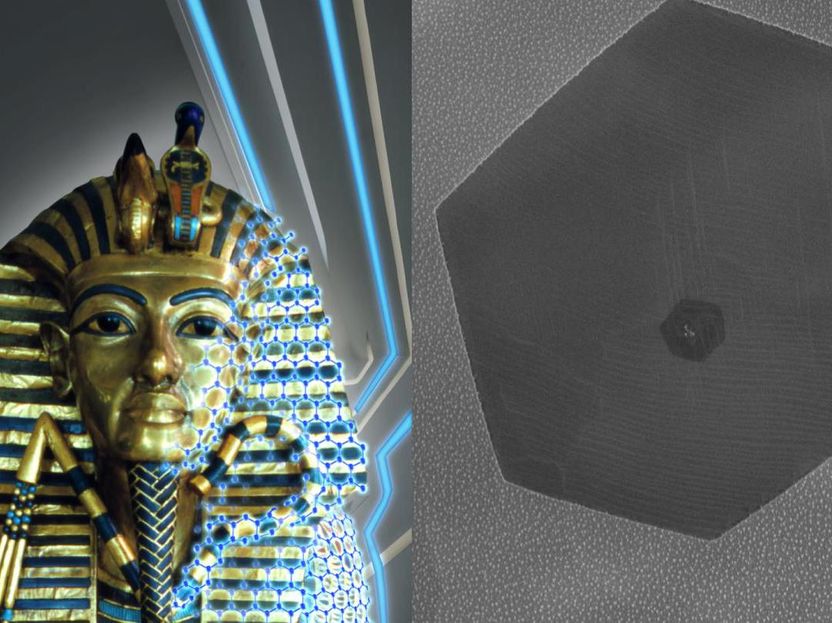
L: An artist rendering of graphene gilding on Tutankhamun's middle coffin (original photograph copyright: Griffith Institute, University of Oxford). R: Microscope image of a graphene crystal is shown on the palladium leaf. Although graphene is only a single atom thick, it can be observed in the scanning electron microscope. Here, a small crystal of graphene is shown to observe its edges. The team produces leaves where the graphene fully cover the metal surface.
Original photograph copyright: Griffith Institute, University of Oxford
In a new study, Sameh Tawfick, an assistant professor of Mechanical Science and Engineering at the University of Illinois at Urbana-Champaign, inspired by this ancient process, has added a single layer of carbon atoms, known as graphene, on top of metal leaves--doubling the protective quality of gilding against wear and tear.
The study, "Gilding with Graphene: Rapid Chemical Vapor Deposition Synthesis of Graphene on Thin Metal Leaves," is published in the journal Advanced Functional Materials. The researchers coated thin metal leaves of palladium with a single layer of graphene.
Metal leaves, or foils, offer many advantages as a scalable coating material, including their commercial availability in large rolls and their comparatively low price. By bonding a single layer of graphene to the leaves, Tawfick and his team demonstrated unexpected benefits, including enhanced mechanical resistance. Their work presents exciting opportunities for protective coating applications on large structures like buildings or ship hulls, metal surfaces of consumer electronics, and small precious artifacts or jewelry.
"Adding one more layer of graphene atoms onto the palladium made it twice as resistant to indents than the bare leaves alone," said Tawfick. "It's also very attractive from a cost perspective. The amount of graphene needed to cover the gilded structures of the Carbide & Carbon Building in Chicago, for example, would be the size of the head of a pin."
Additionally, the team developed a new technology to grow high-quality graphene directly on the surface of 150 nanometer-thin palladium leaves--in just 30 seconds. Using a process called chemical vapor deposition, in which the metal leaf is processed in a 1,100°C furnace, the bare palladium leaf acts as a catalyst, allowing the gases to react quickly.
"Chemical vapor deposition of graphene requires a very high temperature, which could melt the leaves or cause them to bead up by a process called solid state dewetting," said Kaihao Zhang, PhD candidate in MechSE and lead author of the study. "The process we developed deposits the graphene quickly enough to avoid high-temperature degradation, it's scalable, and it produces graphene of very high quality."
Original publication


Other news from the department science



















These products might interest you

Most read news












More news from our other portals


























Last viewed contents

Advanced Automation Technologies (AAT) to rebrand under new name - Velaris - Over the past three years, the platform has strategically acquired six leading companies in adjacent markets
Sustainable recycling of battery raw materials - Analytik Jena participates in EU/Thuringia-funded “ZirKat” project

POLYVANTIS Celebrates Birth of New Company

Longer-lasting and more sustainable green hydrogen production - The findings impact the ability to achieve a lasting and sustainable hydrogen-based energy economy
Merck and Mulliken Center for Theoretical Chemistry Collaborate in Machine Learning Project - The three-year collaboration will focus on the development of new tools for computational chemistry modelling as well as new molecular representations
Self-assembled superlattices create molecular machines with 'hinges' and 'gears'

On the way to sustainable chemistry? Iron makes it possible - Hydroformylation of olefins using iron catalysis and light
3M to sell pressurized polyurethane foam adhesives business
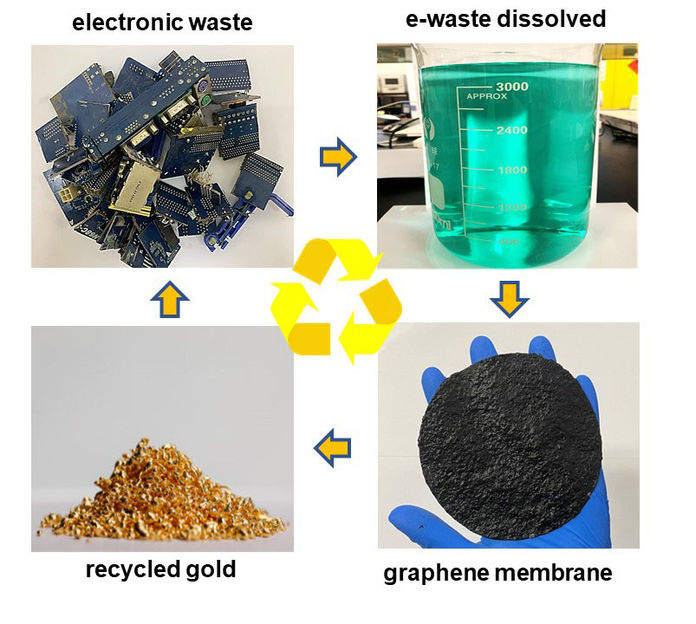
Graphene as 'the philosopher’s stone’: turning waste into gold - "This apparent magic is essentially a simple electrochemical process"

Cleaner air as a result of coronavirus lockdown - Lockdowns in early summer 2020 meant that the amount of soot in the atmosphere, which is harmful to the climate and to health, almost halved
DSM and Chemtrix sign collaboration agreement in Continuous Flow Chemistry