Showtime for photosynthesis
One of nature's most important chemical reactions is now being captured in a breakthrough 'molecular movie'
Advertisement


Using a unique combination of nanoscale imaging and chemical analysis, an international team of researchers has revealed a key step in the molecular mechanism behind the water splitting reaction of photosynthesis, a finding that could help inform the design of renewable energy technology.
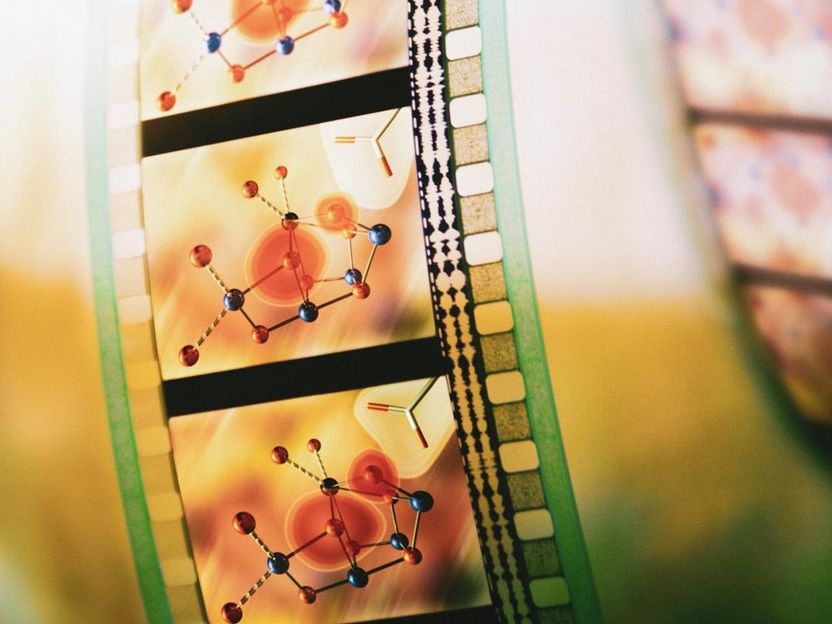
Illustration
Greg Stewart/SLAC National Accelerator Laboratory
"Life depends on the oxygen that plants and algae split from water; how they do it is still a mystery, but scientists, including our team, are slowly peeling away the layers to get to the answer," said Vittal K. Yachandra, co-lead author of a new study published in PNAS and a chemist senior scientist at the Department of Energy's (DOE) Lawrence Berkeley Laboratory (Berkeley Lab). "If we can understand this step of natural photosynthesis, it would enable us to use those design principles for building artificial photosynthetic systems that produce clean and renewable energy from sunlight and water."
With an instrument that the team designed and fabricated, they analyzed photosynthetic proteins using both X-ray crystallography and X-ray emission spectroscopy. This dual approach, which the team pioneered and have been refining for the past 10 years, generates chemical and protein structure information from the same sample at the same time. The imaging was performed with the X-ray free-electron laser (XFEL) at the LCLS at SLAC National Laboratory, and at SACLA in Japan.
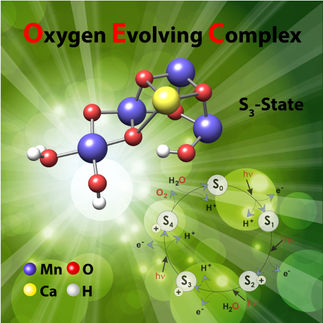
"With this technique, we get the overall picture of how the entire protein structure dynamically changes and we see the chemical intricacies occurring at the reaction site," said co-lead author Junko Yano, a chemist senior scientist in Berkeley Lab's Molecular Biophysics and Integrated Bioimaging (MBIB) Division. "The X-ray free electron laser produces extremely bright, short bursts of X-rays that allow us to not only analyze a protein at room temperature, which is how these reactions occur in nature, but also capture various moments over the reaction time scale."
Traditional crystallography methods often require the sample proteins to be frozen; consequently, they can only generate snapshots of static proteins. This limitation makes it difficult for scientists to get a handle on how proteins actually behave in living organisms, because the molecules morph between different physical states during chemical reactions.
"The water-splitting reaction in photosynthesis is a cyclical process that needs four photons and cycles between four stable 'states,'" said Yano. "Previously, we could only take pictures of these four states. But by taking multiple snapshots in time, we now can visualize how one state goes to the other."
"We saw, really nicely, how the structure changes step-by-step as it transforms from one state to the next state," said Jan F. Kern, MBIB chemist and co-author. "It is pretty exciting, because we can see the 'cause and effect' and the role that each moving atom plays in this transition."
Nicholas K. Sauter, co-author and MBIB computational senior scientist, added: "Essentially, we're trying to take a 'movie' of a chemical reaction. We made a lot of progress to get to this point, in terms of our technology and our computational analyses. The work of our co-author Paul Adams and others in MBIB was critical to interpreting the XFEL and X-ray data. But we still have to get the other frames to see how the reaction is completed and the enzyme is ready for the next cycle."
The Berkeley Lab researchers hope to continue the project once the many research sites that the entire international team relies upon - located in the U.S., Japan, Switzerland, and South Korea - are operating normally following the COVID-19 pandemic.
Kern concluded by noting that the technological milestone presented in this paper benefited greatly from the diverse expertise of the authors from SLAC, Uppsala and Umeå Universities in Sweden, Humboldt University in Germany, and from the capabilities of five DOE Office of Science user facilities: the Stanford Synchrotron Radiation Lightsource and LCLS at Stanford University, and the Advanced Light Source, Energy Sciences Network, and National Energy Research Scientific Computing Center at Berkeley Lab.
Original publication


Other news from the department science





















Most read news












More news from our other portals

























See the theme worlds for related content
Topic world Synthesis
Chemical synthesis is at the heart of modern chemistry and enables the targeted production of molecules with specific properties. By combining starting materials in defined reaction conditions, chemists can create a wide range of compounds, from simple molecules to complex active ingredients.
Topic world Synthesis
Chemical synthesis is at the heart of modern chemistry and enables the targeted production of molecules with specific properties. By combining starting materials in defined reaction conditions, chemists can create a wide range of compounds, from simple molecules to complex active ingredients.
Last viewed contents
Swiss start-up Oxyle commissions first complete PFAS destruction system - Key milestone for Oxyle: the company scales its solution to solve PFAS problems on an industrial scale around the world
High-speed imaging of microchips - Novel method enables fast X-ray scans of large objects with nanometre resolution
Initial energy efficiency index for the German Industry published - High sensitivity – little action
First brew beer, then store energy - Chemists create carbon materials for energy storage device from brewery waste
Artificial Intelligence has learned to estimate oil viscosity - Indirect measurements are a lucky alternative for a variety of sectors
‘Smart plastic’ material is step forward toward soft, flexible robotics and electronics - A new plastic-like material can be manipulated to be soft and stretchy or hard and rigid with only the application of a catalyst and visible light
Exotic vibrations in new materials - New insights show universal applicability of carbyne as a sensor
BASF increases price for Vitamin B2

First controllable nanoscale gas-liquid interface fabricated
Biodiesel made from discarded cardboard boxes - Development of a microorganism that doubles the yield of biodiesel precursor production using genetic scissors and based on the principles of evolution

Breakthrough for efficient and high-speed spintronic devices - New soft X-ray source could be used for many applications in physics, chemistry, and biology