Scientists create rechargeable swimming microrobots using oil and water
Advertisement


By combining oil drops with water containing a detergent-like substance, the scientists found they could produce artificial swimmers that are able to swim independently and even harvest energy to recharge.
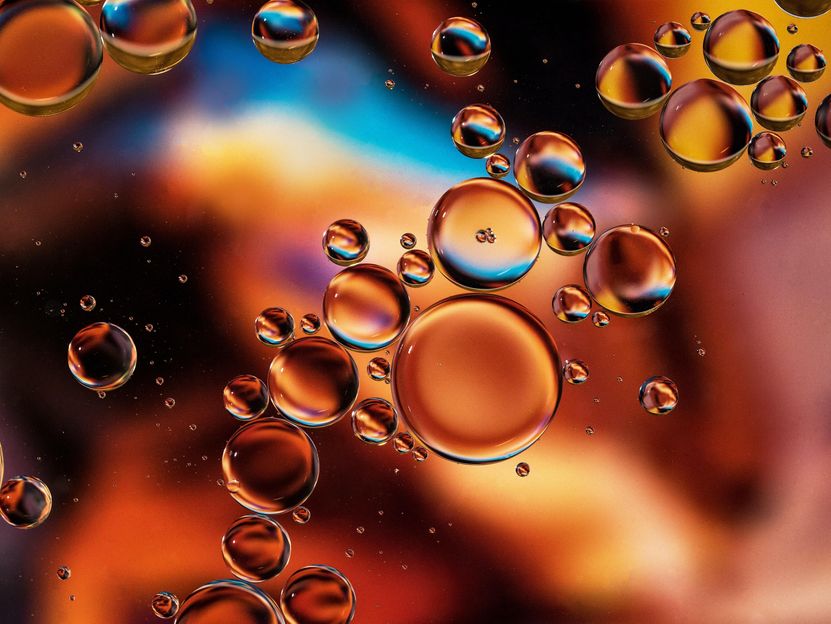
Symbolic image
Unsplash
The oil droplets use fluctuating temperature changes in their surrounding environment to store energy and to swim. When cooled, the droplets release thin 'tail-like' threads into the environment. The friction generated between the tails and surrounding fluid, pushes the droplet causing them to move. On heating, the droplets then retract their tails returning to their original state, and harness the heat from their environment to recharge.
The researchers show that the droplets recharge multiple times and are able to swim for periods of up to 12 minutes at a time.

Dr Stoyan Smoukov, Reader in Chemical Engineering at Queen Mary University of London and author of the study, said: "In biology, research shows that to create even the simplest artificial cells we need over 470 genes. However, through this international collaboration, we show that just by using a few simple and inexpensive components we can create a new type of active matter that can change shape and move just like a living thing."
"We hope that this study will open up the opportunity for people to engage in cutting-edge science. As the only equipment needed is a simple optical microscope, people could create these microswimmers with the most basic laboratory set-ups, or even at home. With thousands of swimmers per drop of water, it's a world in a drop situation. And when it costs 7p per teaspoon, there's plenty for everyone."
Other types of artificial swimmers exist however their movements are either driven by chemical reactions, which create bubbles that propel the swimmers through fluids, or by physical forces such as magnetic or electric fields. Instead, this new class of swimmers, which are around the size of a red blood cell, are able to spontaneously assemble and move without using external forces.
As the swimmers are not harmful to other living things, the scientists hope they could be used to study the basic interactions between living organisms such as bacteria and algae.
"In nature we often see large numbers of organisms such as bacteria, grouping together but our understanding of how these organisms interact with each other is incomplete. By mixing our simple artificial swimmers with groups of living organisms we could develop a clearer picture of how biological microswimmers communicate with each other. For example, do they only communicate due to the physical act of 'bumping' into each other, or are there other chemicals or signals released into the environment essential for their interaction."
Original publication


Other news from the department science




















Most read news












More news from our other portals


























Last viewed contents

Successful online marketing right from the start - As a Silver Sponsor of the Science4Life business plan competition, LUMITOS shares its expertise with entrepreneurs
Sensirion drives AI revolution in sensor technology - New partnership with Italian start-up Sintropy.ai and Repcom

Camels’ noses inspire a new humidity sensor - Device could reliably detect variations in humidity in settings that included industrial exhaust and the air surrounding human skin

New butterfly-inspired hydrogen sensor is powered by light - Light-activated sensor delivers precision results at room temperature: For medical applications and hydrogen economy
New technique paves way for imaging individual molecules - Pioneering experiment exploits quantum properties of X-ray light
Microswimmers move like moths to the light - Impressive behavior of synthetic microswimmers studied
Paper discs that can pick up hydrogen peroxide - “We are in touch with a start-up company in Chennai”

Thermal storage for the energy transition - The energy is not stored in the form of increased heat but in the form of a chemical state

Self-healing, flexible electronic material restores functions after many breaks
An engineered surface unsticks sticky water droplets
Sinopec and SIBUR plan two joint ventures and extend their cooperation