Chemistry discovery could remove micropollutants from environment
Researchers made an unexpected breakthrough discovery
Advertisement


Using a pioneering imaging technique, Cornell University researchers obtained a high-resolution snapshot of how ligands, molecules that bind to other molecules or metals, interact with the surface of nanoparticles. In doing so, they made an unexpected breakthrough discovery. They determined that by varying the concentration of an individual ligand they could control the shape of the particle it attached too.
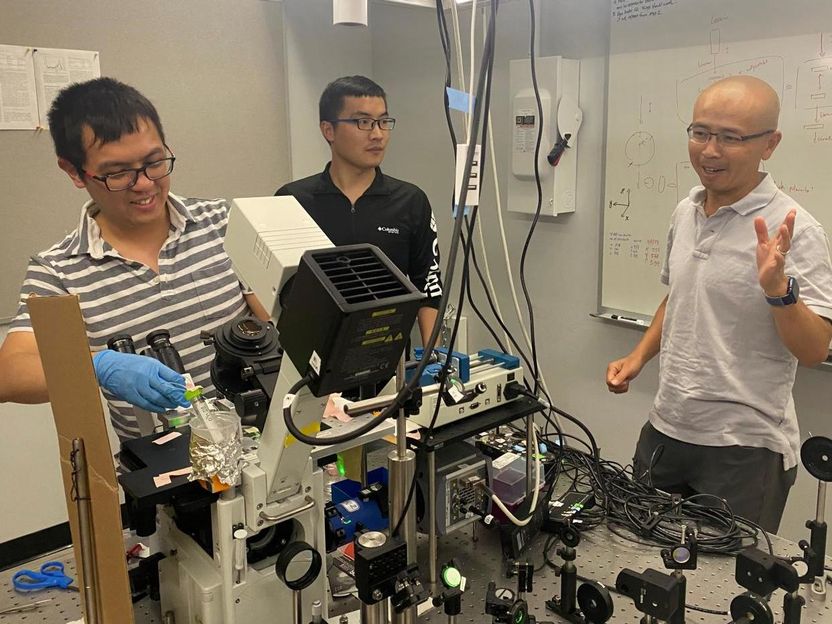
Dr. Rong Ye (left), Dr. Ming Zhao (center), and Dr. Peng Cheng (right) at Cornell discuss their Army-funded research that identifies a new chemistry approach that could remove micropollutants from the environment.
Cornell University
This approach could result in an array of daily applications, including developing chemical sensors that are sensitive at a very low level to a specific chemical in the environment.
"Professor Peng Chen's work allows for deep insights into molecular adsorption processes, which is important to understand for designing molecular sensors, catalysts, and schemes to clean up micro-pollutants in the environment," said Dr. James Parker, program manager, U.S. Army Combat Capabilities Development Command, known as DEVCOM, Army Research Laboratory. "This research is also important for designing and engineering stimuli-responsive materials with specialized function that could not be found in regular, bulk materials."
The research, published in Nature Communications, studied interactions of ligands and gained new understanding of the strength, or affinity of ligand adsorption as well as how multiple ligands cooperate, or don't, with each other.
"When the molecule adsorbs on the surface of a nanoscale material, it also actually protects the surface and makes it more stable," said Dr. Peng Chen, the Peter J.W. Debye Professor of Chemistry in the College of Arts and Sciences at Cornell University, who led the research. "This can be utilized to control how nanoscale particles grow and become their eventual shape. And we found we can do this with just one ligand. You don't do any other trick. You just decrease the concentration or increase the concentration, and you can change the shape."
Understanding how ligands interact with the surface of nanoparticles has been a challenge to study. Adsorbed ligands are difficult to identify because there are other molecules in the mix, and nanoparticle surfaces are uneven and multifaceted, which means they require incredibly high spatial resolution to be scrutinized.
A nanoparticle's size and surface structures, or facets, are intrinsically tied to the particle's potential applications. The larger the particle, the more atoms fit inside it, while smaller particles have less available space internally but a greater surface volume ratio for atoms to sit atop, where they can be utilized for processes such as catalysis and adsorption. The different types of structures the atoms and molecules form on these surface facets are directly correlated with the particle's shape.
Army-funded research identifies a new chemistry approach that could remove micropollutants from the environment.
Scientists have used several imaging methods to survey these particles, but until now, they haven't been able to obtain nanometer resolution to really explore the nooks and crannies of the multiple surface facets and quantify the affinity, or strength, of a ligand's adsorption. The research team was able to do just that by employing a method of their own devising called COMPetition Enabled Imaging Technique with Super-Resolution or COMPEITS.
The process works by introducing a molecule that reacts with the particle surface and generates a fluorescent reaction. A nonfluorescent molecule is then sent to bind to the surface, where its reaction competes with the fluorescent signal. The resulting decrease in fluorescence, essentially creating a negative image, can then be measured and mapped with super high resolution.
Using COMPEITS on a gold nanoparticle, the team was able to quantify the strength of ligand adsorption, and they discovered ligand behavior can be very diverse. Ligands, it turns out, are fair-weather friends of a sort, at some sites they cooperate to help each other adsorb, but at other sites they can impair each other's efforts. The researchers also discovered that sometimes this positive and negative cooperativity exists at the same site.
In addition, the researchers learned that the surface density of adsorbed ligands can determine which facet is dominant. This crossover inspired the team to vary the concentrations of individual ligands as a way to tune the shape of the particle itself.
"For us, this has opened more possibilities," Chen said. "For example, one way to remove micropollutants, such as pesticides, from the environment is to adsorb micro-portions on the surface of some adsorbent particle. After it is adsorbed on the surface of the particle, if the particle is a catalyst, it can catalyze the destruction of the micropollutants."
Original publication



Other news from the department science





















Most read news












More news from our other portals

























Last viewed contents
Increases Evonik’s global hydrogen peroxide capacity by approx. 30 percent - Evonik’s new hydrogen peroxide plant officially opened in Jilin

Researchers turn coffee and plastic waste into climate solution - “What begins with a Starbucks coffee cup and a discarded plastic water bottle can become a powerful tool in the fight against climate change...”

Team develops bioprocess for converting plant materials into valuable chemicals

Wonder material graphene claims yet another superlative
Magnets trump metallics - Magnetic fields can block conductivity of carbon nanotubes

Cellphone converts into powerful chemical detector - With only $50 worth of components, an ordinary cellphone transforms into a sophisticated scientific instrument, capable of identifying chemicals, drugs, and pathogens
Dual-function organic molecule may advance display technologies and medical imaging - Researchers overcome a long-standing molecular design challenge by realizing efficient light emission and photon absorption in the same compound.

Cylib selected as Strategic Project under EU Critical Raw Materials Act - cylib is building a facility in Dormagen designed to process up to 140,000 EV batteries per year
Advanced X-ray technique unveils fast solid-gas chemical reaction pathways
BASF invests in alkoxylate capacity expansion
PerkinElmer Acquires C&A Service Solutions Ltd.