Start-up recycles plastic lab waste into new test tubes and petri dishes
University of Bath is home to UK’s first pilot plant for recycling plastic lab waste

Advertisement


A company co-founded by a University of Bath graduate has opened the UK’s first pilot plant that can recycle up to 60% of plastic lab waste, to make back into new lab consumables. LabCycle hopes the technology could be scaled up in the future to recycle waste from healthcare, research and commercial labs that is currently incinerated or sent to landfill.

The UK's first pilot recycling facility for single-use plastic lab waste is based in a repurposed greenhouse on the University of Bath campus.
LabCycle
To avoid cross-contamination between experiments, most lab-based scientists use a significant amount of single-use plastic in their daily research, including pipette tips, test tubes, petri dishes and multi-well plates. Currently, less than 1% of this waste is being recycled.
LabCycle, a start-up company co-founded by former University of Bath PhD student Dr Helen Liang, aims to recycle up to 60% of this waste, turning it into high grade plastic pellets which can be used to make new tubes and petri dishes.
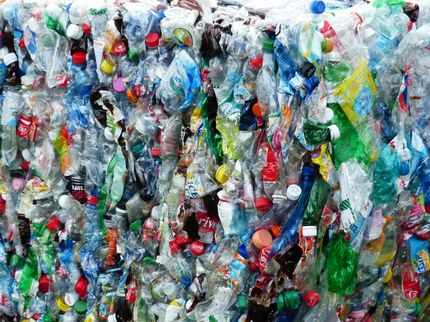
After decontamination, the plastic is turned into high grade pellets the size of rice grains, which are sent to LabCycle’s manufacturing partner to turn into new lab equipment.
Their unique recycling process doesn’t require waste to be autoclaved (sterilised) beforehand meaning that less heat energy is needed. Water usage is also minimised through recycling, further reducing the environmental impact.
Their recent collaboration with the University of Bath’s Innovation Centre for Applied Sustainable Technologies (iCAST) has tested the properties of recycled polystyrene (PS), polypropylene (PP) and polyethylene terephthalate (PET) and shown that the polymers are suitable to go full circle and be used to make new lab consumables.
Dr Liang said: “Adopting a circular economy approach involves optimising laboratory practices to minimise waste generation and resource consumption.
“Research and healthcare workers can focus on reducing and reusing single-use plastic items when possible."
“Additionally, proper waste segregation should be emphasised to enable recycling. Encouragingly, more than 90% of our survey participants from the research and healthcare sectors have indicated strong motivation on single-use plastic waste recycling.”
Dr Liang, who obtained a PhD in Sustainable & Circular Technologies from the University of Bath in 2022, met her fellow co-founders and came up with the idea for the company at a SETsquared workshop in 2019.
Since then, LabCycle has secured funds of around £430k to develop the technology and start the commercialisation process.
Following a successful pilot project recycling single-use plastic waste from three labs at the University of Bath in 2022, the team is working to roll out the service commercially.
With support from the Faculty of Science, iCAST and Campus Infrastructure team at the University of Bath, LabCycle has set up a pilot recycling plant in a converted greenhouse on campus and plans to implement waste recycling for its science and engineering labs.
They are also working with the local NHS Blood and Transplant to recycle waste from their laboratories.
Dr Liang said: “We’re very excited to open our new pilot facility and realise our vision of creating a circular economy for plastic consumables in the research and healthcare sectors. We are sincerely grateful for the support from the University of Bath.”
Dr Fabienne Pradaux-Caggiano, Technical Supervisor in the University’s Department of Chemistry said: “The idea that we are now able to recycle the single use plastic from our research labs onsite is really exciting and will be our small but significant way to have an impact on climate change without compromising our research.
“Dr Liang has been a delight to work with and we fully supported her in her endeavour from the very start. She has proven her concept is strong and very valuable for the environment.
“I can’t wait to see Labcycle expand and thrive both within the University and on a wider scale!”


Other news from the department science



















These products might interest you



Most read news












More news from our other portals


























Something is happening in the chemical industry ...
This is what true pioneering spirit looks like: Plenty of innovative start-ups are bringing fresh ideas, lifeblood and entrepreneurial spirit to change tomorrow's world for the better. Immerse yourself in the world of these young companies and take the opportunity to get in touch with the founders.
Last viewed contents
Automated measurement system enhances quality, reduces handling in Pu-238 production
BASF increases prices in Europe for Dimethylaminopropylamine and Dimethylacetamide
A pioneering spectrometer for hard X-rays at European XFEL - "The new spectrometer opens up completely new spectroscopic possibilities at high X-ray energies"

How to tell if that plastic bottle or bag has recycled material in it
Researchers use failed batteries to fight “forever chemicals” - Studying how battery components degrade created a powerful new way to destroy PFAS

LANXESS and TotalEnergies to cooperate on sustainable styrene - Target 2050: Fully climate-neutral raw materials

Sea foam could contain more ‘forever chemicals’ than water below
Novel synthesis of fluorinated molecules with potential in drug research developed - The new synthetic method relies on two fundamentally challenging chemical processes
New Insights Into the Hydrogen Bonding of Hydrogen Sulphide - What do ice cubes in a drink have to do with the smell of grandma's famous egg salad?
A new rule for orbital formation in chemical reaction discovered
Bacterial glitter: New findings open up possibilities for sustainable color technologies - Predictions with artificial intelligence