Synthetic chemistry approach yields new compounds with potential biomedical applications
The study marks a significant advancement in chemical synthesis techniques, leveraging modern organic chemistry and engineered enzymes
Advertisement


Researchers at Rice University have successfully synthesized a group of natural compounds known as fusicoccanes. The molecules, found in various living organisms, exhibit diverse biological activities, including the ability to modulate protein-protein interactions within biological systems.

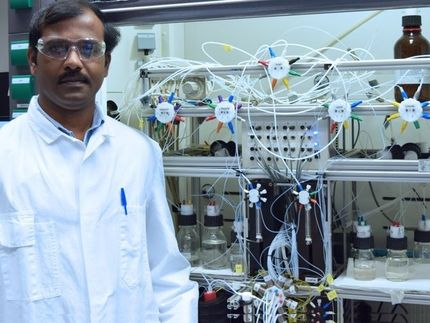
Yanlong Jiang and Hans Renata have synthesized a group of natural compounds known as fusicoccanes.
Photo by Jeff Fitlow/Rice University
The study led by Hans Renata, associate professor of chemistry, marks a significant advancement in chemical synthesis techniques, leveraging modern organic chemistry and engineered enzymes. The research was published May 6 in the journal Nature Chemistry.
The team synthesized 10 distinct fusicoccanes by a novel strategy that combines the synthesis of the compounds’ core structures through organic chemistry with the precise decoration of functional groups using enzymes.
“Our approach represents a fusion of traditional synthetic methods with cutting-edge enzymatic catalysis,” Renata said. “By harnessing the power of engineered enzymes, we’ve achieved the synthesis of these complex molecules and also paved the way for further chemical modifications.”
The researchers encountered challenges during the enzymatic phase of the synthesis as the chosen enzymes were initially unstable and led to undesirable side products. But through rigorous experimentation and enzyme engineering, they identified improved enzyme variants tailored to the synthetic process.
“This work demonstrates the importance of enzyme engineering in enabling the synthesis of biologically relevant compounds,” Renata said. “Our findings highlight the potential of a hybrid synthetic strategy for the development of new molecules with diverse applications.”
In addition to their direct application as modulators of protein-protein interactions, the synthesized compounds open avenues for exploring new drug candidates and understanding biological processes, lead author and postdoctoral researcher Yanlong Jiang said.
“Our methodology could inspire similar innovations in the synthesis of other valuable molecules, driving advancements in various fields,” Jiang said.
Original publication


Other news from the department science




















Most read news












More news from our other portals


























See the theme worlds for related content
Topic world Synthesis
Chemical synthesis is at the heart of modern chemistry and enables the targeted production of molecules with specific properties. By combining starting materials in defined reaction conditions, chemists can create a wide range of compounds, from simple molecules to complex active ingredients.
Topic world Synthesis
Chemical synthesis is at the heart of modern chemistry and enables the targeted production of molecules with specific properties. By combining starting materials in defined reaction conditions, chemists can create a wide range of compounds, from simple molecules to complex active ingredients.
Last viewed contents

Start-up recycles plastic lab waste into new test tubes and petri dishes - University of Bath is home to UK’s first pilot plant for recycling plastic lab waste
Automated measurement system enhances quality, reduces handling in Pu-238 production
BASF increases prices in Europe for Dimethylaminopropylamine and Dimethylacetamide
A pioneering spectrometer for hard X-rays at European XFEL - "The new spectrometer opens up completely new spectroscopic possibilities at high X-ray energies"

How to tell if that plastic bottle or bag has recycled material in it
Researchers use failed batteries to fight “forever chemicals” - Studying how battery components degrade created a powerful new way to destroy PFAS

LANXESS and TotalEnergies to cooperate on sustainable styrene - Target 2050: Fully climate-neutral raw materials

Sea foam could contain more ‘forever chemicals’ than water below
Novel synthesis of fluorinated molecules with potential in drug research developed - The new synthetic method relies on two fundamentally challenging chemical processes

New Insights Into the Hydrogen Bonding of Hydrogen Sulphide - What do ice cubes in a drink have to do with the smell of grandma's famous egg salad?
A new rule for orbital formation in chemical reaction discovered