Take ... Baking Powder! Simple Ingredients for a Chemical Hydrogen Storage System
Easy to Store and Transport

Advertisement


Researchers are still looking for an ideal way to safely and stably store hydrogen, the beacon of hope for the energy transition. Researchers from the Leibniz Institute for Catalysis in Rostock, LIKAT, and the company H2APEX report on how this volatile and combustible gas can be tamed safely and with simple "ingredients" in the latest issue of NATURE COMMUNICATION. Together, they developed a homogeneous catalyst system with which they can bind hydrogen (H2) to potassium bicarbonate and thus store it chemically in a safe and stable manner. Bicarbonate is a salt of carbonic acid, commonly known as baking powder or baking soda.
The hydrogen reacts with bicarbonate in the described system in the presence of a ruthenium catalyst to formate, an equally harmless salt, namely that of formic acid. The highlight of the whole thing: "We can release the hydrogen stored in the formate again at any time - with the same catalyst, in the same system," explain Dr. Rui Sang and PhD student Carolin Stein, both first authors of the scientific publication, in an interview. Such a reaction, which can proceed in either direction, is called reversible.
According to research group leader Dr. Henrik Junge, the system works stably at temperatures of around 60 degrees Celsius. The reaction takes place in a solution containing all the chemical substances involved: Hydrogen and bicarbonate as well as the catalyst, which makes the reaction possible in the first place and is not consumed in the process itself. In the case of the latest publication, it is based on ruthenium and is commercially available. In the end, this solution also contains the newly formed formate - the actual H2 store.
The system is also easy to control technically, says Dr. Sponholz, Head of Research at H2APEX: "Depending on the pressure at which I add the hydrogen to the system, the gas is either bound to the bicarbonate to form formate or the reaction is reversed and the formate releases the hydrogen again."
Easy to Store and Transport
Hydrogen plays a key role in alternative energy supply scenarios. And methanol, ammonia and methane are being discussed as storage media for a future hydrogen economy. Formic acid salts have an advantage over these storage media in terms of the toxicity of the substances and energy consumption. Formate could be easily stored in plastic containers and transported in tankers. Henrik Junge says: "Basically like milk, beer or diesel."
Together with the bicarbonate, the formate forms an energy system that is charged or discharged via hydrogen like a battery. Such a system is actually suitable for use in local, rural areas in particular. There, wind power or solar energy can produce green hydrogen via electrolysis during phases when more electricity is supplied than is consumed, which is then stored as formate.
In the cooperation between LIKAT and H2APEX, one of the researchers' aims is to store as much hydrogen as possible in the formate. This is influenced by the storage density, solubility and "molarity" of the salt used, properties which in turn depend on its "counter ion". This is because salts usually consist of ions of opposite charge, the cation and the anion.
After testing several candidates and weighing up the pros and cons, the decision was made to use potassium, says Dr. Peter Sponholz. The salt that is charged with hydrogen in the "battery" is therefore precisely called potassium bicarbonate. By the way: baking powder for the kitchen usually contains sodium bicarbonate.
40 Cycles for a Climate-neutral Process
The authors emphasize that the process is CO2 -neutral. Normally, when hydrogen is recovered, some of the bicarbonate is decomposed into CO2 and released, explains Carolin Stein. "Our system, on the other hand, holds the CO2 permanently." This means that pure hydrogen can be obtained from this storage system, which can be used directly in a fuel cell without further purification.
In their NATURE COMMUNICATION PAPER, the authors report 40 consecutive cycles of hydrogen storage and release over a period of six months. Using minimal amounts of the ruthenium catalyst in the ppm range, the chemists produced 50 liters of hydrogen with an average purity of 99.5 percent with their laboratory system.
Future Demonstrator at the Transfer Technical Center
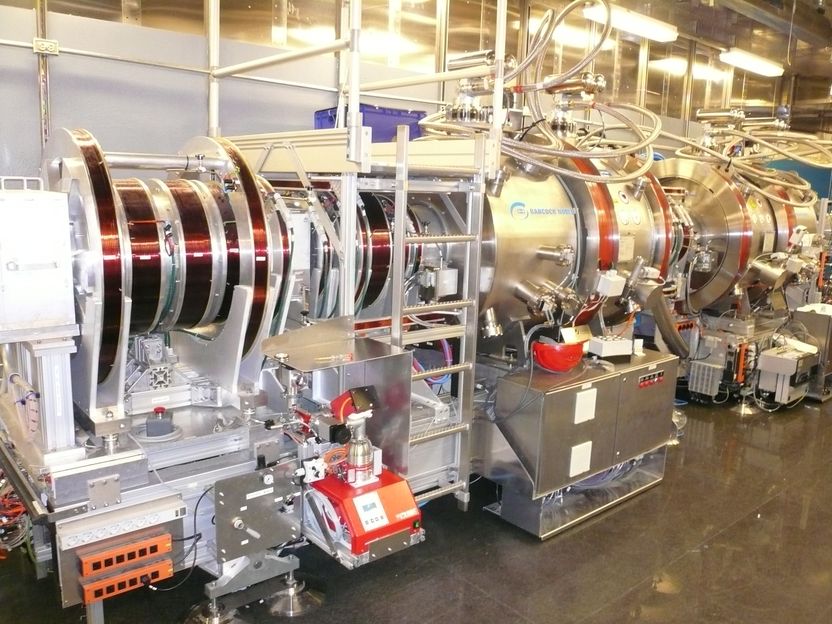
The company H2APEX in Rostock-Laage is using these results, among other things, to build a larger demonstrator, for which the industrial partner is also using the institute's technical center Catalysis2Scale. If everything goes as planned, the corresponding plant will be commercialized by the end of 2025, and the chemical symbol for hydrogen atoms, H, will then also mean H for hope for the energy transition.
Original publication


Other news from the department science




















Most read news












More news from our other portals


























Last viewed contents
Deep brines in northern Germany could be among Europe's largest lithium resources - Project RoLiXX aims to develop extraction methods that work even under high-salinity conditions
Metso introduces an advanced lithium carbonate process to support battery materials production - At the core of the process is soda pressure leaching, which selectively extracts lithium with fewer soluble impurities in one pass
Longer-lasting and more sustainable green hydrogen production - The findings impact the ability to achieve a lasting and sustainable hydrogen-based energy economy
Merck and Mulliken Center for Theoretical Chemistry Collaborate in Machine Learning Project - The three-year collaboration will focus on the development of new tools for computational chemistry modelling as well as new molecular representations
Self-assembled superlattices create molecular machines with 'hinges' and 'gears'

On the way to sustainable chemistry? Iron makes it possible - Hydroformylation of olefins using iron catalysis and light
3M to sell pressurized polyurethane foam adhesives business
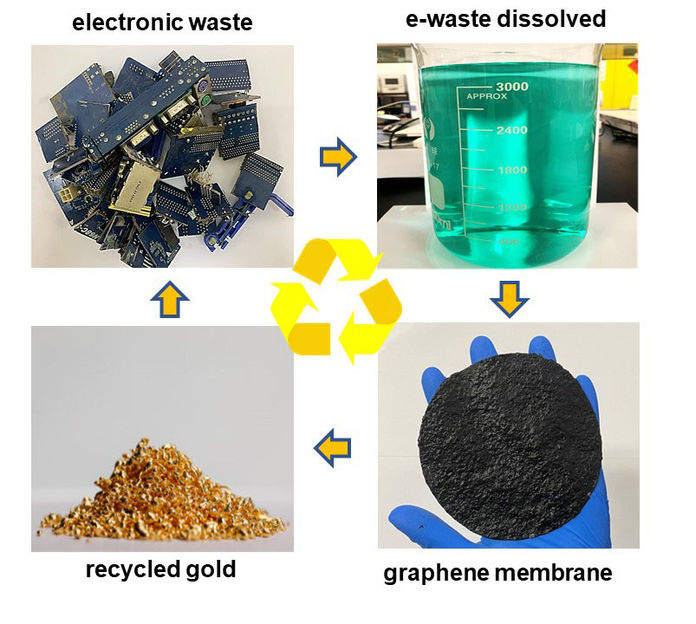
Graphene as 'the philosopher’s stone’: turning waste into gold - "This apparent magic is essentially a simple electrochemical process"

Cleaner air as a result of coronavirus lockdown - Lockdowns in early summer 2020 meant that the amount of soot in the atmosphere, which is harmful to the climate and to health, almost halved
DSM and Chemtrix sign collaboration agreement in Continuous Flow Chemistry