It all adds up: Study finds forever chemicals are more toxic as mixtures
Research also finds that PFOA and PFOS are major contributors to toxicity
Advertisement


A first-of-its-kind study has measured the toxicity of several types of per- and polyfluoroalkyl substances (PFAS), better known as “forever chemicals,” when mixed together in the environment and in the human body. The good news: Most of the tested chemicals’ individual cytotoxicity and neurotoxicity levels were relatively low. The bad news: the chemicals acted together to make the entire mixture toxic.
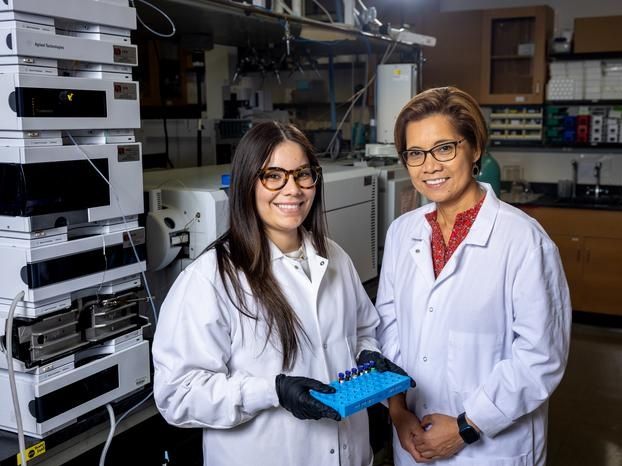
University at Buffalo PhD student Karla Ríos-Bonilla (left) and Diana Aga, director of the UB RENEW Institute, are authors on a study that assessed the mixture toxicity of per- and polyfluoroalkyl substances (PFAS), also known as forever chemicals.
Meredith Forrest Kulwicki/University at Buffalo
“Though they are structurally similar, not all forever chemicals are made equal — some are more potent, others less. When mixed, all components contributed to the mixture’s cytotoxicity and neurotoxicity,” says the study’s first-author, Karla Ríos-Bonilla, a chemistry PhD student at the University at Buffalo.
“In the laboratory assays we used in this study, most of the types of PFAS that we tested did not appear to be very toxic when measured individually. However, when you measure an entire sample with multiple PFAS, you see the toxicity,” adds study co-author Diana Aga, PhD, director of the RENEW Institute, SUNY Distinguished Professor and Henry M. Woodburn Chair in the UB Department of Chemistry.
This research was conducted in collaboration with Beate Escher of the Helmholtz Centre for Environmental Research (UFZ), Leipzig, Germany, where Ríos-Bonilla did the in vitro toxicity experiments in the high-throughput screening facility CITEPro. It was published Sept. 11 inEnvironmental Science and Technology, a journal of the American Chemical Society.
The study is novel in that it assesses mixture toxicity of PFAS. These synthetic compounds have been widely used in consumer products — from nonstick pans to makeup — for decades, and they can take hundreds to thousands of years to break down, if ever. They are estimated to be in at least 45% of the nation’s drinking water and in the blood of practically every American, and they have been linked to cancer and neurodevelopmental disorders.
Earlier this year, U.S. Environmental Protection Agency (EPA) issued the first-ever drinking water standards for six kinds of PFAS. However, it is estimated that there are over 15,000 varieties present in the environment. Only a handful of these chemicals have standards and are regulated.
“There are six PFAS that can be regulated because we know a lot about them and their toxicity. Unfortunately, we cannot regulate other forms of PFAS until their toxicities are known,” says Aga, who is principal investigator of the EPA STAR grant that funded the research. “We need to set maximum contamination levels for each PFAS that is proportional to their toxicity. To regulate contaminants, it is crucial to know their relative potencies when they occur as mixtures in the environment along with their predicted environmental concentrations.”
Other co-authors from UB are G. Ekin Atilla-Gokcumen, PhD, Dr. Marjorie E. Winkler Distinguished Professor and associate chair in the Department of Chemistry, and Judith Cristobal, PhD, senior research scientist.
Ríos-Bonilla is also supported by a graduate fellowship from the National Institute of Environmental Health Sciences (NIEHS) of the National Institutes of Health (NIH).
PFOA and PFOS are major contributors to mixture toxicity
To conduct the study, researchers created their own PFAS mixtures, one that is representative of an average American’s blood serum, and the other of surface water samples found in the U.S. Ríos-Bonilla used data from the U.S. Centers for Disease Control and Prevention and from the U.S. Geological Survey to determine the average concentration ratios of PFAS in human blood and in surface water, respectively.
They then tested these mixtures' effects on two cell lines; one that tests for mitochondrial toxicity and oxidative stress and the other for neurotoxicity.
Of the 12 PFAS spiked in the water mixture, perfluorooctanoic acid (PFOA) — commonly used in nonstick pans and firefighting foam — was the most cytotoxic, making up to 42% of the mixture’s cytotoxicity.
On the other hand, both PFOA and perfluorooctane sulfonic acid (PFOS) contributed roughly the same cytotoxicity (25%) to the neurotoxicity assay, despite both contributing only 10 and 15% to the mixture in terms of concentration, respectively.
The blood mixture had four PFAS present, but PFOA again was the most cytotoxic to both cell lines. Despite its molar contribution being only 29%, PFOA triggered 68% of the cytotoxicity in the cytotoxicity assay, and 38% in neurotoxicity assay.
Interestingly, when researchers analyzed the toxicity of the extracts from real biosolid samples collected from a municipal wastewater treatment plant, very high toxicities were observed despite the measured low concentrations of PFOA and other PFAS in the sample.
“This means that there are many more PFAS and other chemicals in the biosolids, which have not been identified, that contribute to the toxicity of the extracts observed,” Aga says.
Synergistically versus additive
One of researchers’ goals was to determine if PFAS acts synergistically. This is when two or more chemicals’ combined effect is greater than the sum effect of the individual chemicals. However, their findings indicate that the effect of PFAS is concentration-additive: this means that an established mixture toxicity prediction model can be used to predict the combined effect of mixtures.
“As up to 12 PFAS in the mixtures acted concentration-additive for cytotoxicity and specific neurotoxicity, it is likely that the thousands of other PFAS that are in commerce and use are also acting in the same manner,” Escher says. “Mixtures pose more of a risk than individual PFAS. As they act and occur in mixtures, they ought to be regulated as mixtures.”
Researchers say the results of this study will also be very useful in assessing effectiveness of remediation efforts. Breaking down PFAS can sometimes create harmful byproducts that cannot be detected by chemical analysis, so measuring the toxicity of a sample after treatment may be the only way to judge whether a remediation technology is effective.
“Toxicity assays can be a complimentary tool when analytical chemistry doesn't give you all the answers, especially when the identities of contaminants in the mixture are unknown, which is the case in many polluted sites,” Aga says.
Original publication
Karla M. Ríos-Bonilla, Diana S. Aga, Jungeun Lee, Maria König, Weiping Qin, Judith R. Cristobal, Gunes Ekin Atilla-Gokcumen, Beate I. Escher; "Neurotoxic Effects of Mixtures of Perfluoroalkyl Substances (PFAS) at Environmental and Human Blood Concentrations"; Environmental Science & Technology, 2024-9-11



Other news from the department science





















Most read news











More news from our other portals



























Last viewed contents
Pyrolysis oil instead of crude oil: Faster fluorine analysis reduces the risk for refineries - New method solves a key analytical challenge

Research guides future of plastic waste chemical recycling

The competitiveness of low-carbon fuels depends on location - New infrastructure could boost European production

Deep tech startup Reduciner introduces novel technology to turn captured carbon into sustainable fuels - Raising 3.6 million euros in its initial funding round, the Finnish startup plans to build its first industrial-scale pilot

Bruker announces strategic collaboration with Atinary Technologies to advance self-driving laboratories

FUST Lab Receives Investment from Asia2G Capital - The Korean deep-tech company plans to use the capital to expand into the U.S., European, and Japanese markets

ACHEMA Middle East: Debut in Saudi Arabia not until 2027 - Messe Frankfurt Saudi Arabia and DECHEMA are responding to regional uncertainties and are also changing the venue
New core-shell design for anodes significantly increases performance of sodium-ion batteries - Researchers coat porous carbon with a filter-like layer that allows sodium ions to pass through while keeping disruptive electrolyte molecules out

New "chemical armor" could unlock the holy grail of solid-state battery technology - A simple one-step coating builds a silicon-indium hybrid shield on lithium metal, quadrupling current density and extending battery cycle life
Scientists unveil mechanism behind greener ammonia production
Siemens to digitalize one of Europe's largest renewable hydrogen projects - Physics-based digital twin and real-time optimization