Ultrafast dissociation of molecules studied at BESSY II
Findings could deepen our understanding of chemical reactions at the molecular level
Advertisement


For the first time, an international team has tracked at BESSY II how heavy molecules – in this case bromochloromethane – disintegrate into smaller fragments when they absorb X-ray light. Using a newly developed analytical method, they were able to visualise the ultrafast dynamics of this process. In this process, the X-ray photons trigger a "molecular catapult effect": light atomic groups are ejected first, similar to projectiles fired from a catapult, while the heavier atoms - bromine and chlorine - separate more slowly.
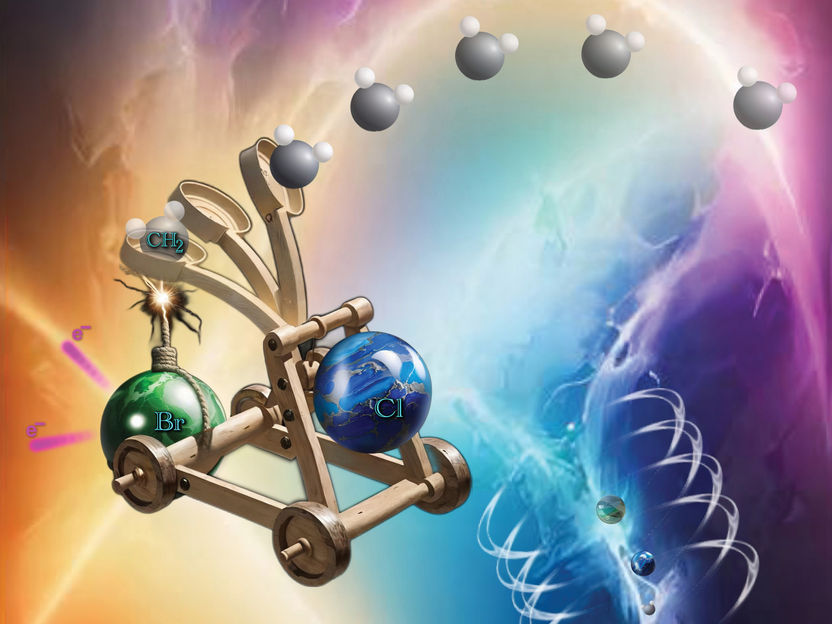
The X-ray photons trigger a ‘molecular catapult effect’: light atomic groups are ejected first, similar to projectiles shot from a catapult, while the heavier atoms – bromine and chlorine – separate much more slowly. The image was printed on the cover of "The Journal of Physical Chemistry Letters".
© The Journal of Physical Chemistry Letters
When X-rays hit molecules, they can knock electrons out of certain orbitals and into extremely high-energy states, breaking chemical bonds. This often happens ultra rapidly, in just a few femtoseconds (10-15 s). While this phenomenon has been studied in light molecules such as ammonia, oxygen, hydrochloric acid or simple carbon compounds, it has hardly been studied in molecules with heavier atoms.
A team from France and Germany has now studied the rapid decay of molecules containing halogens. They focused on a molecule in which bromine and chlorine atoms are linked by a light bridge - an alkylene group (CH2). The measurements were made at the XUV beamline of BESSY II.
The absorption of the X-rays caused molecular bonds to break, creating ionic fragments that could be analysed. The scientists were able to produce a visualisation from the measurement data. It shows how the atoms move in the fleeting intermediate states just before the bonds break. To do this, the team developed a new method of analysis called IPA (Ion Pair Average) and combined it with ab initio theoretical calculations to reconstruct the processes.
The results show that light groups of atoms such as CH2 are ejected first, while the heavier atoms - bromine and chlorine - are left behind and therefore separate more slowly. Interestingly, this catapult-like behaviour only occurs at certain X-ray energies. Theoretical simulations, in agreement with experimental observations, emphasise the crucial role of vibrations of the lighter groups of atoms in triggering these ultrafast reactions.
“This study highlights the unique dynamics of molecular dissociation upon X-ray irradiation," says Dr Oksana Travnikova (CNRS, Université Sorbonne, France), first author of the study now published in J. Phys. Chem. Lett. In particular, it shows that the catapult-like motion of light groups initiates the separation of heavy fragments, a process that unfolds in a remarkably short time. These findings could deepen our understanding of chemical reactions at the molecular level and how high-energy radiation affects complex molecules.
Original publication
Oksana Travnikova, Victor Kimberg, Barbara Cunha de Miranda, Florian Trinter, Markus S. Schöffler, Stéphane Carniato, Tatiana Marchenko, Renaud Guillemin, Iyas Ismail, Gregor Kastirke, Maria Novella Piancastelli, Till Jahnke, Reinhard Dörner, Marc Simon; "X-ray-Induced Molecular Catapult: Ultrafast Dynamics Driven by Lightweight Linkages"; The Journal of Physical Chemistry Letters, Volume 15, 2024-11-21


Other news from the department science




















Most read news












More news from our other portals


























Last viewed contents

Building blocks of the future for photovoltaics - Research team observes formation of "dark" moiré interlayer excitons for the first time
RCT Reichelt Chemietechnik | Drying tubes | Reichelt Chemietechnik
LANXESS strengthens commitment to renewable raw materials with investment in BioAmber - Companies have developed phthalate-free plasticizers from bio-based succinic acid

POLYVANTIS Celebrates Birth of New Company

First experimental evidence of 3-D aromaticity in stacked antiaromatic compounds
LANXESS wins ICIS Innovation Award for LFP battery materials - LANXESS also examines production of iron phosphate as a precursor for LFP
Drei Quantenforscher teilen sich Physik-Nobelpreis 2025 - "It is wonderful to be able to celebrate the way that century-old quantum mechanics continually offers new surprises"
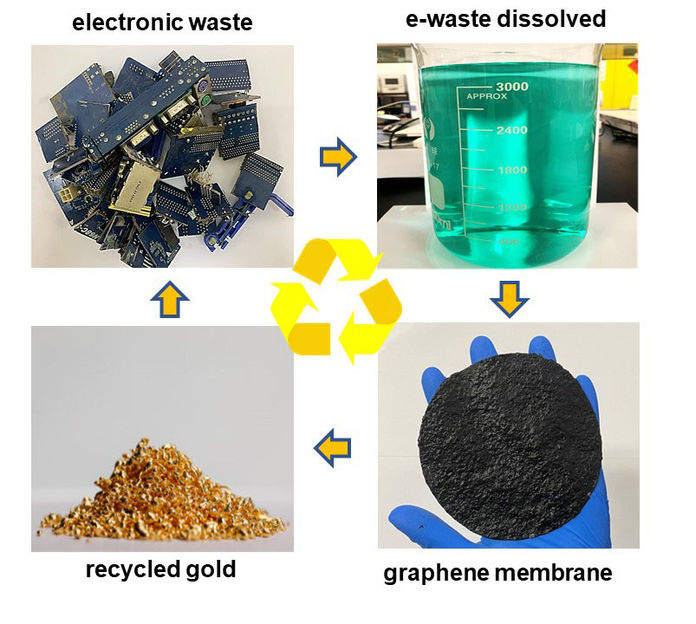
Graphene as 'the philosopher’s stone’: turning waste into gold - "This apparent magic is essentially a simple electrochemical process"
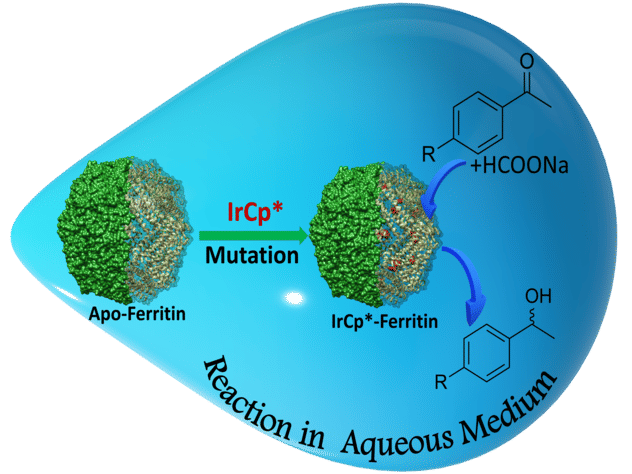
Novel hybrid nanocages for faster catalysis - Hybrid bio-nanocages could effectively catalyze reactions to yield industrially important products
3M to sell pressurized polyurethane foam adhesives business

Researchers work to create biodegradable bioplastics from food waste - Use of microorganisms to convert food waste into fats, which are then processed into bioplastics
