Significant breakthrough in the chemistry of fluorinated compounds
Overcoming the “Fluoro Wall”: Researchers observe tunneling effect of heavy atoms for the first time
Advertisement


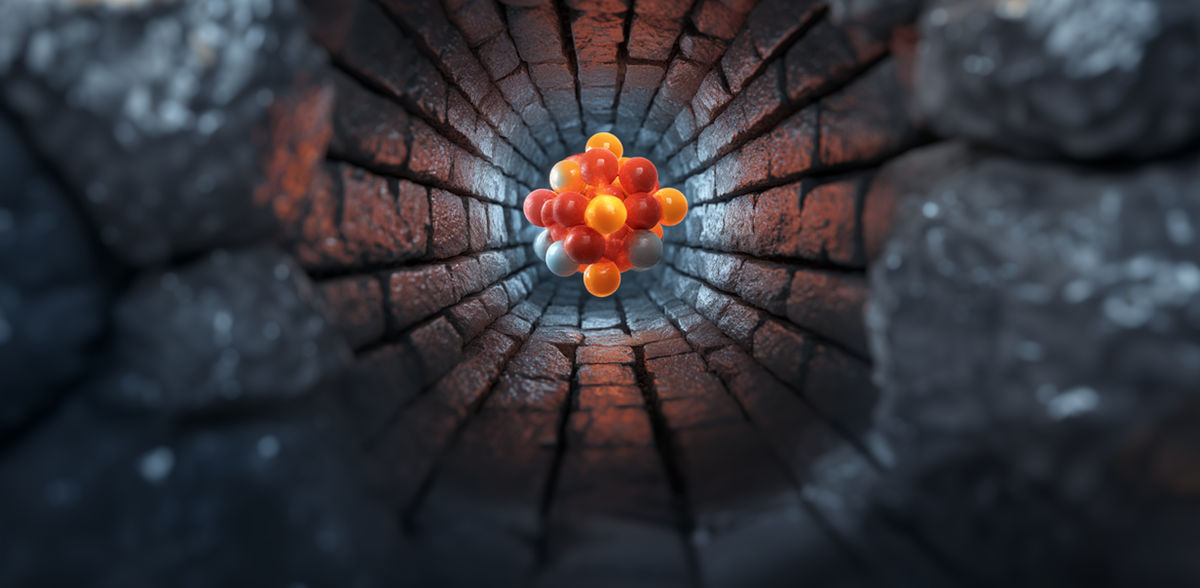
An international research team made up of scientists from Freie Universität Berlin and the French National Center for Scientific Research (CNRS) in conjunction with Université de Lorraine in Metz, France, has achieved a significant breakthrough in the chemistry of fluorinated compounds. With the aid of quantum chemical simulations they were able to prove for the first time that heavy fluorine atoms can also “tunnel,” or in other words, transform between two states. The study “Experimental Observation of Quantum Mechanical Fluorine Tunneling” was published in the scientific journal Nature Communications. It opens up new prospects for controlling chemical reactions and understanding better what makes certain fluorinated compounds particularly stable or reactive.
Fluorine and fluorinated compounds are commonplace in our everyday lives. Fluorinated groups improve the uptake of medications in the body; fluorinated compounds make cellphone batteries more efficient and allow them to last longer; and fluoride in toothpaste prevents cavities. At the same time, per- and polyfluoroalkyl substances (PFAS) pose a growing problem for human health and the environment.
Extensive research on the science behind the interactions produced by fluorine and its compounds is needed in order to fully grasp both the positive and negative effects of fluoride in compounds. This is one of the objectives of the Collaborative Research Center (CRC) 1349 “Fluorine-Specific Interactions,” which has been funded by the German Research Foundation (DFG) since 2019. Within the framework of CRC 1349, teams led by Professor Sebastian Hasenstab-Riedel and Professor Beate Paulus from Freie Universität Berlin together with Professor Jean Christophe Tremblay from the French National Center for Scientific Research (CNRS) in conjunction with Université de Lorraine in Metz, France, have now discovered a unique fluorine-specific interaction.
Over a decade ago Hasenstab-Riedel and his team managed to capture an unusual molecule in a neon crystal at −270°C. This molecule – an anion comprised of just five tightly packed, highly charged, and unstable fluorine atoms – should not actually exist. And yet, the molecule remained surprisingly stable.
In order to understand what held this molecule together, researchers in Paulus’ team together with Tremblay carried out extensive calculations and quantum mechanical simulations. They came across a surprising effect that had up to this point mainly been observed for hydrogen, which is very light, but which was considered virtually impossible for the relatively heavy fluorine atom. The researchers were able to prove that even fluorine atoms can effectively tunnel – i.e., make a molecule spontaneously transform between two states that are actually separated by a finite energy barrier.
This type of tunneling has already been observed in other molecules of much lighter elements such as hydrogen and oxygen. Until now, researchers assumed that fluorine atoms were too heavy to tunnel at all, which is why they tended to speak of a “fluoro wall” when it came to tunneling.
However, this new study appears to signify a paradigm shift. The combination of special bonding conditions in molecules that are trapped in a very small space seems to make it possible for atoms that are heavier than oxygen to tunnel. “The findings don’t just expand our understanding of chemical bonds in fluorinated compounds,” says Dr. Carsten Müller of Freie Universität Berlin, first author of the study. “They have also provided us with new tools to control molecular reactions in a targeted manner – whether that is in materials research, medicine, or designing new technologies.”
Original publication


Other news from the department science




















Most read news












More news from our other portals


























Last viewed contents

A bionanomachine for green chemistry - With the help of an enzyme, the industry could produce valuable chemicals and drug precursors in an energy-saving and environmentally friendly conditions
Deconstructing osmosis provides insight for medical and industrial use
Sartorius to Sell Its Industrial Technologies Division to Minebea Co., Ltd. - Sartorius to focus on its core bioprocess and laboratory businesses

Can I mix those chemicals? There's an app for that! - New technology can find the safest way to store and dispose of reactive chemicals

Chemists pioneer work to reduce carbon emissions - “My team and I have been hard at work trying to find more sustainable ways to separate, purify and trap ethylene..."

Groundbreaking discovery enables cost-effective and eco-friendly green hydrogen production
Aventis Pharma Licences Innovative New Anti-Cancer Agent
Quantum Tricks to Unveil the Secrets of Topological Materials

Otto Roelen Medal for Robert Franke - Recognition of developments in the field of catalytic carbonylation, in particular hydroformylation

Magnetic nanoparticles change their magnetic structure in a magnetic field - International research team studies the effects of magnetic fields on magnetic nanoparticles

Brenntag achieved outstanding results in the third quarter 2021 - Chief Financial Officer Georg Müller not to extend his mandate
