New Dynamics Discovered in Heterogeneous Catalysis
Researchers have shown that solid catalysts can sometimes behave differently than previously assumed during hydrogen production
Advertisement


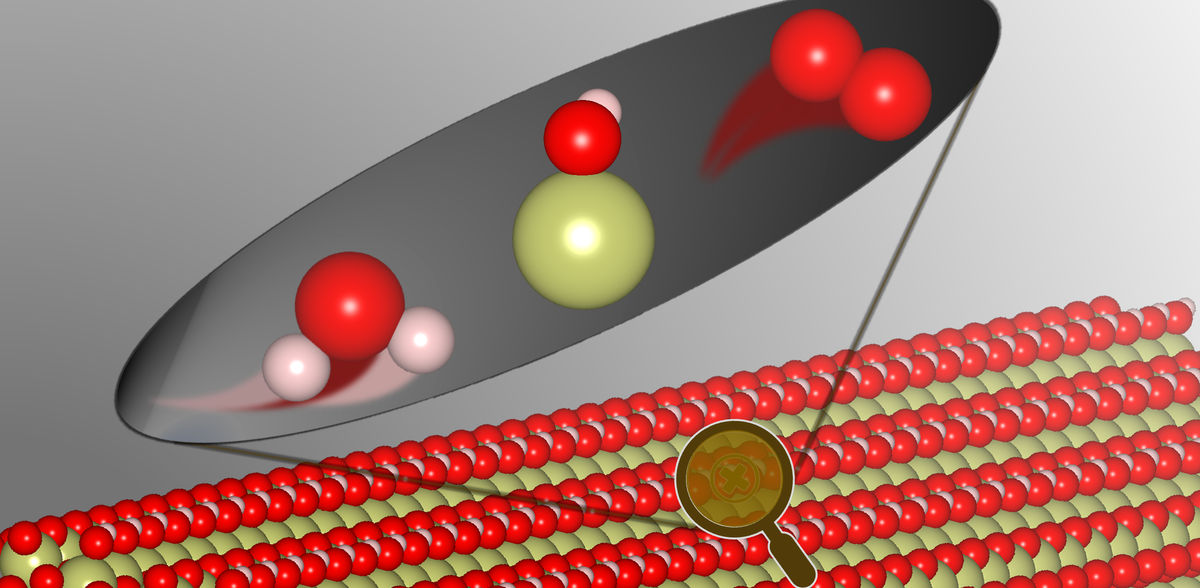
Oxygen evolution is considered one of the most energy-intensive steps in water electrolysis and is therefore a key factor for more efficient green hydrogen production. Modelling of the reaction mechanisms has so far been based on the assumption that the elementary steps take place sequentially and not in a concerted manner. A team led by Prof. Dr. Kai S. Exner from the University of Duisburg-Essen has now shown that this assumption is not always correct. The results, published in Nature Communications, open up new possibilities for improving solid catalysts for energy conversion and storage applications.
There are two basic types of catalysis: homogeneous catalysts have the same physical state as the substances being converted (e.g., they all are liquid), while heterogeneous catalysts are in a different phase, for example a solid that reacts with liquids or gases. For a reaction to take place on the surface of a solid catalyst, the starting materials (reactants) must attach to its surface (adsorption) and then dissolve again after the reaction has taken place (desorption).
Until now, research into solid catalysts – i.e., the heterogeneous variant – has assumed that adsorption and desorption occur sequentially: the reactant binds to the catalyst, reacts, and then the product dissolves. In homogeneous catalysis, however, it is known that these steps take place simultaneously.
When modelling reaction mechanisms in heterogeneous catalysis, possible simultaneous elementary steps have not always been taken into account. However, a theoretical study within the RESOLV Cluster of Excellence now shows that the solid iridium dioxide (IrO₂), which is used as an anode material for the production of green hydrogen, behaves similarly to a homogeneous catalyst with regard to oxygen evolution: oxygen is produced in a ‘Walden-like mechanism’ in which adsorption and desorption occur in a concerted manner, analogous to homogeneous variants. This contradicts previous ideas and opens up new possibilities for improving solid catalysts that are more closely aligned with the principles of homogeneous processes in solution.
Exner's research builds on several joint projects within the University of Duisburg Essen and the University Alliance Ruhr: the Natural Water to Hydrogen project headed by Prof. Dr Corina Andronescu, the Collaborative Research Centre 247 Heterogeneous Oxidation Catalysis in the Liquid Phase and, last but not least, the research in the new Active Sites building, for which the ground-breaking ceremony recently took place.
Original publication



Other news from the department science





















Most read news












More news from our other portals

























Last viewed contents

Charged “molecular beasts” the basis for new compounds - Researchers use “aggressive” fragments of molecular ions for chemical synthesis
Recycle high-tech waste biologically - Innovative biotechnological process extracts gallium from industrial wastewater

New technology for liquid-crystal displays
Initial energy efficiency index for the German Industry published - High sensitivity – little action
First brew beer, then store energy - Chemists create carbon materials for energy storage device from brewery waste

Artificial Intelligence has learned to estimate oil viscosity - Indirect measurements are a lucky alternative for a variety of sectors
‘Smart plastic’ material is step forward toward soft, flexible robotics and electronics - A new plastic-like material can be manipulated to be soft and stretchy or hard and rigid with only the application of a catalyst and visible light
Exotic vibrations in new materials - New insights show universal applicability of carbyne as a sensor
BASF increases price for Vitamin B2

First controllable nanoscale gas-liquid interface fabricated
Biodiesel made from discarded cardboard boxes - Development of a microorganism that doubles the yield of biodiesel precursor production using genetic scissors and based on the principles of evolution
