Novel Solar System Converts Nitrate in Wastewater into High-Value Ammonia
Advertisement


A research team, affiliated with UNIST has unveiled a groundbreaking technology that transforms nitrates found in wastewater into ammonia, a vital chemical and promising energy carrier, without carbon emissions. This advancement not only offers a sustainable method for ammonia production but also contributes to wastewater purification efforts.
Jointly led by Professors Kwanyong Seo and Ji-Wook Jang from the School of Energy Chemistry at UNIST, the research team announced that they have successfully engineered a solar-powered photoelectrochemical (PEC) system capable of converting nitrate pollutants into ammonia under ambient conditions.
Ammonia is an essential chemical used globally in agriculture and industry, with an annual consumption exceeding 150 million tons. Its high hydrogen content also positions it as a promising candidate for next-generation energy storage and transportation solutions. However, the prevailing industrial method— the Haber-Bosch process— relies heavily on high-temperature and high-pressure conditions, resulting in significant greenhouse gas emissions.
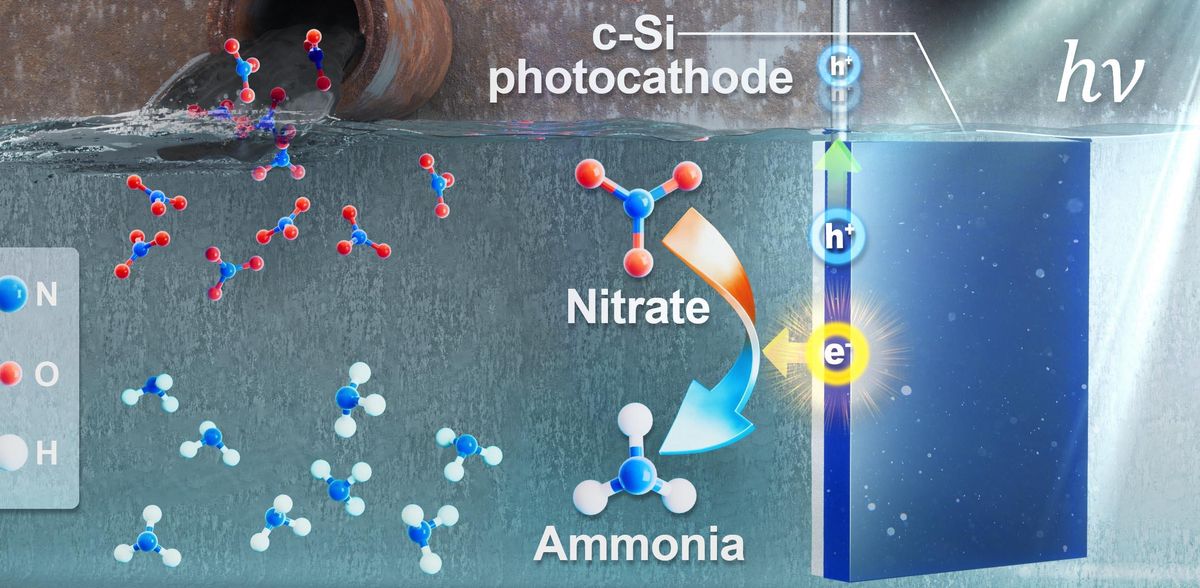
Their innovative PEC system utilizes sunlight to drive nitrate reduction without the need for external electrical power, leveraging wastewater as a raw material. Nitrates, when present at high concentrations, pose health risks such as methemoglobinemia and gastric cancers. The new technology selectively reduces nitrates to ammonia, effectively addressing both water pollution and sustainable ammonia synthesis.
The system comprises a silicon-based photocathode paired with a nickel foil catalyst. Sunlight excites the silicon, generating electrons that are then channeled via the nickel catalyst to reduce nitrates to ammonia. A key innovation lies in the formation of a thin layer of nickel hydroxide (Ni(OH)₂) on the catalyst surface during operation, which suppresses competing reactions like hydrogen evolution and enhances selectivity toward ammonia production.
This mechanism was confirmed through extensive experiments and quantum mechanical calculations. Professor Suthsu Ryu from UNIST’s Department of Physics, utilizing density functional theory (DFT) simulations, demonstrated that Ni(OH)₂ offers active sites that favor nitrate reduction to ammonia, lowering the energy barriers involved.
Remarkably, the system achieved a record-high ammonia production rate of 554 micrograms per square centimeter per hour without any external bias, outperforming previous technologies by more than 50%. The system maintained its performance on a larger 25 cm² scale, indicating promising potential for real-world application.
Professor Seo emphasized, “Converting nitrate pollutants into ammonia not only purifies water but also contributes to carbon neutrality. Our goal is to develop large-scale, practical PEC devices capable of producing ammonia outdoors, directly utilizing sunlight and wastewater as resources.”
Original publication
Wonjoo Jin, Hyunju Go, Juyeon Jeong, “Nickel Hydroxide Catalyzed Bias-free Photoelectrochemical NH3 Production via Nitrate Reduction,” Adv., Mat., (2025).


Other news from the department science





















Most read news











More news from our other portals



























Last viewed contents
Enzymes Overcome the 100-Degree Heat Barrier - The process is of interest to the chemical industry
Step towards sustainable hydrogen production with cyanobacteria - An oxygen-free microenvironment protects the sensitive enzymes
Atomic reshuffle paves way for record-breaking catalysts for hydrogen production - "This opens a new strategy for designing adaptive catalysts for a wide range of applications"

Global underground CO₂ storage hits record 43.6 million tonnes - London Register expands reach
Research Breakthrough on the Path to a New Reserve Antibiotic - For the first time, chemists have succeeded in synthesizing the highly potent natural compound neosorangicin A

Endress+Hauser expands its presence in the U.S. - 44 million euros are being invested in the new facility in Greenwood, Indiana
Plastic bottles could find new life in batteries as graphite - Penn State researchers converting PET waste into synthetic graphite that outperforms natural graphite
Turning food waste into carbon captors - Expected to be cheaper than other capture methods

Study shows: Lithium and sodium-ion technologies are more closely linked than assumed - "Switching to a new battery technology does not automatically open the door to new market players"

ETH spin-offs sweep the board at Venture Awards
How to generate and steer electrons in liquid water - Surprising results reveal a new aspect of extremely strong electric fields in liquid water