Several roadblocks identified on the way to a net-zero chemical industry
New report outlines barriers and points to solutions

Advertisement


A study published by the Renewable carbon Initiative (RCI) reveals that existing EU policies continue to create significant barriers for renewable carbon-based chemicals and materials – despite growing political ambition to defossilise the European economy. The report pinpoints specific barriers to regulations and even the relevant articles, explains why they represent a problem and provides practical suggestions for upcoming legislative revisions.
The new background report “Policy Barriers for Renewable Carbon Uptake”, based on a survey among RCI member companies, identifies ten specific policy barriers across seven EU legislative frameworks, including the EU Emissions Trading System Directive (ETS), the Renewable Energy Directive (REDIII), the Packaging and Packaging Waste Regulation (PPWR), and the Single-Use Plastics Directive (SUPD). These barriers delay the transition from fossil to bio-based, carbon capture and utilisation (CCU)-based and recycled carbon sources.
For policy-makers, the following key findings are particularly relevant:

Regulatory misalignment: The study demonstrates that current rules often create a “non-level playing field.” For example, bio-based products face stricter sustainability proof requirements than fossil alternatives, while biofuel subsidies distort feedstock markets for material uses. A major concern is regulatory uncertainty for CCU investments due to the sunset clause, where time-limited recognition of fossil-derived CO2 creates investment horizons that are incompatible with industrial financing cycles. This threatens to delay or cancel CCU projects that are essential for climate-neutral value chains, especially in hard-to-abate sectors.
Outdated definitions and misleading classifications: The most common barrier stems from overly restrictive definitions which exclude too many renewable carbon products. Current overly restrictive definitions, such as those in the Emission Trading System (ETS) or the Packaging and Packaging Waste Regulation (PPWR), exclude entire categories of innovative, climate-friendly products from incentives or market access. Particularly critical is the limitation of Carbon Capture and Utilisation (CCU) to products with lifetimes longer than several centuries in the ETS, ignoring the circular substation of virgin fossil feedstocks through CCU. Keeping products in the loop through recycling is completely neglected in this framework so far.
Misleading classifications create barriers, such as the SUPD definition of ‘natural polymer,’ which excludes industrially produced nature-identical polymers, and the PPWR Annex, which groups all biodegradable plastics together regardless of biodegradability or recyclability, potentially causing confusion in the value chain.
Bureaucracy vs practical reality: The implementation of requirements often fails to align with industrial production realities, diverting resources needed for the actual transformation. For example, calculating minimum post-consumer recyclate (PCR) content for each plant and product format is highly impractical, diverting time and resources from scaling up PCR use and improving overall recycling rates. Rules and regulations aimed at increasing renewable feedstock in the chemical and materials industries should be designed to allow companies to implement them efficiently and with reasonable effort.
The biggest barrier is not a single regulation, but the lack of a coherent support framework for renewable carbon in the chemicals and derived materials economy. RCI members consistently point to the absence of clear targets and incentives for renewable carbon materials as the biggest hindrance.
The suggested solutions in the report include amending restrictive definitions e.g. in ETS and PPWR, introducing more nuanced rules for CCU sources, adopting more practical solutions to reduce unnecessary administrative burdens, and align rules and sustainability requirements for carbon both for different use cases and different origin.
This report is designed to complement RCI’s Policy Proposal Study published in 2025.


Other news from the department business & finance
















Most read news












More news from our other portals



























Last viewed contents

Digital lab day 2025 celebrates international success - virtual battery day 2025 follows in November

RE:VOLTAGE and CometHire Win the HTW Startup Challenge 2026 in Berlin - The competition awarded 10,000 euros in prize money in the GreenTech and Impact Entrepreneurship categories

Atomic reshuffle paves way for record-breaking catalysts for hydrogen production - "This opens a new strategy for designing adaptive catalysts for a wide range of applications"

Global underground CO₂ storage hits record 43.6 million tonnes - London Register expands reach

Research Breakthrough on the Path to a New Reserve Antibiotic - For the first time, chemists have succeeded in synthesizing the highly potent natural compound neosorangicin A

Endress+Hauser expands its presence in the U.S. - 44 million euros are being invested in the new facility in Greenwood, Indiana
Plastic bottles could find new life in batteries as graphite - Penn State researchers converting PET waste into synthetic graphite that outperforms natural graphite
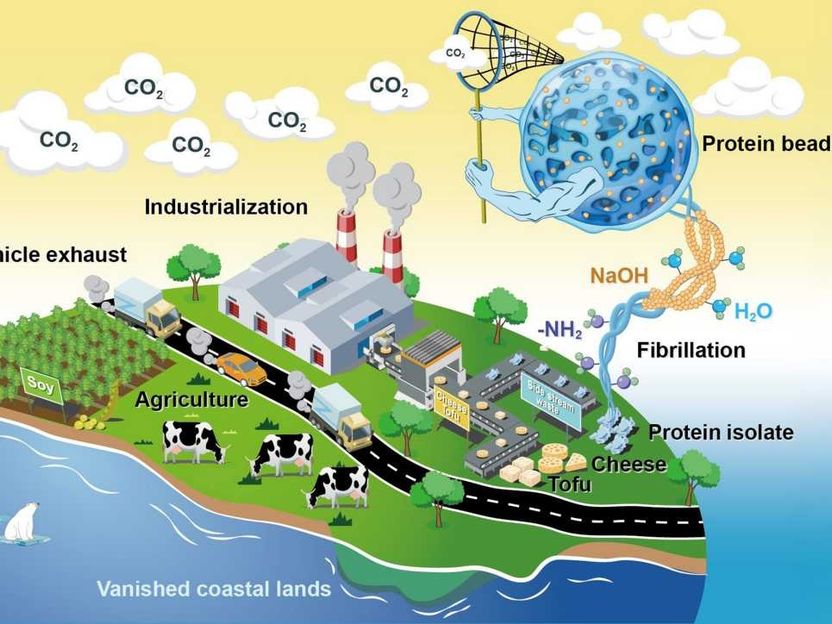
Turning food waste into carbon captors - Expected to be cheaper than other capture methods

Study shows: Lithium and sodium-ion technologies are more closely linked than assumed - "Switching to a new battery technology does not automatically open the door to new market players"

ETH spin-offs sweep the board at Venture Awards
How to generate and steer electrons in liquid water - Surprising results reveal a new aspect of extremely strong electric fields in liquid water