New AI method accelerates liquid simulations
"This approach makes it possible to determine the chemical potential indirectly, but consistently, without having to train it explicitly"
Advertisement


Researchers at the University of Bayreuth have developed a method using artificial intelligence that can significantly speed up the calculation of liquid properties. The AI approach predicts the chemical potential – an indispensable quantity for describing liquids in thermodynamic equilibrium. The researchers present their findings in a new study published in the journal Physical Review Letters, where it was selected as an Editors’ Suggestion.
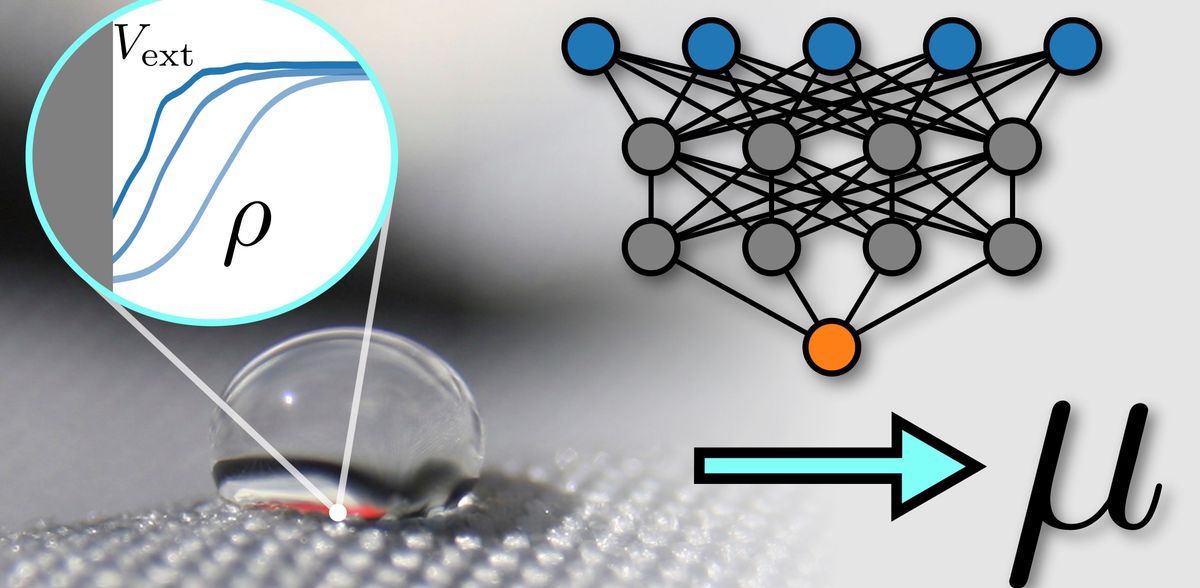
Many common AI methods are based on the principle of supervised machine learning: a model – for instance a neural network – is specifically trained to predict a particular target quantity directly. One example that illustrates this approach is image recognition, where the AI system is shown numerous images in which it is known whether or not a cat is depicted. On this basis, the system learns to identify cats in new, previously unseen images. “However, such a direct approach is difficult in the case of the chemical potential, because determining it usually requires computationally expensive algorithms,” says Prof. Dr. Matthias Schmidt, Chair of Theoretical Physics II at the University of Bayreuth. He and his research associate Dr. Florian Sammüller address this challenge with their newly developed AI method. It is based on a neural network that incorporates the theoretical structure of liquids – and more generally, of soft matter – allowing it to predict their properties with great accuracy.
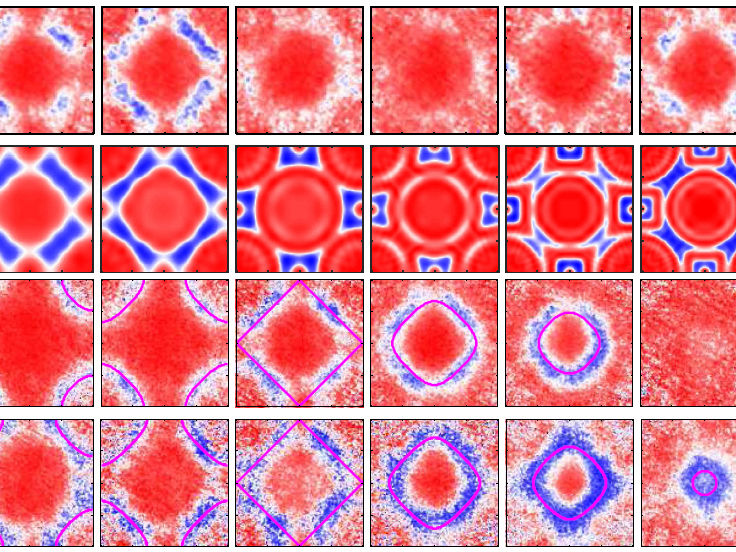
“What is special about our method is that the AI does not learn the chemical potential at all,” Schmidt explains. Instead, the AI learns the universal density functional, which captures the fundamental physical relationships within a liquid and remains the same across many different systems. “This can be illustrated by comparing different surfaces coated with the same liquid. Even though the surfaces may differ in structure or material, the liquid still follows the same underlying physical laws. These ‘intrinsic’ properties of the liquid correspond to the universal density functional that is captured via machine learning,” says Schmidt.
Between the learned density functional and observable properties of a system – such as the particle density profile and the external potential – a remaining difference persists. This gap is not closed by the AI model but by physical principles: from general considerations of thermodynamic stability, it follows that this remaining difference uniquely corresponds to the chemical potential.
“Our method combines data-driven learning with fundamental insights from theoretical physics: the AI-derived density functional provides a universal framework, while the chemical potential itself is derived from established physical conditions. This approach makes it possible to determine the chemical potential indirectly, but consistently, without having to train it explicitly,” notes Sammüller. He adds: “In terms of image recognition, it would be almost as if an AI could recognise cats without ever having seen one during training.”
Original publication



Other news from the department science




















Most read news












More news from our other portals


























Last viewed contents

New method for the temperature-dependent generation of terahertz radiation - Use in medicine and material control

OQ Chemicals Launches Cost-Cutting Program and Organizational Realignment in Germany - “We will take all necessary steps to make the reorganization socially responsible and preserve as many jobs as possible“
WACKER Presents Innovation Award for Novel Manufacturing Process for Polymer Dispersions

Artificial rocks from macroplastics threaten ocean health - German-Indonesian research team identifies new rock-like compounds from plastic waste and coral rubble for the first time

RCT Reichelt Chemietechnik | Flow indicators | Reichelt Chemietechnik

World record for tandem perovskite-CIGS solar cell

New method for determining exchange energy in 2D materials - Detective work yielded a simple solution
Magnetism without metal: a milestone for materials science - “This is fundamentally new”

Magnetic nanoparticles change their magnetic structure in a magnetic field - International research team studies the effects of magnetic fields on magnetic nanoparticles
Breakthrough in capturing 'hot' CO2 from industrial exhaust - A metal-organic framework is capable of capturing CO2 at extreme temperatures
Quantum Tricks to Unveil the Secrets of Topological Materials