From stillage to storage: Researchers turn bourbon byproducts into supercapacitors
Distillery waste powers supercapacitors with 25x the energy of commercial devices

Advertisement


The state of Kentucky produces 95% of the world’s bourbon, and all that bourbon leaves behind an enormous amount of waste grain, called stillage. Now, researchers at the University of Kentucky have developed a process to transform that stillage into electrodes. With the bourbon byproduct electrodes, they created supercapacitors that could store more energy than similarly sized commercial devices.
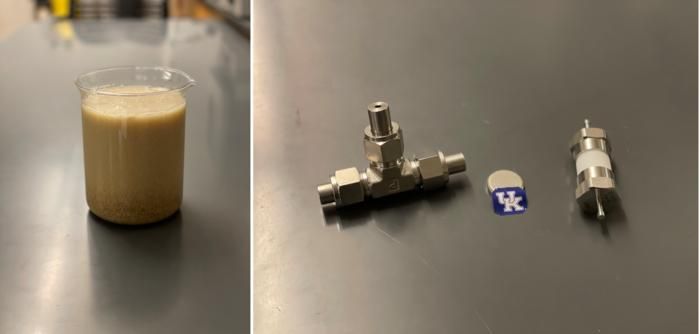
Researchers converted bourbon distillery waste (left image) into electrodes for supercapacitors (right image) that store more energy per kilogram than commercial devices.
Josiel Barrios Cossio
Josiel Barrios Cossio, a graduate student, first learned about the scale of American whiskey’s waste problem while working on a research traineeship to examine food, energy and water issues in Kentucky. “From the final volume of bourbon produced, you get 6 to 10 times that amount of stillage as waste,” says Barrios Cossio, “so it's a big deal."
This stillage is a sloppy mash that’s typically sold to farmers as livestock feed or a soil additive. But it is difficult to transport while wet, and it is expensive to dry.
One alternative solution is to directly convert the soupy stillage into more valuable carbon materials using a technique called hydrothermal carbonization, which is like high-intensity pressure cooking. “We could take the stillage as it is, in a dispersion with a lot of water,” says Barrios Cossio, “and use that disadvantage as an advantage.”
The team was interested in carbon materials because they make good electrodes for supercapacitors, a type of energy storage device. Hydrothermal carbonization could offer a plant-based waste as the source for these electrodes. Previous research demonstrated that agricultural byproducts like corn fibers could be converted into carbon materials with this type of heating, but the strategy hasn’t been tried with bourbon stillage, which is made of a blend of grains that must include corn.
So, Barrios Cossio and Marcelo Guzman, a chemist at the University of Kentucky and the principial investigator for the project, set out to convert their local distilleries’ waste into electrodes for supercapacitors.
The first step was to engage with distillery owners, build trust and convince them to let the researchers into their facilities to take samples and “do something fun with it,” says Barrios Cossio. The University of Kentucky chemists have built relationships with distilleries from Kentucky to Illinois and even Canada to use their waste.
The team transformed the soggy stillage into a fine black powder by treating the waste product with heat and pressure in a 10-liter reactor. From there, the black powder was heated, for example, to 392 degrees Fahrenheit (200 degrees Celsius) in a furnace, either on its own to form hard carbon, or with potassium hydroxide to 1,472 F (800 C) to form activated carbon. Hard carbon is like graphite but with carbon sheets that are less neatly stacked, which makes it ideal for adsorbing more lithium ions to boost energy storage capability. Activated carbon is extremely porous, meaning it can store large amounts of charge, and therefore energy, within its large internal surface area.
For a proof-of-concept, the team made double-layer capacitors by sandwiching a liquid electrolyte between activated carbon electrodes. In tests, these coin-sized supercapacitors could store up to 48 watt hours per kilogram, which was on par with commercially available ones.
The researchers also experimented with hybrid lithium-ion supercapacitors, which are designed to compromise between the fast discharge speeds of capacitors and the higher energy storage of batteries. So, they built devices with one capacitor-type activated carbon electrode and one battery-type hard carbon electrode, which were both infused with lithium ions. These stillage-derived supercapacitors stored up to 25 times the energy per kilogram as conventional versions.
The lithium-ion supercapacitors are also a new example of using one agricultural source for two different electrodes in a single device. “It was a huge discovery for me that you can make hybrid devices from this waste,” says Barrios Cossio. “Hybrid devices are not common. Not common and not easy to make.”
The researchers' next steps are to study the energy storage mechanisms of their stillage-derived supercapacitors to optimize them for commercialization. Their goal is to develop larger versions of the supercapacitors, so that one day, this technology could help stabilize the electrical grid as more renewable energy sources are incorporated. More immediately, the team will pursue life cycle analysis as well as economic and technological feasibility evaluations to assess the sustainability of converting distillery waste into energy storage devices.
Overall, the team is excited to have found a prototype solution for a local issue in collaboration with Andrea Balducci’s group at the Friedrich Schiller University Jena, Germany. “This project allowed us to link with a real-world problem with industries at our state level,” says Guzman, “And that was super cool.”
Original publication


Other news from the department science





















Most read news












More news from our other portals

























Last viewed contents
Researchers develop procedure to interpret x-ray emission spectra of liquid water - Study helping to advance the understanding of the structure of water

How can life emerge in a world of minerals? - The European Research Council (ERC) has awarded an ERC Synergy Grant to the project “The role of silica at the dawn of life on our planet” (PROTOS)
New reactor could save millions when making ingredients for plastics and rubber from natural gas - With oil production dropping, a process using natural gas is needed to avert a shortage of a workhorse chemical used for automotive parts, cleaning products and more
Manganese could make luminescent materials and the conversion of sunlight more sustainable
Fibers from old tires can improve fire resistance of concrete

Consortium develops evolutionary concept for recycling of end-of-life polyurethane mattress foams - Ecomaison, Covestro, Secondly and Federal Eco Foam launch research project
Controversial Mass Products: Ceresana Analyzes the Global Market for Plasticizers
New metal-free, recyclable polypeptide battery that degrades on demand - Breakthrough could lead to battery production moving away from cobalt
Shedding light on mechanisms of electrochemical energy storage - UV-visible spectroscopy gives researchers a tool to study battery materials - a breakthrough that could speed the design of higher performing energy storage devices
Researchers discover new ultra strong material for microchip sensors - A material that doesn't just rival the strength of diamonds and graphene, but boasts a yield strength 10 times greater than Kevlar

Brown chemists report promising advance in fuel-cell technology
