Polar air and tea: TUW invention makes environmental pollutants measurable
Fine dust in the air or nanoparticles in water - with an amazing new technology from TU Wien, tiny quantities of a wide variety of substances can be detected in a short space of time
Advertisement


Years of work have led to the development of an unusual new measuring technique at TU Wien: Nanomembranes and infrared rays are used to detect tiny quantities of different substances. Now it has been demonstrated: The technology is ready for practical use and surpasses previous methods by orders of magnitude in many respects. environmental pollutants can be detected in the nanogram or picogram range - results can be obtained in minutes that previously took days or weeks to obtain.
This measurement technology has been developed and refined over the last few years at TU Wien - in collaboration with the spin-off "Invisible-Light Labs", which Prof. Silvan Schmid founded together with Dr. Josiane P. Lafleur, Dr. Niklas Luhmann and Dr. Hajrudin Bešić. The resulting product "EMILIETM" is now commercially available and the first scientific publications have appeared. The team has now been able to show how well the new method works in two specialist articles: In "Science Advances", the technique was applied to aerosols in the air, and in "ACS Nano" to nanoparticles in water - for example, it was possible to measure the tiniest residues of a nylon tea bag in tea. "We have now taken the decisive step: we were able to show that our method delivers excellent results in practical use and significantly better results than other methods."
Invisible light makes many things visible
"In principle, practically any chemical substance can now be detected in minute traces," says Silvan Schmid, head of the research team. "For example, you can irradiate a sample with many different wavelengths in the infrared range. Different molecules react to different wavelengths - this allows you to identify which molecules are present in the sample."
However, this poses problems: You need a sufficient quantity of the substance you are looking for in order to obtain a measurable signal. Other, uninteresting components of the sample can overlay the signal you are actually looking for and make it invisible, similar to how the noise of a jackhammer makes a bird's song inaudible.
The trick with the nanomembrane
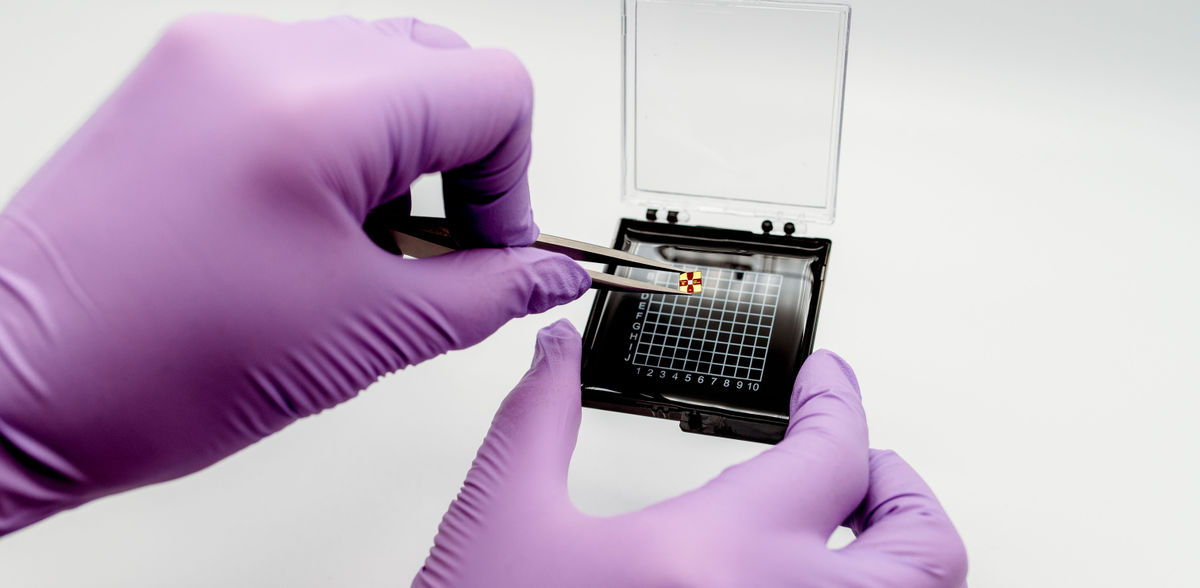
"In recent years, however, we have developed a detection method that makes tiny quantities of substances reliably measurable," says Silvan Schmid. Particles that accumulate on a tiny membrane are examined. The membrane together with the particles is illuminated by an infrared beam. Certain wavelengths are particularly well absorbed by the particles, causing the particles and therefore the membrane to heat up. This causes the vibration behavior to change slightly - similar to a drum, which sounds slightly different depending on the temperature. These differences can be measured and used to chemically identify tiny quantities of particles.
Greenland air and a nanoliter of tea
If you wanted to detect tiny fine dust particles in the air, for example, you used to use special filters that often had to have air flowing through them for days or weeks until a detectable amount of particles had accumulated there. With the membrane trick, a much smaller number of particles is sufficient - a result is obtained after just 15 to 45 minutes. This 100-fold reduction in sampling time enables cost-effective field studies on the chemical composition of atmospheric aerosols - from urban agglomerations to the polar regions.
Prof. Julia Schmale from the Extreme Environments Research Laboratory (EERL) at EPFL in Switzerland was able to use the new method to study aerosols from Arctic and Antarctic regions in order to understand their influence on the climate. The novel sensors are so sensitive and at the same time so portable that they could be launched on tethered balloons in polar regions to study the vertical distribution of air particles and their chemical composition.
"Thanks to the high sensitivity of our method, Julia Schmale's team can investigate the chemical composition of particles with high temporal resolution. In a sense, it is now possible to use tethered balloons to observe how the chemical composition of aerosol particles changes over very short periods of time and how they are distributed vertically on the Earth's surface and at altitude - something that was practically impossible with previous methods," explains Josiane P. Lafleur, Managing Director of Invisible-Light Labs.
The technology also works perfectly with liquids: Silvan Schmid's group at TU Wien analyzed 100 nanolitres of tea water - roughly one thousandth of a drop. And they were not only able to find tea particles in this tiny amount, they were even able to detect nylon residues from the tea bag.
"We have shown that our method enables an important leap forward in environmental analysis," says Silvan Schmid. "In collaboration with Invisible-Light Labs, we now want to continue working on the commercialization of this technology and hopefully make a contribution to more effective environmental protection."
Note: This article has been translated using a computer system without human intervention. LUMITOS offers these automatic translations to present a wider range of current news. Since this article has been translated with automatic translation, it is possible that it contains errors in vocabulary, syntax or grammar. The original article in German can be found here.
Original publication
Mihnea Surdu, Radiance Calmer, Jelena Timarac-Popović, Tatjana Penn, Niklas Luhmann, Johannes Hiesberger, Veljko Vukićević, Erine Alvino Démolis, Lionel Favre, Berkay Dönmez, Hajrudin Bešić, Kostas Kanellopulos, Silvan Schmid, Josiane P. Lafleur, Satoshi Takahama, Julia Schmale; "Quantifying submicrometer atmospheric aerosol chemical composition using nanoelectromechanical Fourier transform infrared spectroscopy"; Science Advances, Volume 12


Other news from the department science




















Most read news












More news from our other portals


























Something is happening in the chemical industry ...
This is what true pioneering spirit looks like: Plenty of innovative start-ups are bringing fresh ideas, lifeblood and entrepreneurial spirit to change tomorrow's world for the better. Immerse yourself in the world of these young companies and take the opportunity to get in touch with the founders.
See the theme worlds for related content
Topic World Spectroscopy
Investigation with spectroscopy gives us unique insights into the composition and structure of materials. From UV-Vis spectroscopy to infrared and Raman spectroscopy to fluorescence and atomic absorption spectroscopy, spectroscopy offers us a wide range of analytical techniques to precisely characterize substances. Immerse yourself in the fascinating world of spectroscopy!

Topic World Spectroscopy
Investigation with spectroscopy gives us unique insights into the composition and structure of materials. From UV-Vis spectroscopy to infrared and Raman spectroscopy to fluorescence and atomic absorption spectroscopy, spectroscopy offers us a wide range of analytical techniques to precisely characterize substances. Immerse yourself in the fascinating world of spectroscopy!
Last viewed contents

BASF invests in new alcoholates plant in Ludwigshafen - Advanced production facilities to support growing life science market as well as the biodiesel industry
Frost & Sullivan: Which are the emerging growth markets for nondestructive test inspection services? - Brazil and South Africa lead the way, while India and China offer long-term growth opportunities
Brenntag further strengthens its business in India

How dangerous are nanoplastics for babies in the womb? - The focus is on nanoplastic particles, which could lead to the development of a hypersensitive immune system in the child
Seeing clearly into a new realm – researchers prototype a new generation of quantum microscopy - “What began as an experimental annoyance ended up being a hint towards a capability of our microscope that is unique among current alternatives”
Indo-German research collaboration in the field of surface engineering and thin films officially started
Production begins at BASF’s largest Indian investment to date - BASF inaugurates chemical complex in Dahej, India
Portable and precise gas sensor could monitor pollution and detect disease
Monitoring of Critical Raw Material Recycling from Battery Black Mass - This study demonstrates the effective use of measuring instruments for separation and analysis
Making biodiesel from dirty old cooking oil just got way easier - New ultra-efficient catalyst can recycle old cooking oil into biodiesel and turn food scraps into high-value complex molecules