Biological recycling of electronic waste shows great potential
Microbes and algae as treasure hunters
Advertisement


microorganisms and microalgae can be used to recover valuable metals from electronic waste – in an environmentally friendly, selective manner with potential for industrial application. Researchers at the Fraunhofer Institute for Interfacial Engineering and Biotechnology IGB demonstrated this in a study. At IFAT 2026, the leading trade fair for environmental technologies in Munich, the IGB will demonstrate how this biological recycling works using a fixed-bed reactor.
Millions of tons of electronic waste are generated worldwide every year. Old smartphones, laptops, and other electronic devices contain valuable metals such as palladium and neodymium – raw materials that are indispensable for the production of modern technologies, electric motors, and wind turbines. So far, however, only a fraction of these metals has been recycled. The RüBioM feasibility study by Fraunhofer IGB in Stuttgart showed that biological processes offer a promising alternative here.
Bioleaching: Microorganisms extract valuable metals
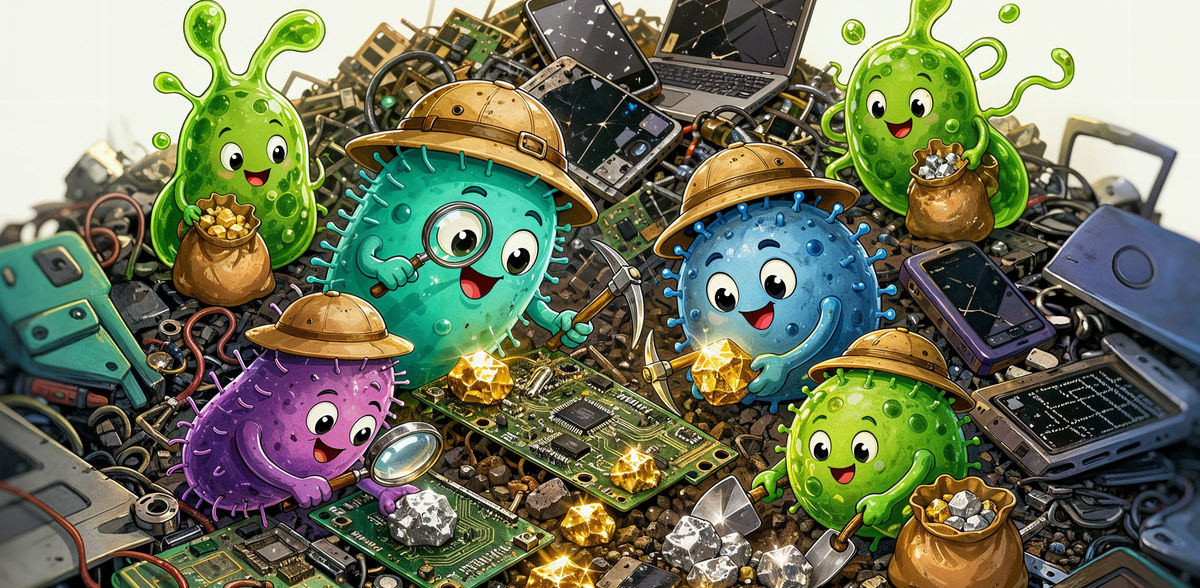
At the heart of the process is a technique known as bioleaching: microorganisms such as Pseudomonas aeruginosa are applied to shredded electronic waste. They produce acids and other compounds that selectively extract metals from the material. The resulting metal-containing solution is then treated using microalgae – the algae absorb the metal ions through biosorption, acting like biological sponges.
Promising laboratory results
“The results of the feasibility study are encouraging,” summarizes project manager Dr. Lukas Kriem. “We initially focused on palladium and investigated both bioleaching and biosorption. With bioleaching, the release rate was more than 13 percent higher than with comparable chemical methods. Using biosorption, we were even able to remove over 30 percent of the dissolved palladium.” The bioleaching of neodymium with the aid of various microorganisms was also examined closely. “Here, too, we see positive initial results, though these cannot – yet – compete with chemical processes,” Kriem continues.
Furthermore, these processes were tested on a larger scale in a fixed-bed reactor. Despite technical challenges such as biofilm formation and uneven flow, palladium was successfully mobilized – an important step toward industrial scalability.
Sustainable, resource-efficient, and economically viable
The biological process offers decisive advantages over conventional methods: It does not require toxic chemicals, operates at low temperatures, and enables selective metal recovery. In this way, biomining makes an important contribution to the circular economy and can reduce Europe’s dependence on metal imports from geopolitically sensitive regions – an aspect whose importance has become clear due to supply chain disruptions in recent years. “Sometimes the treasure isn’t buried deep underground, but right in our drawer,” Kriem sums up.
Outlook: Bio-recycling plants as a model for the future
The researchers’ vision is a decentralized bio-recycling infrastructure in which microbes and algae recover valuable raw materials from end-of-life devices locally and feed them directly into the production of new devices. To achieve this goal, further optimization of cultivation conditions and an economic evaluation of the processes are necessary. However, the groundwork has been laid.
Fraunhofer IGB is now actively seeking partners from the waste management sector and industry for joint follow-up projects. This year’s IFAT – taking place May 4 – 7, 2026, in Munich – offers interested parties the perfect opportunity to speak with the institute’s experts and learn more about potential applications. The Fraunhofer booth is located in Hall B2, Booth 115.


Other news from the department science





















Most read news











More news from our other portals



























Last viewed contents
Collaboration between University of Bristol and Malvern Panalytical - Bringing academia and business together to solve global challenges
Digital lab day 2025 celebrates international success - virtual battery day 2025 follows in November
RE:VOLTAGE and CometHire Win the HTW Startup Challenge 2026 in Berlin - The competition awarded 10,000 euros in prize money in the GreenTech and Impact Entrepreneurship categories
Atomic reshuffle paves way for record-breaking catalysts for hydrogen production - "This opens a new strategy for designing adaptive catalysts for a wide range of applications"

Global underground CO₂ storage hits record 43.6 million tonnes - London Register expands reach
Research Breakthrough on the Path to a New Reserve Antibiotic - For the first time, chemists have succeeded in synthesizing the highly potent natural compound neosorangicin A
Endress+Hauser expands its presence in the U.S. - 44 million euros are being invested in the new facility in Greenwood, Indiana
Plastic bottles could find new life in batteries as graphite - Penn State researchers converting PET waste into synthetic graphite that outperforms natural graphite
Turning food waste into carbon captors - Expected to be cheaper than other capture methods
Study shows: Lithium and sodium-ion technologies are more closely linked than assumed - "Switching to a new battery technology does not automatically open the door to new market players"
ETH spin-offs sweep the board at Venture Awards