Researchers discover an unexpected synthetic route: A new route to climate-neutral methane
A novel material can produce methane from water and carbon dioxide – as a climate-neutral substitute for natural gas
Advertisement


natural gas still plays an important role in many industrial sectors – but it is a climate-damaging fossil fuel. TU Wien and the University of Innsbruck have now discovered an unexpected reaction pathway that makes it possible to synthesize natural gas, or methane (CH4), using CO2 that was previously captured from exhaust gas streams or directly from the air. In this way, methane can become climate-neutral overall.
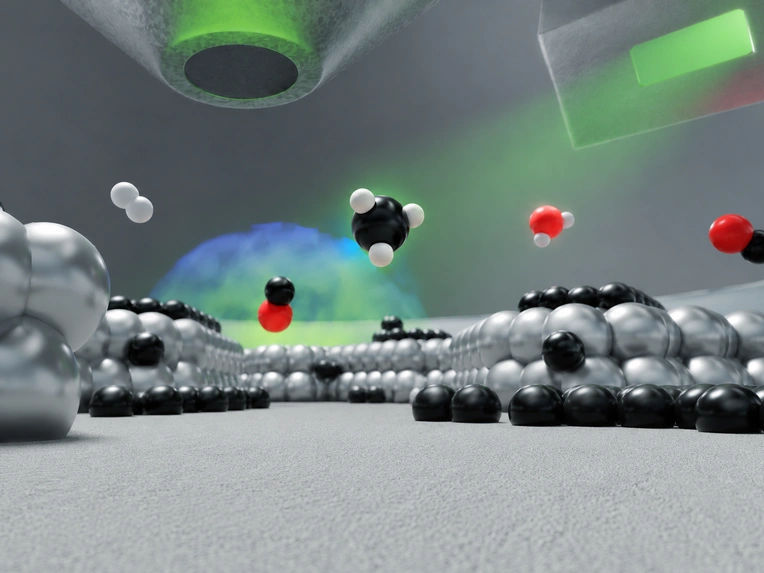
Under an applied electric voltage, the surface of nickel on zirconia can convert carbon dioxide and water vapor into methane – a possible way to store renewable energy chemically.
© TU Wien
To achieve this, however, special materials are needed. The search for such materials is the focus of the research project MECS, an Austrian Cluster of Excellence funded by the Austrian Science Fund FWF. Now, an important step has been achieved: The team investigated nickel on yttria-stabilized zirconia. In contact with water vapor and carbon dioxide, this material enables a complicated cascade of chemical processes, which has now been deciphered in detail for the first time – ultimately producing methane.
Two Steps at Once
“The idea of converting carbon dioxide into product gases is not new,” says Prof. Günther Rupprechter from the Institute of Materials Chemistry at TU Wien. “Carbon dioxide can be split and then reacted with hydrogen. However, the question then is: Where does the hydrogen come from?”

Today, most hydrogen is still produced from fossil sources – known as “black” or “grey” hydrogen. If one relies on such hydrogen, the overall process is not climate-neutral. “For us in the MECS research cluster, it was clear that it would be much more elegant to develop a process that accomplishes two things at the same time: first, splitting carbon dioxide in order to provide carbon, and second, splitting water in order to simultaneously provide ‘green’ hydrogen,” explains Günther Rupprechter. Hydrogen and carbon can then be used to form fully renewable methane (CH4). In further steps, if required, this methane could also be converted into other substances, such as renewable liquid fuels.
Zirconia, the Underestimated Star
“For years, it was assumed that nickel was the main factor determining this chemical process,” says Bernhard Klötzer from the University of Innsbruck. “But some experimental findings did not quite fit this picture. We wanted to understand exactly what is happening at the electrochemically active surface.”
To find out, the team developed a very special porous model electrode made of nickel on yttria-stabilized zirconia and analyzed it using X-ray photoelectron spectroscopy. This technique makes it possible to track chemical changes directly during the process, in real time.
The result was a surprise: Zirconia had originally been used mainly because it is permeable to oxygen ions and can transport oxygen away. “But as it turned out, zirconia plays a much more active role here than previously thought,” says Christoph Thurner, the first author of the current study. “When we apply an electric voltage, carbon is initially deposited on the nickel atoms – that was what we expected. But part of this carbon then migrates further onto the zirconia surface, where a reactive carbon-zirconium compound is formed. As soon as small amounts of water vapor come into contact with this compound, it reacts again, and methane is formed.”
Storing Solar Power Chemically
“The dynamic behavior of the zirconia surface turned out to be crucial,” says Alexander Genest from TU Wien, who carried out simulations. “We were able to show that methane is formed via a previously unknown reaction pathway. This opens up new perspectives for the development of electrolysis cells. It gives us a way to use surplus electrical energy electrochemically, for example on particularly sunny days when photovoltaics generate excess power, and produce methane. In this way, energy can be stored in the form of versatile fuels that can be stored over the long term without difficulty.”
Original publication


Other news from the department science





















Most read news











More news from our other portals



























See the theme worlds for related content
Topic World Spectroscopy
Investigation with spectroscopy gives us unique insights into the composition and structure of materials. From UV-Vis spectroscopy to infrared and Raman spectroscopy to fluorescence and atomic absorption spectroscopy, spectroscopy offers us a wide range of analytical techniques to precisely characterize substances. Immerse yourself in the fascinating world of spectroscopy!

Topic World Spectroscopy
Investigation with spectroscopy gives us unique insights into the composition and structure of materials. From UV-Vis spectroscopy to infrared and Raman spectroscopy to fluorescence and atomic absorption spectroscopy, spectroscopy offers us a wide range of analytical techniques to precisely characterize substances. Immerse yourself in the fascinating world of spectroscopy!
Last viewed contents

2026 KlarText Prize for Science Communication: Klaus Tschira Foundation Honors Seven Researchers - Articles such as “Good News for Those Who Hate Brussels Sprouts,” “The Stamp-Sized Lab,” and “Faster Drug Development Through Math” won over the jury

AkzoNobel and Axalta announce three directors to finalize the combined company Board
Innovation paves way to make ‘clean’ chemicals, plastics and food using solar energy - Integrated solar reactor uses sunlight, water, CO2 and engineered bacteria to grow biomass in a single beaker
Chemicals and energy sectors move away from fossil raw materials - Fraunhofer and an Estonian deep-tech start-up are testing a modular biomass platform on an industrial scale
From Flue Gas to Raw Material: Extracting Carbon from CO₂ Produced by Waste Incineration - KIT and EEW Energy from Waste (EEW) plan to use CO₂ from flue gases in the NECOC process

KAIST identifies a route to faster-charging, longer-lasting EV batteries - Research team uses a 3D digital twin to reveal localized degradation mechanisms during fast charging

Matthews Engineering and start-up hs-tumbler partner on dry battery electrode manufacturing - Companies aim to enable dry electrode manufacturing through trajectory mixing

Winter-ready lithium batteries: scientists use "polarity-contras" electrolyte strategy to outsmart extreme cold - Lithium metal batteries retain 80% capacity after 150 cycles at -40 °C

The competitiveness of low-carbon fuels depends on location - New infrastructure could boost European production

Deep tech startup Reduciner introduces novel technology to turn captured carbon into sustainable fuels - Raising 3.6 million euros in its initial funding round, the Finnish startup plans to build its first industrial-scale pilot
Bruker announces strategic collaboration with Atinary Technologies to advance self-driving laboratories