Fungal mycelium instead of epoxy resin: compostable printed circuit board developed
Researchers are using waste from citric acid production as the basis for biodegradable printed circuit boards.
Advertisement


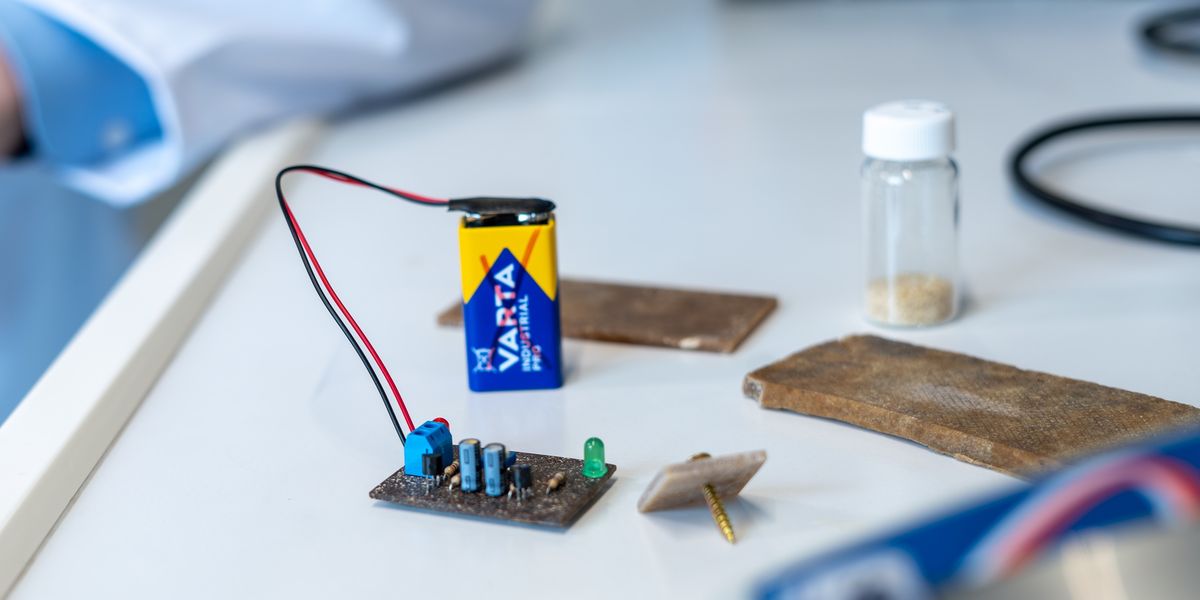
Worldwide, discarded electronic toys, computers, or smartphones are becoming increasingly massive amounts of electronic waste. The basis for electronic circuits are printed circuit boards (PCB), which are typically made of glass fiber-reinforced fossil epoxy resin, making them difficult to recycle, let alone biodegrade. A team from TU Bergakademie Freiberg has now presented a fully compostable alternative made from the mycelium of the Aspergillus niger fungus, a byproduct of industrial citric acid production.
Instead of disposing of this biomass waste, the team processes it into a plastic-like material through an innovative process involving molding and air-drying, resulting in a small, approximately 0.5 cm thick plate with a density of 1.23 g/cm³, comparable to the density of conventional printed circuit boards (PCBs). Using direct ink writing or a standard etching process and manual soldering, the researchers were able to deposit electronic components directly onto the fungal plates.
"In laboratory tests, the material from fungal mycelium shows high mechanical properties and good heat stability," explained Nina Oehlsen, a doctoral student at the TU Bergakademie Freiberg and first author of the scientific publication. "Although the electrical properties are still below those of standard PCBs, fungal mycelium is sufficient for prototype or low-frequency applications - such as environmental sensors, consumer goods, and toys."
However, in order for the plate to be comparable to current PCBs, it must be tested according to standards such as IPC-A-600 or DIN EN 60249-1 and optimized in terms of its water absorption.
Challenges in End-of-Life Management
By 2030, an estimated 82 million tons of electronic waste are expected worldwide, according to the "Global E-waste Monitor". The sustainable circuit board, named AnimatPCB, addresses not only the environmental burden of non-recyclable e-waste but also offers a solution for the avoidance of non-reusable materials at the end of life of the circuit boards. The circuit board itself is fully biodegradable, and the transistors deposited on it could be functionally recovered, said Linus Stegbauer, junior professor for biogenic technical materials at the TU Bergakademie Freiberg: "We have created a high-quality, functional material from an industrial waste product - without additional fossil raw materials. In comparison to a conventional circuit board, fungal mycelium has up to 56% lower CO2 footprint and can be easily and safely dissolved in water at the end of its life."
The bio-inspired research can make a significant contribution to the development of a circular electronics industry: "We demonstrate that it is possible to develop high-quality electronic components without long-term environmental burden - and show solutions for a circular electronics industry," emphasizes Professor Simon Glöser-Chahoud, an economist at the TU Bergakademie Freiberg, who calculated the CO2 footprint over the entire life cycle of the innovative material.
Original publication


Other news from the department science





















Most read news











More news from our other portals



























Last viewed contents

RE:VOLTAGE and CometHire Win the HTW Startup Challenge 2026 in Berlin - The competition awarded 10,000 euros in prize money in the GreenTech and Impact Entrepreneurship categories
Atomic reshuffle paves way for record-breaking catalysts for hydrogen production - "This opens a new strategy for designing adaptive catalysts for a wide range of applications"

Global underground CO₂ storage hits record 43.6 million tonnes - London Register expands reach
Research Breakthrough on the Path to a New Reserve Antibiotic - For the first time, chemists have succeeded in synthesizing the highly potent natural compound neosorangicin A

Endress+Hauser expands its presence in the U.S. - 44 million euros are being invested in the new facility in Greenwood, Indiana
Plastic bottles could find new life in batteries as graphite - Penn State researchers converting PET waste into synthetic graphite that outperforms natural graphite
Turning food waste into carbon captors - Expected to be cheaper than other capture methods
Study shows: Lithium and sodium-ion technologies are more closely linked than assumed - "Switching to a new battery technology does not automatically open the door to new market players"

ETH spin-offs sweep the board at Venture Awards
How to generate and steer electrons in liquid water - Surprising results reveal a new aspect of extremely strong electric fields in liquid water
Turning renewable energy into drop-in fuels - Synhelion advances scale-up with large-scale synthetic fuel project in Morocco