A Sustainable Flame Retardant Derived From Corn Steep Liquor
Bio-based flame retardant derived from starch production wastewater matches the effectiveness of commercial reference compounds
Advertisement


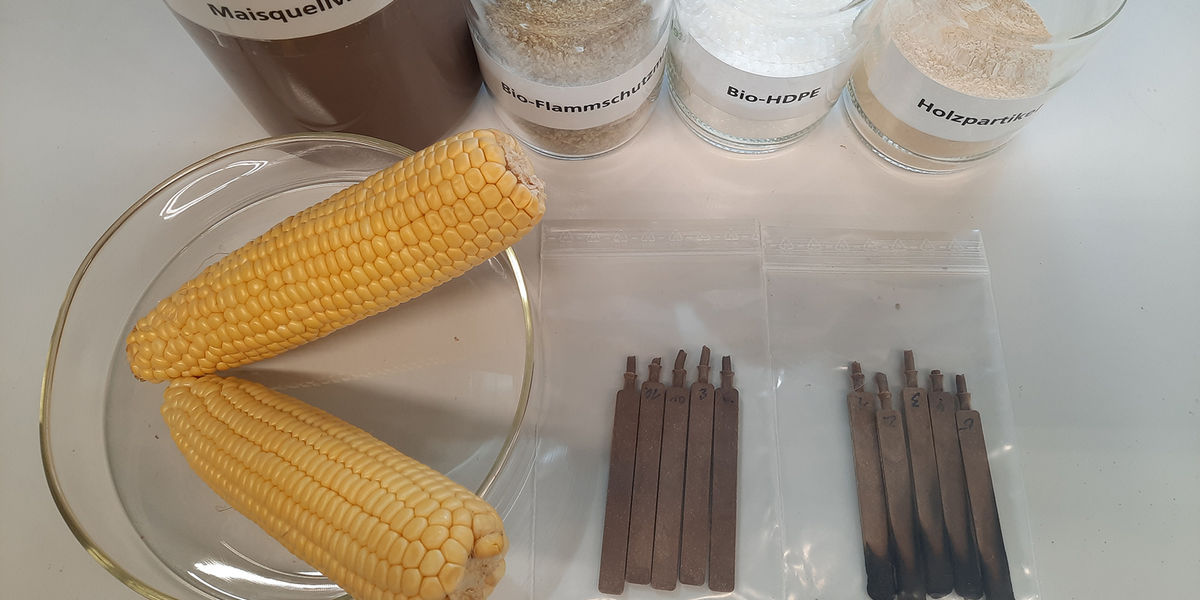
Halogenated flame retardants raise environmental concerns and are considered harmful to human health. As a result, researchers have been searching for alternatives for many years. Fraunhofer researchers are focusing on sustainable phosphorus-based raw materials derived from corn steep liquor. The phytic acid it contains is an excellent natural flame retardant for biomaterials.
Certain phosphorus compounds are highly effective at suppressing fires, which is why they are widely used in flame retardants. Phosphorus, however, is a finite resource. Estimates suggest it could be depleted within the next 50–300 years. That is why, as part of the ScaleAmP project, a research team is working to extract phosphorus from corn steep liquor, a byproduct of starch production. The team brings together researchers from the Fraunhofer Institute for Wood Research, Wilhelm-Klauditz-Institut WKI and the Fraunhofer Institute for Applied Polymer Research IAP. Together with partners, they are using corn steep liquor to develop a flame retardant for use in wood-plastic composites (WPCs) and other biomaterials.
The phytic acid that can be extracted from corn steep liquor, also known as phytate, is a natural source of phosphorus. It is found in large quantities in plants such as corn, wheat bran, soybeans and rice. “Commercial halogenated flame retardants are highly effective, but they are also toxic and environmentally harmful. To help protect the climate and meet regulatory requirements, industry is stepping up its transition to sustainable phosphorus-based flame retardants,” says Matthias Bischoff, a research scientist at Fraunhofer WKI. “We are supporting this trend by using the phytic acid in corn steep liquor as an active ingredient in flame retardants and developing a cost-effective process for producing the flame retardant on a technical scale.” The research partners are demonstrating potential applications and flame retardant properties using a wood-plastic composite material, which is used in construction and in the automotive and furniture industries.
Thanks to its high phosphorus content, phytic acid has strong potential as a flame retardant, especially in the form of ammonium phytates. When heated, the molecule forms an insulating carbon layer that cuts off the fire’s oxygen supply. However, for effective flame retardancy, phytic acid absolutely requires a source of nitrogen to form a synergistic compound with phosphorus. Pure phytic acid is ineffective and has a very low pH, making it incompatible with most materials.
Sustainable extraction of phytic acid
One challenge the researchers faced was developing an efficient, cost- effective process to purify phytic acid, which is highly water-soluble. Using a series of simple procedural steps, Fraunhofer IAP researchers successfully extracted phytic acid. By separating solids from liquids and adjusting the pH, they separated proteins and organic acids, the main components of corn steep liquor. Another challenge was identifying which amines work best with phytic acid to evaluate flame retardant performance. To do this, Bischoff and his team at Fraunhofer WKI studied more than 20 different amines.
Bio-based flame retardants can compete with commercially available, non- sustainable products
The ammonium phytates obtained were compounded into WPC test specimens. To assess the flame retardant performance of different ammonium phytate formulations in varying ratios, the researchers ran standard tests such as the UL 94 flammability test and the limiting oxygen index test. They then compared the WPC specimens to assess the effectiveness of the various ammonium phytate formulations. The result: The best ammonium phytate formulation tested delivered flame retardant performance comparable with the commercially available reference product.
So far, Fraunhofer researchers have been extracting phytic acid at the 1-kilogram scale. The next step would be to scale production up to 100 kilograms. They also plan to tap additional feedstocks beyond corn steep liquor, such as rice or wheat, and further refine the purification process. “Its potential for industrial-scale use hinges on the combination of a reliable supply, ease of processing, flame retardant performance and price,” Bischoff says.


Other news from the department science





















Most read news











More news from our other portals



























Last viewed contents
Hydrogen from Waste Materials for Stationary and Mobile Engines - Lower purity requirements open up the use of fermentation residues and sewage sludge as sources of hydrogen
New paths for quantum technologies: Optical control of nuclear spins in molecules - Molecular systems can be chemically tailored and could thus enable atomically precise qubits

How Carbon Accounting Rules Shape Incentives for Hydrogen Production

How Chemicals End Up in the Mountains - Permanent chemicals harm insects—even in near-natural habitats
Quasiparticle solves mystery of vanishing conductivity - CAU team detects polarons in rare earth compound for the first time
Cryo-electron microscopy – Reaction cycle of an enzyme for CO2 fixation decoded - A promising enzyme candidate for biofuel production from carbon dioxide

Protein Content in Foods — New Conversion Factors Enable More Precise Assessment - Max Rubner Institute Releases New Database for Nitrogen-to-Protein Conversion

AI-driven microorganism mix has the potential for groundbreaking innovation - Federal Ministry for the Environment Launches First Joint SPRIND Challenge for a Biotech Breakthrough in the Circular Economy
Researchers develop cleaner, scalable process to recycle lithium-ion batteries - "We’ve shown that it’s possible to create high-performance batteries from recycled materials at scale"
30 Million Euros for Catalyst Research Using AI-Controlled Laboratories - ASCEND is leveraging automated learning loops and 3D thin-film catalysts to develop industrially viable drop-in substitutes.
