Sketchy emission reports revealed by Empa measurements at Jungfraujoch
Fudging in greenhouse gas stats?
Advertisement


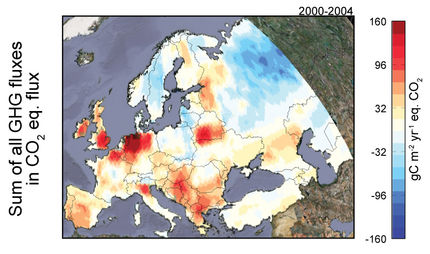
Fluorinated hydrocarbons are potent greenhouse gases, emission of which must be reduced under the Kyoto Protocol. If you rely on the official reports of the participating countries, the output of trifluoromethane (HFC-23) in Western Europe is indeed significantly decreasing. However, pollutant measurements carried out by Empa now reveal that several countries under-report their emissions. For instance, Italy emits 10 to 20 times more HFC-23 than it officially reports.
International agreements such as the Kyoto Protocol to reduce greenhouse gases (GHG) basically have one snag: it is almost impossible to independently verify whether participating countries abide by the agreement. Thus the evaluation of whether or not the countries have achieved their reduction targets is based on the official reports by the countries that are signatories to the UNFCCC (‘United Nations Framework Convention on Climate Change’). If they report reduced emissions they're sitting pretty; if not, they are pilloried.
This could change soon. Pollutant analyses by Empa, the Swiss Federal Laboratories for Materials Science and Technology, – at the Jungfraujoch research station at 3580 metres above sea level, among others – using a special gas chromatograph mass spectrometer called ‘MEDUSA’ not only enables the emission levels of more than 50 halogenated GHG to be quickly and precisely evaluated; they also make it possible to identify the emission sources regionally, thanks to atmospheric and meteorological computer models. The sobering result: Western Europe emits around twice as much HFC-23 as officially reported. A corresponding study was recently published in the journal ‘Geophysical Research Letters’.

“Our results show that these types of measurements really are suitable for checking compliance with international agreements on air pollution control”, says Empa researcher Stefan Reimann from the ‘Air Pollution/Environmental Technology’ laboratory. It is true that the Kyoto Protocol did not specify any independent control mechanisms; this could, however, be of central importance in subsequent agreements with binding emission targets.
The usual suspects?
The suspicion that some countries have not been overly precise in reporting their GHG emissions has been around for some time; projections from measurements of the world-wide AGAGE network (‘Advanced Global Atmospheric Gases Experiment’) showed significantly higher readings than officially reported. Reimann: “It was assumed that, above all, China and some developing countries did not correctly report their emissions levels.“
For example emissions of HFC-23, with an atmospheric half life of approximately 270 years an extremely long-lived GHG – and with a global warming potential 15,000 times greater than CO2 a particularly potent one. HFC-23 is produced as a by-product in the manufacture of chlorodifluoromethane (HCFC-22), which is used as a cooling and foaming agent and in Teflon production. The advantage of HFC-23 is that it is almost exclusively emitted by HCFC-22 manufacturers. And there were just six of them in Western Europe in 2008. Reimann: “That means we exactly know our point sources.”
In order to estimate the HFC-23 amounts in the atmosphere over Western Europe as precisely as possible, Reimann and his doctoral student, Christoph Keller, analysed the HFC-23 emissions from July 2008 to July 2010 at both Jungfraujoch and Mace Head, an AGAGE measurement station on the west coast of Ireland. Time and again they found mysterious peaks, which far exceeded the average. Using atmospheric transport models, the Empa researchers were able to calculate where the polluted air masses originated that transported HFC-23 to Jungfraujoch – first and foremost from Italy's sole HCFC-22 factory west of Milan.
"Clean" Italy: virtually HFC-23-free since 1996 – according to the records
So far, so good. If it were not for the official figures from Italy, which did not report any appreciable HFC-23 emissions – and that since 1996. An isolated case? Reimann and his team wanted to dig deeper. With financial support from the Federal Office for the Environment (FOEN), they evaluated HFC-23 figures for 2008 to 2010 throughout Western Europe and pinpointed the source regions. The emission figures approximately doubled those that had been reported – whereby countries significantly differed in their ‘reporting accuracy’. Alongside the ‘front runner’ Italy, also the Netherlands and Great Britain underestimated their HFC-23 emissions; France and Germany’s figures, in contrast, lay within the reported values. And, to Reimann's delight, the computer model was able to identify all six HCFC-22 factories with great accuracy.
Overall the unreported amounts of ‘Italian’ HFC-23 could be calculated as 270,000 to 630,000 tonnes of CO2 equivalent – roughly corresponding to the annual CO2 emissions of a city of 75,000 inhabitants. “On the other hand, what is positive is that we can ‘see’ emission sources, which are located hundreds of kilometres away from Jungfraujoch”, reflects Reimann. In order to be able to collect data such as these on a global scale, the network of measurement stations would have to expanded, above all in Eastern Europe and East Asia.
Original publication


Other news from the department science



















These products might interest you

Most read news












More news from our other portals


























See the theme worlds for related content
Topic World Mass Spectrometry
Mass spectrometry enables us to detect and identify molecules and reveal their structure. Whether in chemistry, biochemistry or forensics - mass spectrometry opens up unexpected insights into the composition of our world. Immerse yourself in the fascinating world of mass spectrometry!

Topic World Mass Spectrometry
Mass spectrometry enables us to detect and identify molecules and reveal their structure. Whether in chemistry, biochemistry or forensics - mass spectrometry opens up unexpected insights into the composition of our world. Immerse yourself in the fascinating world of mass spectrometry!
Topic world Gas chromatography
Gas chromatography is an essential method in analytical chemistry for the separation and analysis of volatile compounds. Due to its high resolution and sensitivity, it has become firmly established in areas such as environmental analysis, food chemistry or forensic science. GC provides precise and reliable results and enables deep insights into the chemical composition of samples.

Topic world Gas chromatography
Gas chromatography is an essential method in analytical chemistry for the separation and analysis of volatile compounds. Due to its high resolution and sensitivity, it has become firmly established in areas such as environmental analysis, food chemistry or forensic science. GC provides precise and reliable results and enables deep insights into the chemical composition of samples.
Topic World Chromatography
Chromatography enables us to separate, identify and thus understand complex substances. Whether in the food industry, pharmaceutical research or environmental analysis - chromatography opens up a treasure trove of information about the composition and quality of our samples. Discover the fascinating world of chromatography!

Topic World Chromatography
Chromatography enables us to separate, identify and thus understand complex substances. Whether in the food industry, pharmaceutical research or environmental analysis - chromatography opens up a treasure trove of information about the composition and quality of our samples. Discover the fascinating world of chromatography!
Last viewed contents
Polar air and tea: TUW invention makes environmental pollutants measurable - Fine dust in the air or nanoparticles in water - with an amazing new technology from TU Wien, tiny quantities of a wide variety of substances can be detected in a short space of time
BASF invests in new alcoholates plant in Ludwigshafen - Advanced production facilities to support growing life science market as well as the biodiesel industry
Frost & Sullivan: Which are the emerging growth markets for nondestructive test inspection services? - Brazil and South Africa lead the way, while India and China offer long-term growth opportunities
Brenntag further strengthens its business in India

How dangerous are nanoplastics for babies in the womb? - The focus is on nanoplastic particles, which could lead to the development of a hypersensitive immune system in the child
Seeing clearly into a new realm – researchers prototype a new generation of quantum microscopy - “What began as an experimental annoyance ended up being a hint towards a capability of our microscope that is unique among current alternatives”
Indo-German research collaboration in the field of surface engineering and thin films officially started
Production begins at BASF’s largest Indian investment to date - BASF inaugurates chemical complex in Dahej, India
Portable and precise gas sensor could monitor pollution and detect disease
Monitoring of Critical Raw Material Recycling from Battery Black Mass - This study demonstrates the effective use of measuring instruments for separation and analysis
Making biodiesel from dirty old cooking oil just got way easier - New ultra-efficient catalyst can recycle old cooking oil into biodiesel and turn food scraps into high-value complex molecules