Neonicotinoid pesticides cause harm to honeybees
Advertisement


One possible cause of the alarming bee mortality we are witnessing is the use of the very active systemic insecticides called neonicotinoids. A previously unknown and harmful effect of neonicotinoids has been identified by researchers at the Mainz University Medical Center and Goethe University Frankfurt. They discovered that neonicotinoids in low and field-relevant concentrations reduce the concentration of acetylcholine in the royal jelly/larval food secreted by nurse bees. This signaling molecule is relevant for the development of the honeybee larvae. At higher doses, neonicotinoids also damage the so-called microchannels of the royal jelly gland in which acetylcholine is produced.
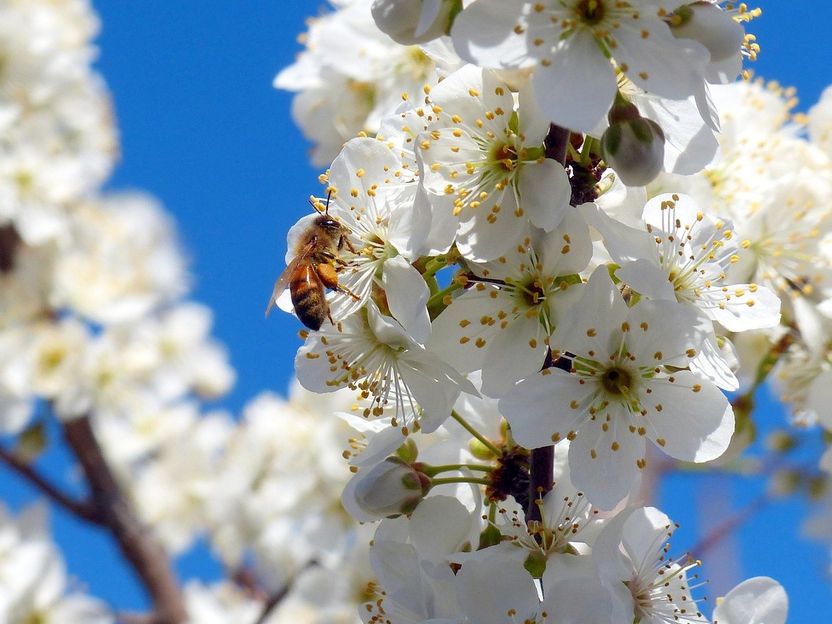
dmgreen44, pixabay.com, CC0
"As early as 2013, the European Food Safety Authority published a report concluding that the neonicotinoid class of insecticides represented a risk to bees," said Professor Ignatz Wessler of the Institute of Pathology at the University Medical Center of Johannes Gutenberg University Mainz (JGU). "The undesirable effect of neonicotinoids now discovered is a further indication that these insecticides represent a clear hazard to bee populations and this is a factor that needs to be taken into account in the forthcoming reassessment of the environmental risks of this substance class." Working in collaboration with Professor Bernd Grünewald of the Bee Research Institute at Goethe University Frankfurt, Professor Ignatz Wessler and his team uncovered this previously unknown damaging effect of neonicotinoids that impairs the development of honeybee larvae.
Wessler and Grünewald were able to directly demonstrate that neonicotinoids reduce the acetylcholine content of the larval food produced by nurse bees. Acetylcholine is a signaling molecule produced in the microchannels of the royal jelly gland of nurse bees. Comparable to neonicotinoids, it stimulates the nicotinic acetylcholine receptors that are also present in this gland.
"In lab tests we artificially removed acetylcholine from the larval food and the result was that bee larvae fed with this died earlier than bee larvae that received food containing acetylcholine," explained Wessler. In order to examine the effect of neonicotinoids on the acetylcholine content in the jelly in more detail, bee colonies were exposed to various concentrations of neonicotinoids in flight tunnels (clothianidin: 1, 10 and 100 µg/kg glucose solution; thiacloprid 200 and 8800 µg/kg). "This exposure led to a reduction in the acetylcholine content of the jelly. Thus we were able to demonstrate that the field-relevant dose of the neonicotinoid agent thiacloprid (200 µg/kg) significantly reduces acetylcholine content by 50 percent. On exposure to higher doses, we were even able to verify that acetylcholine content can be reduced by 75 percent. Exposure of the bees with the higher doses results in serious damage to the microchannels and secretory cells of the jelly gland," emphasized Professor Ignatz Wessler. "Our research results thus confirm that the neonicotinoids can jeopardize the normal development of honeybee larvae."
The EU came to a similar conclusion back in December 2013 and imposed temporary restrictions on the use of three neonicotinoids, i.e., clothianidin, imidacloprid, and thiamethoxam. It had already been reported in several scientific publications that high but not lethal doses of various neonicotinoids could be associated with the falls in the populations of wild bees, bumblebees, and queen bees. Also reported were abnormalities in breeding activity and impaired flight orientation in the case of honeybees. However, at the time there were critics of these reports who pointed out that, among other things, the researchers had used high, non-field-relevant doses of neonicotinoids and had carried out their experiments under artificial laboratory conditions. Moreover, the proponents of the use of neonicotinoids cited other possible causes of bee mortality, for example, the proliferation of the varroa mite and other pathogens.
Original publication


Other news from the department science




















Most read news












More news from our other portals


























Last viewed contents
BASF increases European prices for methylamines and methylamine derivatives
Intelligent material improves aerodynamics in cars and aircraft - Start-up designs active components and systems based on shape memory alloys

3E acquires Yordas and expands its REACH registration business - Yordas manages REACH registrations for over 100 multinational companies across seven global jurisdictions

More cost-effective production of fuels from renewable electricity - Start-up receives €1.2 million in fresh capital for particularly innovative technology

German industrial pump specialist Lutz Holding expands into Italy - Operations have commenced at the new branch office “Lutz-Jesco Italia S.r.l.”
Useful Alcohols: Ceresana Analyzes the World Market for Solvents

Sachverständigenbüro für Kunststoffe Dr. Sebastian - St. Wendel, Germany
Automated measurement system enhances quality, reduces handling in Pu-238 production
BASF increases prices in Europe for Dimethylaminopropylamine and Dimethylacetamide
A pioneering spectrometer for hard X-rays at European XFEL - "The new spectrometer opens up completely new spectroscopic possibilities at high X-ray energies"

How to tell if that plastic bottle or bag has recycled material in it