Photoreversible molecular switch changes the physical property of thermoresponsive polymer
Advertisement


Researchers have developed a novel strategy to control the shapes of polymeric materials by utilizing photoresponsive molecular switches, which may evolve tractable stimuli-responsive soft materials.
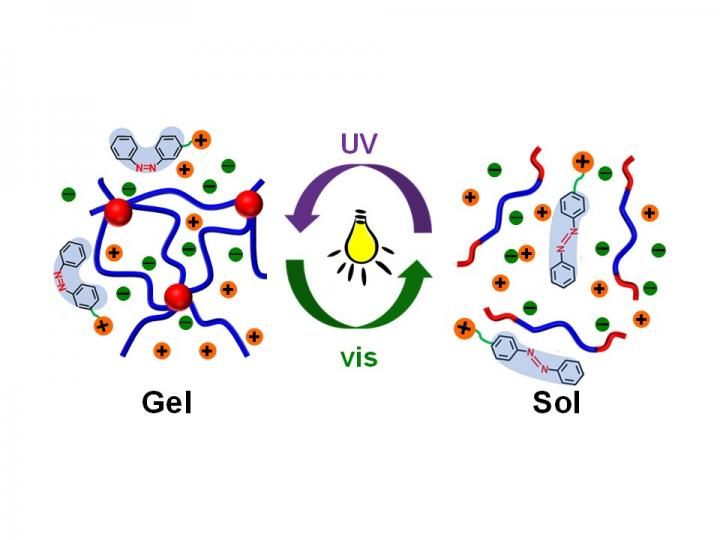
Schematic illustration of sol-gel transition triggered by photoisomerization of azobenezene-containing ionic liquid molecular switch.
Yokohama National University
Ionic liquids (ILs) are liquid-state salts at room temperature and are high-potential materials in electrochemistry and materials science because of their unique properties such as high chemical and thermal stabilities, negligible volatility and flammability, and suitable ionic conductivity. The group previously developed ion gels suitable for industrial application by combining ILs and network polymer molecules.
The group reported that thermoresponsive triblock copolymers in a conventional IL containing a small amount of azobenezene-IL (a photoresponsive molecule) showed reversible physical property changes upon by light irradiation. Sol and gel states of the mixture were tunable by light, i.e., the gel state was formed under UV light and the sol state was formed under visible light. Photoisomerization of azobenzene in the IL triggered the macroscopic response. The composite also possessed similar ion conductivity as conventional ILs.
"This is the first application of an ionic liquid functioning as a molecular switch," says corresponding author Masayoshi Watanabe, Professor, Yokohama National University. "The important point in this system is that photo-responsive azobenzene is added to a solvent. Compared to conventional stimuli-responsive polymers, the solubility of the mixture can be controlled by the structural change of the solvent, not that of the polymer."
This system could aid the development of a novel electrolyte that exhibits photoreversible viscoelastic changes and could be applied to other polymers for the production of innovative stimuli-responsive soft materials, e.g., in printing and biomedicine.
Original publication


Other news from the department science




















Most read news












More news from our other portals


























Last viewed contents
Chemical plastics recycling is ready to go - “It’s every chemical engineer’s dream to have a formula like this at hand for their process”
International agreement on the FAIR international accelerator facility
Animal-free method predicts nanoparticle toxicity for safer industrial materials - A step closer to safe-by-design material development
Researchers describe 'implausible' chemistry that produces herbicidal compound

Chemetall opens new surface treatment plant in India

Will the climate transition be a battle of materials? - Heavy additional demand for commodities like cobalt, lithium, copper, aluminium and iron: Countermeasures include behavioural changes in mobility, housing and nutritin
New AI algorithm generates innovative substances on the basis of desired properties - Function determines form

Beyond lithium: A systematic search for candidate materials for calcium-ion batteries - Scientists conduct quantum mechanics simulations to identify a promising class of materials for new types of rechargeable battery
Bioplastic bottles also keep cooking oil fresh for a long time - No transfer of compounds from the bottle material into the oil detected
Pea protein, Nanogels and Particle adhesion on surfaces - 3 young trend-setters nominated for LUM science award YSA 2019
DKSH extends partnership with LAUDA to Singapore and Taiwan