Towards a new design paradigm for high-performance catalysts
Advertisement


Mark Greiner and Travis Jones from the Max-Planck Institute for Chemical Energy Conversion and the Fritz-Haber Institute, along with a team of international researchers, have recently made a discovery that could transform the way chemicals are synthesized.
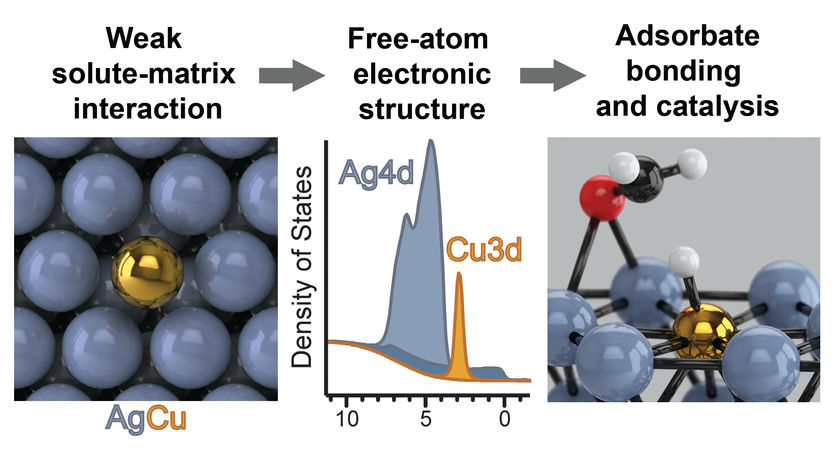
An illustration of an isolated-atom alloy
Nature Chemistry
The chemical industry relies on high-performance catalysts to produce the chemicals used by society – such as fuels, plastics and medicines. Some chemicals cannot be efficiently produced because the needed catalysts have not yet been discovered. A great deal of contemporary research is aimed at designing novel catalysts to fulfill these roles.
Recently reported in the journal Nature Chemistry, Greiner, Jones and Co. discovered a phenomenon that occurs in metal alloys that could yield a new design paradigm for high-performance catalysts. The team of researchers found that when adding a very small amount of one metal to another, the minority element’s properties can change drastically, altering how it interacts with molecules. This finding is of particular interest to chemical industry, where the efficiency of chemical production often depends on how molecules interact with metal catalysts.
The team found that a dilute mixture of copper in silver results in certain properties that resemble free isolated atoms. Nature uses isolated metal atoms in biological catalysts called enzymes. These finely tuned catalysts are known for their unparalleled catalytic efficiency. However, industrial catalysts have yet to capitalize on this phenomenon because they require much harsher conditions than biological systems can tolerate. Industrial catalysis must instead rely on less efficient inorganic materials in the form of macroscopic particles. By taking advantage of the properties of isolated atoms, there is the potential that catalytic efficiencies of industrial catalysts could rival biological systems.
Jones and Greiner made use of the recently developed concept of “single-atom alloys–alloys” in which the minority element forms no bonds to other minority element atoms. Using such materials, they showed experimentally that certain single-atom alloys exhibit properties that resemble isolated ions. With theoretical calculations, they showed that a number of metal combinations should also give rise to this behavior, representing a class of hitherto unexplored class of materials whose catalytic properties can be tuned. These findings could open up a new paradigm for designing novel high-performance catalysts.
Original publication


Other news from the department science




















Most read news












More news from our other portals


























See the theme worlds for related content
Topic world Synthesis
Chemical synthesis is at the heart of modern chemistry and enables the targeted production of molecules with specific properties. By combining starting materials in defined reaction conditions, chemists can create a wide range of compounds, from simple molecules to complex active ingredients.
Topic world Synthesis
Chemical synthesis is at the heart of modern chemistry and enables the targeted production of molecules with specific properties. By combining starting materials in defined reaction conditions, chemists can create a wide range of compounds, from simple molecules to complex active ingredients.
Last viewed contents

New system for widespread availability of green hydrogen - Hydrogen researchers and Graz-based start-up developed a cost-effective process for the decentralised production of high-purity hydrogen
Breakthrough in capturing 'hot' CO2 from industrial exhaust - A metal-organic framework is capable of capturing CO2 at extreme temperatures
Hybrid electrolyte enhances supercapacitance in vertical graphene nanosheets
Statistics on Chemistry Degree Programs in Germany: More International Students - Around 30 percent of doctoral students in 2024 came from abroad

Analytica conference 2020 for the first time virtual - Topics in focus: Antibiotic resistance and the “laboratory of the future”

Graphene discovery could help generate hydrogen cheaply and sustainably - Microscopic insights into electrochemical interfaces

Bright and tough: A material that heals itself and glows - New material could pave the way for new materials such as organic solar cells
Do We Need to Reassess Chemicals? - Chlorinated organic substances can be converted into dioxins in the atmosphere
INVISTA’s polyamide salt facility starts production
BASF inaugurates world-scale acrylic acid complex in Brazil
Physicists catch a magnetic wave that offers promise for more energy-efficient computing