As hard as a diamond and as deformable as metal
Scientists develop new material for tomorrow's technology
Advertisement


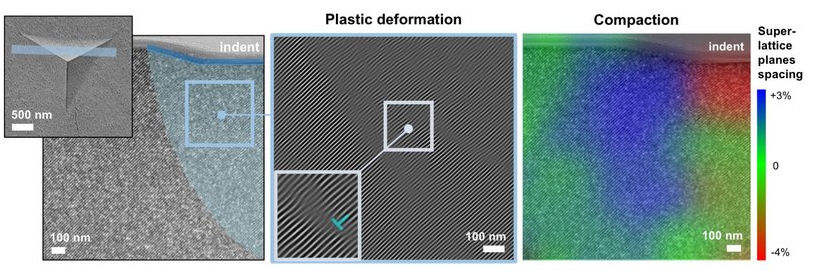
Smartphones with large glass housings and displays are impressive, but they are also very prone to get cracked and scratched. To prevent these kinds of damages, a material combining the hardness of diamond and the deformability of metals would be ideal – and is indeed considered the holy grail of structural materials. Professor Gerold Schneider of the Hamburg University of Technology and other Hamburg materials researchers, together with colleagues in Berkeley, California, have now developed a hybrid material, a so-called supercrystal, that comes closer to achieving this goal.
TU Hamburg
Such a material has the potential to make technology in areas such as electronics, photonics and energy storage more robust and cost-effective.
Deformable material made of nanoparticles
In collaboration with colleagues from the Helmholtz-Zentrum Geesthacht and the University of California, Berkeley, the research team led by Professor Gerold Schneider has discovered that nanoparticles can be arranged like atoms in a three-dimensional, periodic lattice, and adhere to each other with the help of ultra-thin layers of fatty acids. Since the nanoparticles are made of hard iron oxide, a type of rust, and the bonding layer is made of liquid oleic acid, the supercrystal is both hard and at the same time easy to deform, together with completely environmentally compatible. Perfect for surfaces subject to heavy wear.
New material concept
"Plastic deformation of materials such as copper, aluminum or steel has long been known in research. The fact that this mechanical behavior can also be transferred to high-strength supercrystals is completely new," explains Diletta Giuntini, a research associate at TU Hamburg and now an assistant professor at the Eindhoven University of Technology. "As part of our work, we have gained valuable knowledge about how to control the mechanical properties and deformability of supercrystals. In the next steps, we want to fine-tune their individual components and the interactions among them, and perfect these hybrid materials for a diverse set of applications," she continued.
Original publication


Other news from the department science




















Most read news












More news from our other portals


























Last viewed contents
Controlling chemical reactions more efficiently and sustainably - New synthesis method enables targeted modifications to hard-to-reach sites on molecules
WACKER Presents Innovation Award for Novel Manufacturing Process for Polymer Dispersions

Artificial rocks from macroplastics threaten ocean health - German-Indonesian research team identifies new rock-like compounds from plastic waste and coral rubble for the first time

RCT Reichelt Chemietechnik | Flow indicators | Reichelt Chemietechnik

World record for tandem perovskite-CIGS solar cell

New method for determining exchange energy in 2D materials - Detective work yielded a simple solution
Magnetism without metal: a milestone for materials science - “This is fundamentally new”

Magnetic nanoparticles change their magnetic structure in a magnetic field - International research team studies the effects of magnetic fields on magnetic nanoparticles
Breakthrough in capturing 'hot' CO2 from industrial exhaust - A metal-organic framework is capable of capturing CO2 at extreme temperatures
Quantum Tricks to Unveil the Secrets of Topological Materials
The nano-lasagna: Novel 2D materials gain momentum - Research team develops environmentally friendly MXene synthesis without hazardous hydrofluoric acid for industrial scaling