Sustainable Chemistry Based on Wood
Producing materials for solar cells, light-emitting diodes and other organic electronics applications as sustainably as possible
Advertisement


Some hikers carry a small solar power plant with them: a foil is attached to their backpack that converts sunlight into electricity. This allows them to charge their mobile phone while on the move. Flexible, thin and lightweight solar panels can also be attached to outdoor clothing or glued to curved surfaces - such as the roofs of mobile homes.

Example of a boron-containing polymer based on furan.
Maximilian Fest / Universität Würzburg
Such solar cells capture the sun's energy not with crystalline silicon, but with special organic materials. Unfortunately, these materials have so far been made from crude oil or natural gas - and that is not in the spirit of sustainability.
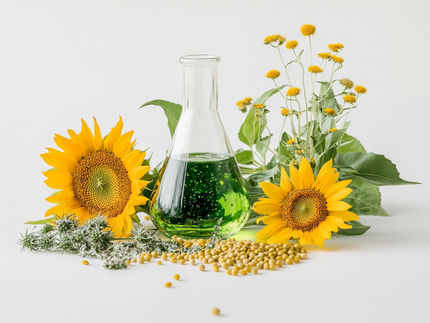
That's why scientists are looking for alternatives. The team led by chemistry professor Holger Helten from the Julius-Maximilians-Universität (JMU) Würzburg in Bavaria, Germany, has a focus on the renewable raw material wood. Furans can be derived from wood, and these ring-shaped molecules are very suitable for organic electronics: they can be used for solar cells, light-emitting diodes, displays or electronic circuits.
Boron stabilises furan-based polymers
Crucially, furan-based materials have much better properties for many applications than most materials used in organic electronics to date. Compared to standard thiophene-based materials, they have, among other things, a stronger luminosity and are more soluble - this simplifies their processing and saves solvents. Furans are also biodegradable, which is why such materials can probably be recycled.
Unfortunately, most furan-based materials are very unstable under ambient conditions; they decompose quickly in the presence of oxygen and light. But they can be stabilised by linking them with the element boron. "This produces compounds that can withstand temperatures of up to 300 degrees Celsius and remain unharmed by light for months," says JMU chemist Maximilian Fest, who is doing his doctoral thesis under Professor Helten.
Environmentally friendly synthesis methods in use
Research into boron-containing polymers is still in its infancy. The Würzburg doctoral student is synthesising various new variants from boron and furans and characterising their properties. In doing so, he relies on environmentally friendly synthesis methods that are being developed in his professor's working group.
Holger Helten explains why these methods are environmentally friendly: "The polymerisation of boron and furans, but also the synthesis of purely organic polymers, usually produces very questionable waste products. Often these are organic tin compounds that are highly toxic to humans and the environment. With our approach, no metals are needed and no toxic waste is produced."
His team wants to further improve these synthesis processes, to make them even more sustainable. One goal is to reduce the number of reaction steps - which saves energy and reagents.
Funded by the German Federal Environmental Foundation
With all these plus points in terms of sustainability, it is not surprising that the German Federal Environmental Foundation (Deutsche Bundesstiftung Umwelt, DBU) is funding Maximilian Fest's dissertation project: It is granting him a scholarship of 1,500 euros a month for 2.5 years plus material resources.
The incorporation of boron into furan-based polymers opens up many other possibilities beyond organic electronics. "We can use it, for example, to build sensors that detect toxic amines and other substances," says Professor Helten. Such polymers can also be used as catalysts for chemical reactions or as electrode materials for lithium-ion batteries.


Other news from the department science




















Most read news












More news from our other portals


























See the theme worlds for related content
Topic world Synthesis
Chemical synthesis is at the heart of modern chemistry and enables the targeted production of molecules with specific properties. By combining starting materials in defined reaction conditions, chemists can create a wide range of compounds, from simple molecules to complex active ingredients.
Topic world Synthesis
Chemical synthesis is at the heart of modern chemistry and enables the targeted production of molecules with specific properties. By combining starting materials in defined reaction conditions, chemists can create a wide range of compounds, from simple molecules to complex active ingredients.
Last viewed contents

More deaths due to air pollution - Air pollution could claim 6.6 million lives by 2050

Mussel research strenghtens graphene - Polydopamine acts as binder to achieve high mechanical and electrical properties
Pushing boundaries: Detecting the anomalous Hall effect without magnetization in a new class of materials - The first experimental evidence for the anomalous Hall effect emerging in a collinear antiferromagnet with non-Fermi liquid behavior
Electrical conductivity in doped organic semiconductors deciphered

Scientists convert chicken fat into energy storage devices - Cost-effective method for converting waste chicken fat into electrically conductive nanostructures
List_of_drugs:_Ti

Radioactive isotopes reveal age of oil and gas wastewater spills
Chemical shifts help track molecules breaking apart in real time - Ultrafast X-ray photoelectron spectroscopy offers a new way to watch reactions, atom by atom
Innovative Research Unveils News Path to Ethanol Production from CO2 - Discovery represents a significant step forward in understanding in the quest for sustainable energy solutions
Engineers develop 'chameleon metals' that change surfaces in response to heat
Light-induced shape shifting of MXenes - Femtosecond light creates switchable nano-waves in MXenes and moves the materials’ atoms at a record-breaking speed
