The Power of light: How light can be used to control processes in synthetic cells
Advertisement


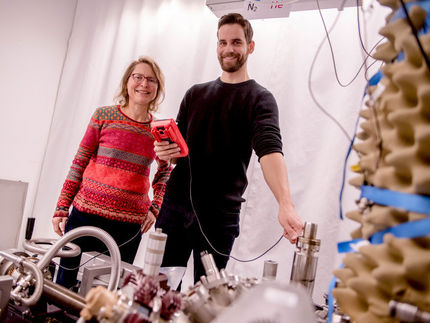
Synthetic – i. e. artificially produced - cells can imitate certain functions of biological cells. These synthetic cells could open up new medical possibilities in the future. In laboratories, such cells can already help in chemical processes on a miniature scale as "mini-reactors". Scientists at the Max Planck Institute for Polymer Research have now developed a method to control the course of these chemical processes with the help of light.

Molecules that react to light were introduced into an artificial cell membrane. This allows the permeability of the cell wall to be controlled from the outside.
© MPI-P
The processes that take place in biological cells are complex: chemical reactions contribute, for example, to the production of certain substances required by the body - whether to supply energy or to defend against disease. For this purpose, biological cells regulate via their cell membrane which substances are absorbed by the cell and which are excreted again.
Artificially produced cells with a size of approx. 20-50 millionth of a metre (20-50 µm) are already able to reproduce such functions in the laboratory. An active component is packed into a shell made of polymers, the so-called "compartment", which enables an enzymatic reaction, for example.
"A biological cell can die - with artificial cells we can build miniature reactors that can be used over a much longer period of time," explains Lucas Caire da Silva, who researches these cells in Katharina Landfester's department. "However, the problem with these mini-reactors so far has been how to control the transport of substances into the cell. In general, the shells of these artificial cells are difficult to permeate."
The team of researchers led by da Silva and Landfester have now changed this behaviour: They have designed special light-responsive molecules, which can be integrated into the polymer membranes to produce channels. As a result, the shell’s permeability increases when irradiated with UV light. If the shell is then irradiated with visible light again, this process can also be reversed.
"We can use this approach to precisely control when a substance enters the compartment, allowing us to initiate a chemical reaction at a specific time and place," says da Silva.
The scientists hope that in future they will be able to use their mini-reactors to control reactions that actually take place in biological cells on a micro-scale and see many applications for this technology, for example in medicine.
Original publication


Other news from the department science



















These products might interest you

Most read news












More news from our other portals


























Last viewed contents

Breakthrough in research on production of 2D crystals with excellent optical properties - Flat crystals showing uniform parameters over the entire surface, including - most valuably - excellent optical properties

Extending the Lifespan of Electrocatalysts

Meteorites reveal likely origin of Earth’s volatile chemicals - Outer Solar System played a bigger role than previously thought

Metal-ion catalysts and hydrogen peroxide could green up plastics production
Click & Try: A Failed Experiment and Chance Opened up new Paths to an Established Reaction for Chemists - Freed from the Niche with Click Chemistry

LANXESS signs contract to acquire Emerald Kalama Chemical - Targeted portfolio expansion in the Consumer Protection segment
Nuclear detector: New materials hold promise for better detection of nuclear weapons
LANXESS strengthens commitment to renewable raw materials with investment in BioAmber - Companies have developed phthalate-free plasticizers from bio-based succinic acid
LLC SIBUR selects INEOS Technologies as a licensor for 1.5 million tonnes of polyethylene capacity.
Invisible battery parts finally seen with pioneering technique - New method reveals critical weaknesses in battery electrodes
Why safe and sustainable innovations pay off for companies - ‘Safe and Sustainable by Design’ protects against costly missteps