Nuclear detector: New materials hold promise for better detection of nuclear weapons
Advertisement


Northwestern University scientists have developed new materials that can detect hard radiation, a very difficult thing to do. The method could lead to a handheld device for detecting nuclear weapons and materials, such as a "nuclear bomb in a suitcase" scenario.
"The terrorist attacks of 9/11 heightened interest in this area of security, but the problem remains a real challenge," said Mercouri G. Kanatzidis, who led the research. "We have designed promising semiconductor materials that, once optimized, could be a fast, effective and inexpensive method for detecting dangerous materials such as plutonium and uranium."
Kanatzidis is a Charles E. and Emma H. Morrison Professor of Chemistry in the Weinberg College of Arts and Sciences. He also holds a joint appointment at Argonne National Laboratory.
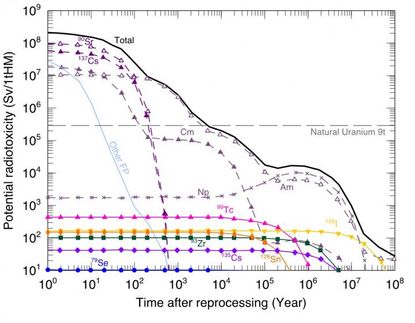
The Northwestern materials perform as well as materials that have emerged from five decades of research and development, Kanatzidis said.
To design an effective detector, Kanatzidis and his team turned to the heavy element part of the periodic table. The researchers developed a design concept to make new semiconductor materials of heavy elements in which most of the compound's electrons are bound up and not mobile. When gamma rays enter the compound, they excite the electrons, making them mobile and thus detectable. And, because every element has a particular spectrum, the signal identifies the detected material.
The method, called dimensional reduction, will be published in the Sept. 22 issue of the journal Advanced Materials.
In most materials, gamma rays emitted by nuclear materials would just pass right through, making them undetectable. But dense and heavy materials, such as mercury, thallium, selenium and cesium, absorb the gamma rays very well.
The problem the researchers faced was that the heavy elements have a lot of mobile electrons. This means when the gamma rays hit the material and excite electrons the change is not detectable.
"It's like having a bucket of water and adding one drop -- the change is negligible," Kanatzidis explained. "We needed a heavy element material without a lot of electrons. This doesn't exist naturally so we had to design a new material."
Kanatzidis and his colleagues designed their semiconductor materials to be crystalline in structure, which immobilized their electrons.
The materials they developed and successfully demonstrated as effective gamma ray detectors are cesium-mercury-sulfide and cesium-mercury-selenide. Both semiconductors operate at room temperature, and the process is scaleable.
"Our materials are very promising and competitive," Kanatzidis said. "With further development, they should outperform existing hard radiation detector materials. They also might be useful in biomedicine, such as diagnostic imaging."
Original publication


Other news from the department science




















Most read news












More news from our other portals


























Last viewed contents
Artificial intelligence evaluates chemical spectra in minutes - Researchers from the University of Jena, Helmholtz-Zentrum Berlin, and Zakodium develop AI system for chemical structure analysis

Claus Rettig to serve as interim CEO of Evonik - Christian Kullmann on the road to recovery

Scientists discover molecular ‘reshuffle’ and crack an 80-year-old conundrum - “Our findings open the door to new asymmetric transformations based on mechanistic pathways that chemists previously dismissed as inaccessible”

Rigaku opens Rigaku Technology Center Taiwan - Advancing regional growth through engineering and collaboration in Taiwan and beyond
Surface analysis of catalyst particles in aqueous solutions - The results are relevant for the development of efficient photoelectrodes for the production of green hydrogen

Linking superconductivity and structure
Putting electronic cigarettes to the test
Sophisticated monitoring array to address mystery of uranium plume - Groundwater contamination remains significantly unchanged for 10 years
Oxea receives European Product Leadership Award for its Phthalate-free Plasticizer product range

Start-up Entrepreneurs Want to Make Chemical Industry More Sustainable

Evonik aligns two business lines with new growth strategy - Businesses outside core areas are to be sold or discontinued