Growth of Nanoholes Visible for the First Time Thanks to Helium Scattering
Scientists were able to observe and document the growth of hexagonal boron nitride for the first time
Advertisement


Atomically thin 2D materials for applications in microelectronics or nanotechnology are grown by breaking down gas on a hot metal surface. Due to the high temperatures and rapid transformation of the gas, it is extremely difficult to observe this process.
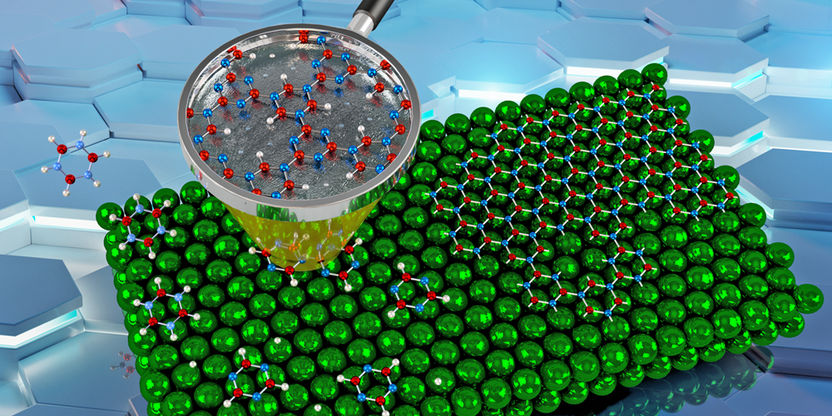
The graphic and paper by Anton Tamtögl and his team even made it onto the cover of Nanoscale Horizons.
Technische Universität Graz
Researchers from TU Graz have now joined forces with colleagues from the University of Surrey to form a successful team combining theory and experiment and were able to observe and document the growth of hexagonal boron nitride for the first time. Hexagonal boron nitride is used primarily in microelectronics and nanotechnology, photonics and power electronics, in fuel cells and as a dielectric for field-effect transistors.
Regularly Arranged Nanopores
The group led by Anton Tamtögl from the Institute of Experimental Physics at TU Graz observed the growth using helium spectroscopy – a highly sensitive analytical technique for investigating material surfaces and reactions taking place on them with a previously unattainable level of detail and time resolution. Even fast movements of atoms and molecules on crystal surfaces – including quantum movements of protons and ballistic diffusion of molecules – can be studied in this way.
In their experiment with h-BN, they came up with unexpected results: Hexagonal boron nitride has a honeycomb 2D crystal structure that is identical to the structure of graphene. Instead of carbon atoms, however, the hexagon has alternating boron and nitrogen atoms. During the growth process, the scientists saw that the ordered structure of h-BN emerges from regularly arranged holes, so-called nanopores. This is the first time that this open structure has been identified and its role during h-BN growth observed.
“We were surprised that instead of the expected diffraction pattern of hexagonal boron nitride, the measurements showed a completely different structure, which we now assign to a novel phase of h-BN,” explains Anton Tamtögl, who led the experiment. “Finding a new phase for such a well-known and technologically important 2D material is like discovering a completely new species of butterfly in your own backyard,” adds Adrian Ruckhofer, who is conducting the experiments as part of his doctoral thesis.
Experiment combined with quantum chemical calculation
Because they were so surprised by their results, the researchers at TU Graz sought the help of theory and wanted to confirm that their observations were even computationally possible. Marco Sacchi of the University of Surrey then performed the quantum chemical calculations using the national ARCHER2 supercomputer and confirmed that the observed structure is also the unambiguously preferred one mathematically. “We have proven that the combination of experiments and quantum chemical calculations can provide new and important insights into the growth of 2D materials,” says Marco Sacchi: “And we are already planning to use our method to study the growth of other 2D materials.”
Original publication


Other news from the department science




















Most read news












More news from our other portals


























See the theme worlds for related content
Topic World Spectroscopy
Investigation with spectroscopy gives us unique insights into the composition and structure of materials. From UV-Vis spectroscopy to infrared and Raman spectroscopy to fluorescence and atomic absorption spectroscopy, spectroscopy offers us a wide range of analytical techniques to precisely characterize substances. Immerse yourself in the fascinating world of spectroscopy!

Topic World Spectroscopy
Investigation with spectroscopy gives us unique insights into the composition and structure of materials. From UV-Vis spectroscopy to infrared and Raman spectroscopy to fluorescence and atomic absorption spectroscopy, spectroscopy offers us a wide range of analytical techniques to precisely characterize substances. Immerse yourself in the fascinating world of spectroscopy!
Last viewed contents

Polar air and tea: TUW invention makes environmental pollutants measurable - Fine dust in the air or nanoparticles in water - with an amazing new technology from TU Wien, tiny quantities of a wide variety of substances can be detected in a short space of time

BASF invests in new alcoholates plant in Ludwigshafen - Advanced production facilities to support growing life science market as well as the biodiesel industry
Frost & Sullivan: Which are the emerging growth markets for nondestructive test inspection services? - Brazil and South Africa lead the way, while India and China offer long-term growth opportunities
Brenntag further strengthens its business in India

How dangerous are nanoplastics for babies in the womb? - The focus is on nanoplastic particles, which could lead to the development of a hypersensitive immune system in the child
Seeing clearly into a new realm – researchers prototype a new generation of quantum microscopy - “What began as an experimental annoyance ended up being a hint towards a capability of our microscope that is unique among current alternatives”
Indo-German research collaboration in the field of surface engineering and thin films officially started

Production begins at BASF’s largest Indian investment to date - BASF inaugurates chemical complex in Dahej, India
Portable and precise gas sensor could monitor pollution and detect disease

Monitoring of Critical Raw Material Recycling from Battery Black Mass - This study demonstrates the effective use of measuring instruments for separation and analysis
Making biodiesel from dirty old cooking oil just got way easier - New ultra-efficient catalyst can recycle old cooking oil into biodiesel and turn food scraps into high-value complex molecules